
Anonymous Object
1. Introduction
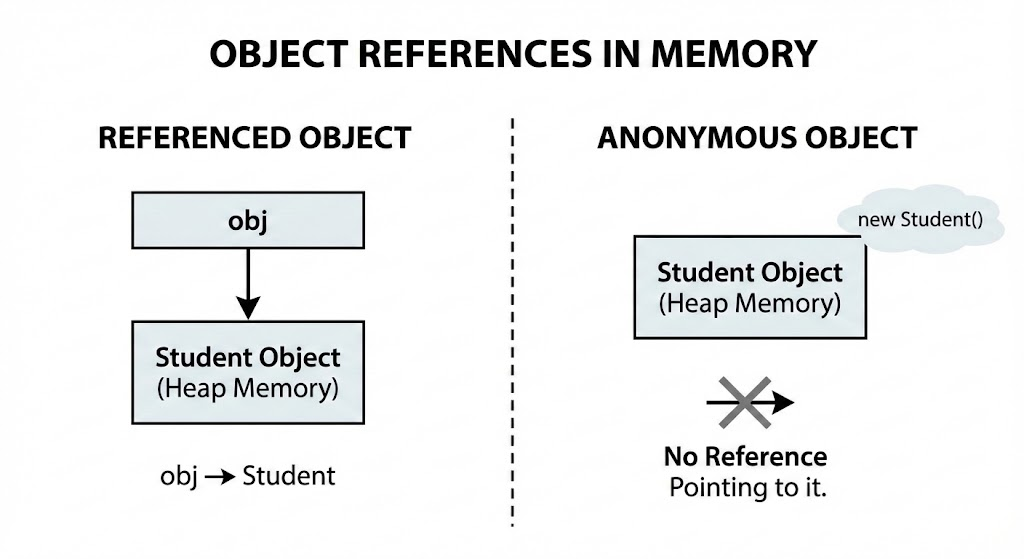
An anonymous object in Java is an object that is created without storing its reference in a variable.
Example:
new Student().show();Here:
- The object is created
- A method is called on it immediately
- The object becomes eligible for garbage collection after the statement ends
Anonymous objects are useful when:
- You need a one-time object
- You don't want to reuse the object
- You want clean, compact code
They are commonly used in:
- Method calling
- Passing objects as arguments
- Anonymous inner classes
- Event handling (especially in GUI frameworks)
2. What Is an Anonymous Object?
A normal object:
Student s = new Student();
s.show();
Anonymous object:
new Student().show();Difference:
| Normal Object | Anonymous Object |
|---|---|
| Has reference variable | Has no reference |
| Can be reused | Cannot be reused |
| Stored until out of scope | Immediately becomes unused |
| Uses more code | Short and clean |
3. When Should You Use Anonymous Objects?
Use them when:
- You only need the object once
- You want compact code
- The object does not need reuse
- You are calling one or very few methods
Example:
new Scanner(System.in).nextInt();This Scanner object is created and directly used without a variable.
4. Anonymous Object Example - Method Call
class Demo {
    void display() {
        System.out.println("Display method called");
    }
}

public class Main {
    public static void main(String[] args) {
        new Demo().display();  // anonymous object
    }
}
The object is used once and discarded.
5. Anonymous Object Passed as an Argument
class Test {
    void show(Student s) {
        System.out.println("Student object received");
    }
}

new Test().show(new Student());
No variable is created for the Student object.
6. Anonymous Object with Constructor
Used when constructors perform important initialization.
new Car("Honda", 2024);Even if no methods are called, the constructor runs and initializes the object.
7. Anonymous Objects and Arrays
You can create anonymous arrays as arguments.
show(new int[] {10, 20, 30});A full array object is created without storing it.
8. Anonymous Inner Classes (Very Important)
Anonymous objects are heavily used in anonymous inner classes, especially in GUI, threads, and event handling.
Example:
Thread t = new Thread(new Runnable() {
    @Override
    public void run() {
        System.out.println("Thread running");
    }
});
t.start();
Here, new Runnable() {...} is an anonymous object of an anonymous class.
9. Anonymous Object vs Named Object
| Feature | Named Object | Anonymous Object |
|---|---|---|
| Has reference variable | No variable | |
| Can call multiple methods | One-time use | |
| Lives longer | Short-lived | |
| Used in full programs | Mostly used for arguments or quick tasks |
10. Anonymous Object and Garbage Collection
Anonymous objects are not stored in any reference. So they become eligible for garbage collection immediately after use.
Example:
new Demo();Since it's not stored, nothing points to it → GC collects it sooner.
11. Real-World Uses
11.1 Singleton-like operations
new Logger().log("start");11.2 Reading input
int age = new Scanner(System.in).nextInt();11.3 Comparing values
new Integer(10).compareTo(20);11.4 GUI Click Handlers
button.setOnClickListener(new OnClickListener() {
    public void onClick() {
        System.out.println("Clicked");
    }
});
12. Complete Example Demonstrating Anonymous Objects
class MathOp {
    int square(int n) {
        return n * n;
    }
}

public class Main {
    public static void main(String[] args) {
        int result = new MathOp().square(5); // anonymous object
        System.out.println(result);
    }
}
Output:
2513. Summary
- Anonymous objects are created without reference variables.
- Used when an object is needed once.
- Saves memory (short-lived).
- Cannot be reused.
- Useful for method calls, passing arguments, and anonymous inner classes.
- Becomes immediately eligible for garbage collection after use.
This completes Anonymous Object in Java.
Written By: Shiva Srivastava
How is this guide?
Last updated on