
Default vs Parameterized Constructor
1. Introduction
Constructors are special methods used to initialize objects in Java.
There are two primary types:
- Default Constructor
- Parameterized Constructor
Understanding the difference between them is essential for writing clean and maintainable Java code.
2. Default Constructor
A default constructor is a constructor that:
- Has no parameters
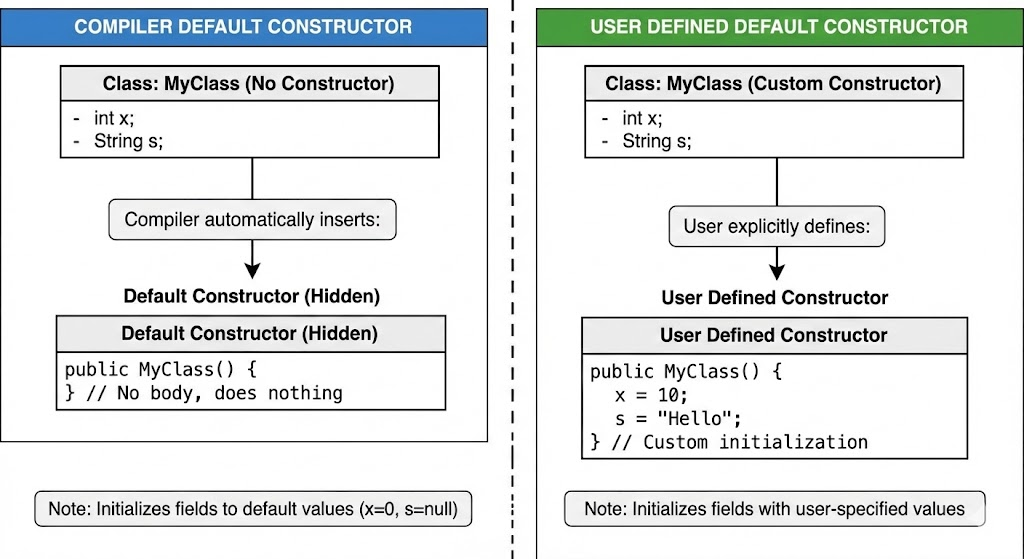
- Is automatically provided by the Java compiler only when no constructor is manually written
2.1 Compiler-Provided Default Constructor
If you do not write any constructor, Java inserts:
ClassName() { }Example:
class Student {
    int age;
    String name;
    // compiler provides: Student() { }
}
Creating the object:
Student s = new Student();All fields get default values:
- int → 0
- String → null
- boolean → false
- double → 0.0
2.2 User-Defined Default Constructor (No-Arg Constructor)
You can also create your own default constructor:
class Student {
    int age;
    String name;

    Student() {
        age = 18;
        name = "Unknown";
    }
}
Here, default values are replaced with meaningful initialization.
3. Parameterized Constructor
A parameterized constructor accepts arguments, allowing you to initialize objects with specific values.
Example:
class Student {
    String name;
    int age;

    Student(String name, int age) {
        this.name = name;
        this.age = age;
    }
}
Creating objects:
Student s1 = new Student("Amit", 22);
Student s2 = new Student("Sara", 20);
Each object gets different initial values.
4. Why Parameterized Constructors Are Useful
They allow:
- Custom initialization
- Flexibility to create fully prepared objects
- Avoiding the need for setter methods after creation
- Ensuring required fields are always initialized
Example:
new BankAccount("Rahul", 5000);
// ensures account holder & balance cannot be uninitialized
5. Differences Between Default and Parameterized Constructors
| Feature | Default Constructor | Parameterized Constructor |
|---|---|---|
| Accepts arguments? | No | Yes |
| Provided automatically? | Yes (if no constructor exists) | No |
| Used for | Basic object creation | Custom initialization |
| Overloading | Can be overloaded | Can be overloaded |
| Behavior | Assigns default or preset values | Assigns values from parameters |
6. Both Constructors in One Class
You can include both:
class Car {
    String model;
    int price;

    Car() {
        model = "Unknown";
        price = 0;
    }

    Car(String model, int price) {
        this.model = model;
        this.price = price;
    }
}
Usage:
Car c1 = new Car();
Car c2 = new Car("Honda City", 1200000);
7. Complete Example Program
class Book {
    String title;
    String author;

    // Default constructor
    Book() {
        title = "Not Available";
        author = "Unknown";
    }

    // Parameterized constructor
    Book(String title, String author) {
        this.title = title;
        this.author = author;
    }

    void show() {
        System.out.println(title + " by " + author);
    }
}

public class Main {
    public static void main(String[] args) {
        Book b1 = new Book();
        Book b2 = new Book("Java Basics", "Amit Kumar");

        b1.show();
        b2.show();
    }
}
Output:
Not Available by Unknown
Java Basics by Amit Kumar
8. Summary
Default Constructor
- No arguments
- Automatically inserted if none provided
- Initializes fields to default values
Parameterized Constructor
- Accepts arguments
- Allows custom initialization
- MUST be written manually
Both can be used together to give flexibility in object creation.
This completes Default vs Parameterized Constructor.
Written By: Shiva Srivastava
How is this guide?
Last updated on