
Copy Constructor
1. Introduction
A copy constructor is a constructor that creates a new object by copying the values of another object of the same class.
Java does not provide a built-in copy constructor (unlike C++),
but you can create your own to duplicate objects safely.
Copy constructors are used when:
- You want a fresh object with the same values
- You want to avoid sharing references (deep/shallow copy control)
- You want more control than Java's
clone()method provides
2. What Is a Copy Constructor?
A copy constructor takes another object of the same class as a parameter.
Syntax
ClassName(ClassName obj) {
    // copy values from obj
}
3. Basic Example of Copy Constructor
class Student {
    String name;
    int age;

    Student(String name, int age) {
        this.name = name;
        this.age = age;
    }

    // Copy Constructor
    Student(Student obj) {
        this.name = obj.name;
        this.age = obj.age;
    }
}

public class Main {
    public static void main(String[] args) {

        Student s1 = new Student("Amit", 21);
        Student s2 = new Student(s1);  // copying object

        System.out.println(s2.name + " " + s2.age);
    }
}
Output:
Amit 21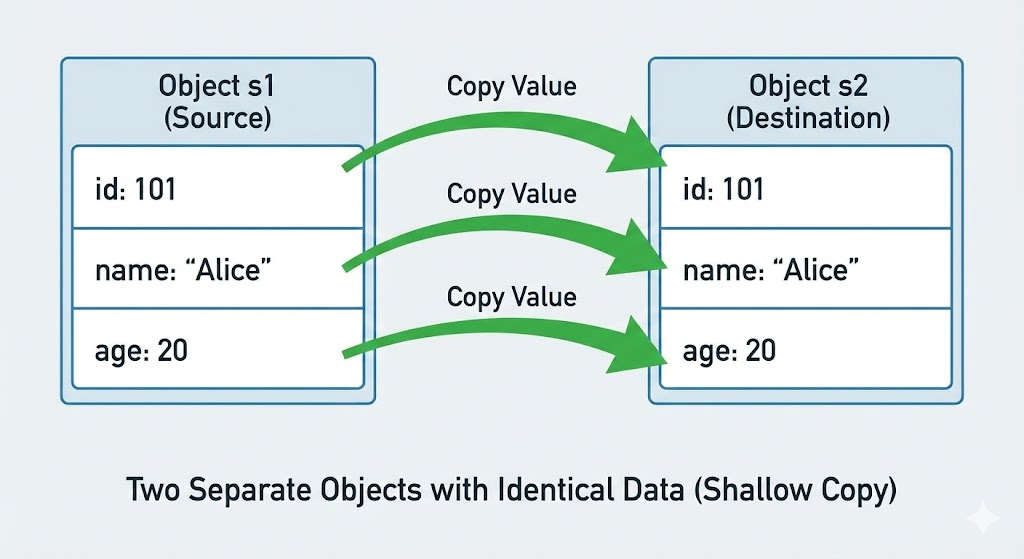
4. Why Use a Copy Constructor Instead of clone()?
Java has a clone() method, but copy constructors are preferred because:
| Feature | clone() | Copy Constructor |
|---|---|---|
| Complex | Yes (requires Clonable, overriding clone) | Simple |
| Type Safety | No (returns Object) | Yes |
| Customization | Harder | Very easy |
| Readability | Low | High |
| Control over deep vs shallow copy | Limited | Full control |
Copy constructors are the recommended way to copy objects in Java.
5. Shallow Copy vs Deep Copy
5.1 Shallow Copy
Only references are copied, not the actual objects.
class Department {
    String name;
}

class Employee {
    String name;
    Department dept;

    Employee(Employee e) {
        this.name = e.name;
        this.dept = e.dept;  // shallow copy
    }
}
Both objects share the same dept reference → changes in one reflect in the other.
5.2 Deep Copy
Copies actual objects, not just references.
class Employee {
    String name;
    Department dept;

    Employee(Employee e) {
        this.name = e.name;
        this.dept = new Department();
        this.dept.name = e.dept.name;  // deep copy
    }
}
Now both have separate Department objects-safer.
6. Example Demonstrating Shallow vs Deep Copy
class Address {
    String city;

    Address(String city) {
        this.city = city;
    }
}

class Person {
    String name;
    Address address;

    // Deep copy constructor
    Person(Person p) {
        this.name = p.name;
        this.address = new Address(p.address.city);
    }
}

public class Main {
    public static void main(String[] args) {

        Person p1 = new Person("Raj", new Address("Delhi"));
        Person p2 = new Person(p1);  // deep copy

        p2.address.city = "Mumbai";

        System.out.println(p1.address.city); // Delhi (unchanged)
        System.out.println(p2.address.city); // Mumbai
    }
}
7. When Should You Use a Copy Constructor?
Use a copy constructor when:
- You want a safe clone of an object
- You need to avoid shared references
- You want explicit control over how deep the copy is
- You want easier, readable, maintainable duplication code
Avoid when:
- You prefer immutability instead (final fields)
8. Adding Copy Constructor Alongside Other Constructors
A class can have:
- Default constructor
- Parameterized constructor
- Copy constructor
class Car {
    String model;
    int price;

    Car() { }

    Car(String model, int price) {
        this.model = model;
        this.price = price;
    }

    Car(Car other) {        // copy constructor
        this.model = other.model;
        this.price = other.price;
    }
}
9. Complete Example Program Demonstrating Copy Constructor
class Book {
    String title;
    int pages;

    Book(String title, int pages) {
        this.title = title;
        this.pages = pages;
    }

    // Copy Constructor
    Book(Book b) {
        this.title = b.title;
        this.pages = b.pages;
    }

    void show() {
        System.out.println(title + " - " + pages);
    }
}

public class Main {
    public static void main(String[] args) {

        Book b1 = new Book("Java Guide", 450);
        Book b2 = new Book(b1);

        b1.show();
        b2.show();
    }
}
10. Summary
-
A copy constructor creates a new object by copying another object.
-
Syntax:
ClassName(ClassName obj) -
Used for:
- Creating safe copies
- Custom deep/shallow copying
- Avoiding clone()
-
Must be written manually; Java does not generate one automatically.
-
Deep copy avoids side effects; shallow copy shares references.
This completes Copy Constructor in Java.
Written By: Shiva Srivastava
How is this guide?
Last updated on