
this Keyword
1. Introduction
The this keyword in Java is a special reference variable that refers to the current object - the object on which a method or constructor is being invoked.
Whenever you write code inside an instance method or constructor, this always points to that specific object's memory.
this is used to:
- Access instance variables
- Call instance methods
- Call constructors (constructor chaining)
- Pass the current object as an argument
- Return the current object
Understanding this is essential for writing clean, bug-free object-oriented code.
2. Why Do We Need this?
2.1 To Differentiate Between Instance Variables and Local Variables
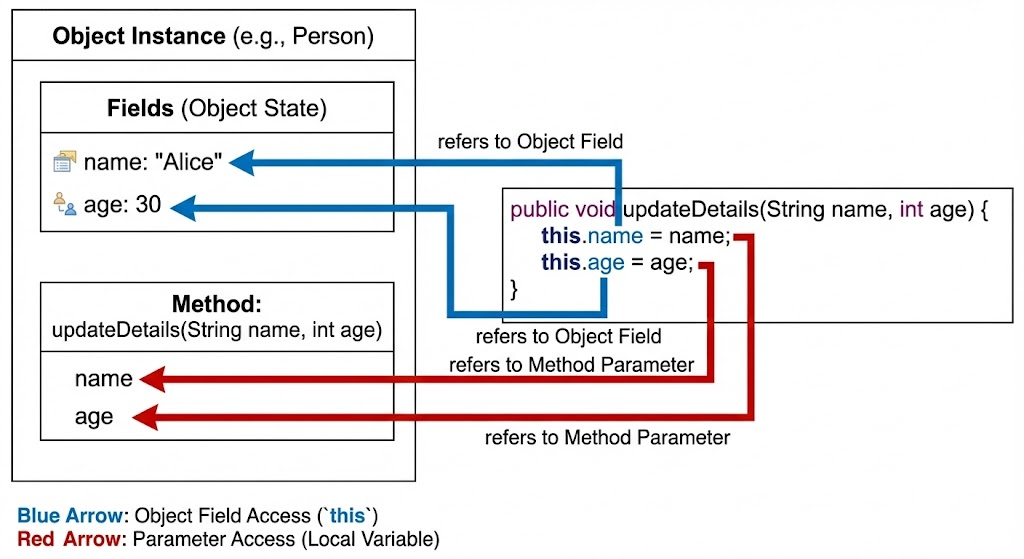
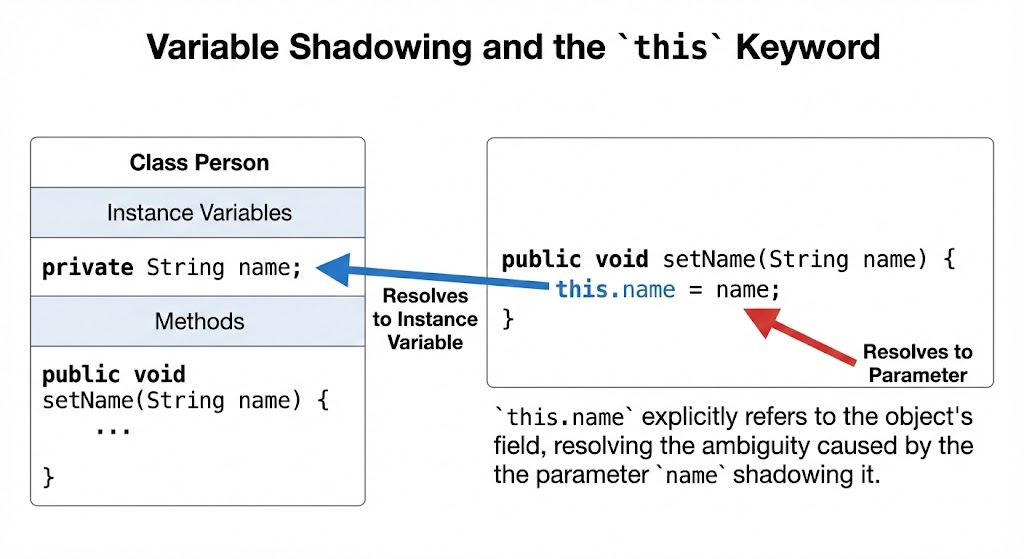
If a local variable (parameter) has the same name as an instance variable, Java prefers the local variable.
To access the instance variable, we must use this.
Example Without this (Incorrect)
class Student {
    String name;

    Student(String name) {
        name = name; // assigns local name to itself
    }
}
This assigns the local parameter to itself, leaving the instance variable unchanged.
Corrected Version Using this
class Student {
    String name;

    Student(String name) {
        this.name = name;  // this.name = instance variable
    }
}
Now the instance variable receives the correct value.
3. Using this to Call Instance Methods
class Demo {
    void show() {
        System.out.println("Show method");
    }

    void display() {
        this.show();   // calling show()
    }
}
Using this is optional here - calling show() directly also works.
However, this clarifies that the call belongs to the current object.
4. Using this to Call Another Constructor
( Constructor Chaining - explained fully in constructor-chaining.mdx )
You can call one constructor from another using:
this(arguments);Example:
class Rectangle {
    int length, width;

    Rectangle() {
        this(10, 20);  // calls parameterized constructor
    }

    Rectangle(int length, int width) {
        this.length = length;
        this.width = width;
    }
}
Rules:
this()call must be the first statement in a constructor.- Only one
this()call is allowed per constructor.
5. Using this to Return the Current Object
class Test {
    Test getObject() {
        return this;
    }
}
Useful in:
- Method chaining
- Builder pattern
Example of method chaining (popular in frameworks):
obj.setName("Amit").setAge(24).save();6. Passing this as an Argument
You can pass the current object to another method or constructor.
Example
class A {
    void m1(B obj) {
        System.out.println("Received object of B");
    }

    void m2() {
        B b = new B(this); // passing current object A
    }
}

class B {
    A ref;

    B(A a) {
        ref = a;
    }
}
This is common in event listeners, callbacks, and dependency passing.
7. Using this in Setters (Very Common)
class Employee {
    private String name;
    private int age;

    void setName(String name) {
        this.name = name; // avoids confusion
    }

    void setAge(int age) {
        this.age = age;
    }
}
Without this, you cannot distinguish between instance and local variables.
8. When Should You Use this?
Use this when:
- Instance variable names match parameter names
- Calling another constructor
- Passing current object to another method
- Returning the current object
- Clarifying access to instance context
Avoid this in:
- Static methods (because
thisdoes not exist there)
9. When this Cannot Be Used
this cannot be used inside:
9.1 Static Methods
static void test() {
    this.show();   // ERROR
}
Because static methods belong to the class, not to objects.
9.2 Static Blocks
static {
    System.out.println(this); // ERROR
}
9.3 Outside a Class
(this exists only inside instance context)
10. Complete Example
class Car {

    String model;
    int speed;

    Car(String model, int speed) {
        this.model = model;
        this.speed = speed;
    }

    void display() {
        System.out.println("Model: " + this.model);
        System.out.println("Speed: " + this.speed);
    }

    Car increaseSpeed(int value) {
        this.speed += value;
        return this; // enables method chaining
    }
}

public class Main {
    public static void main(String[] args) {
        Car c = new Car("Honda City", 120);

        c.increaseSpeed(20).increaseSpeed(30);
        c.display();
    }
}
Output:
Model: Honda City
Speed: 170
11. Summary
-
thisrefers to the current object (the one calling the method). -
Helps differentiate between instance and local variables.
-
Used for:
- Accessing instance members
- Calling instance methods
- Calling constructors (
this()) - Passing the current object
- Returning the current object
-
Cannot be used in static methods.
-
Fundamental in object-oriented programming and method/constructor chaining.
This completes this keyword in Java.
Written By: Shiva Srivastava
How is this guide?
Last updated on