
super Keyword
1. Introduction
The super keyword in Java is a reference variable used to access members (variables, methods, and constructors) of the parent class (also known as the superclass).
Whenever inheritance is used in Java, the super keyword helps the child class interact with the parent class by:
- Accessing parent class variables
- Calling parent class methods
- Calling parent class constructors
Understanding super is essential to mastering inheritance and avoiding naming conflicts.
2. Why Do We Need super?
A child class inherits properties from the parent class.
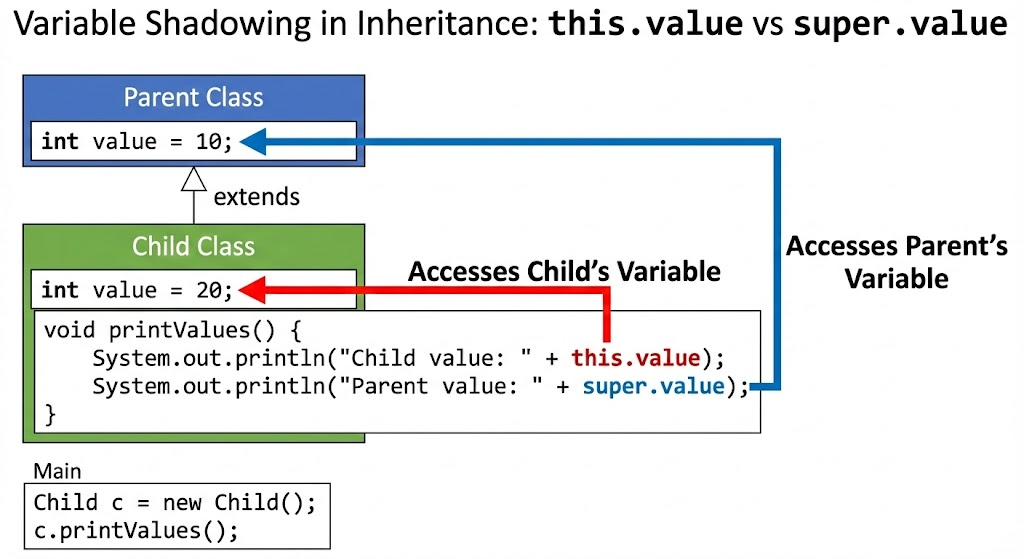
But sometimes, the child class defines variables or methods with the same name as the parent class.
In such cases, super helps remove ambiguity.
Example of conflict:
class Parent { int value = 10; }
class Child extends Parent { int value = 20; }
Inside the child:
value→ refers to child’s value (20)super.value→ refers to parent’s value (10)
3. Using super to Access Parent Class Variables
class Parent {
    int x = 10;
}

class Child extends Parent {
    int x = 20;

    void show() {
        System.out.println(x);       // child's x → 20
        System.out.println(super.x); // parent's x → 10
    }
}
Calling:
new Child().show();Output:
20
10
4. Using super to Access Parent Class Methods
If a child class overrides a method, super lets you call the overridden parent method.
class Parent {
    void show() {
        System.out.println("Parent version");
    }
}

class Child extends Parent {
    void show() {
        System.out.println("Child version");
        super.show();     // calling parent method
    }
}
Output:
Child version
Parent version
This is crucial in behavioral extensions where the child adds extra functionality while retaining parent behavior.
5. Using super to Call Parent Class Constructor
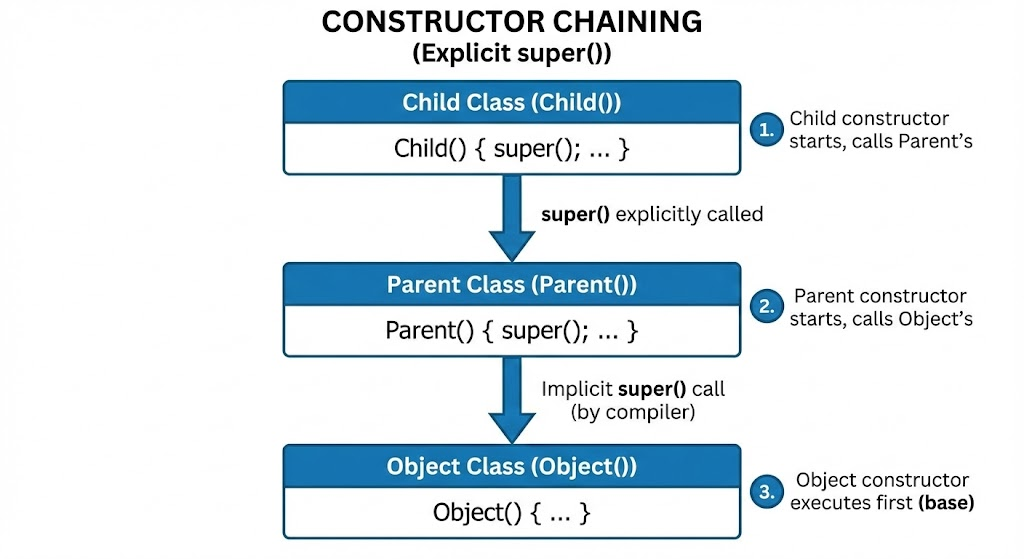
A child class constructor must call some constructor of the parent class.
Java automatically inserts:
super();But we can explicitly call:
super(arguments);Example:
class Parent {
    Parent(int a) {
        System.out.println("Parent constructor: " + a);
    }
}

class Child extends Parent {
    Child() {
        super(100); // must be first statement
        System.out.println("Child constructor");
    }
}
Output:
Parent constructor: 100
Child constructor
Rules:
super()orsuper(arguments)must be the first line in the child constructor.- Only one super call allowed per constructor.
6. Why Constructor Chaining Uses super()
Because parent class properties must be initialized first.
When an object is created:
- Memory for full object (parent + child fields) is reserved.
- Parent constructor runs first.
- Child constructor runs afterward.
Example:
class A {
    A() { System.out.println("A"); }
}

class B extends A {
    B() { System.out.println("B"); }
}
Creating new B() prints:
A
B
Even without writing super(), Java inserts it automatically.
7. super vs this
| Feature | this | super |
|---|---|---|
| Refers to | Current object | Parent object |
| Access | Child class members | Parent class members |
| Constructor call | this() | super() |
| Usable in | Instance methods & constructors | Instance methods & constructors |
| Use in static context | Not allowed | Not allowed |
Important: You cannot use this or super inside static methods.
8. Common Mistakes Students Make
Mistake 1: Trying to use super in a static method
static void test() {
    super.show(); // ERROR
}
Mistake 2: Using both this() and super() in the same constructor
Child() {
    this();  //
    super(); // cannot use both
}
Only one can appear, and it must be the first statement.
Mistake 3: Assuming super always calls parent’s no-arg constructor
super();          // calls no-arg constructor
super(10, 20);    // calls parameterized constructor
9. Complete Example Demonstrating All Uses of super
class Animal {
    String type = "Animal";

    Animal() {
        System.out.println("Animal constructor");
    }

    void sound() {
        System.out.println("Animal makes sound");
    }
}

class Dog extends Animal {
    String type = "Dog";

    Dog() {
        super(); // calls Animal()
        System.out.println("Dog constructor");
    }

    void sound() {
        System.out.println("Dog barks");
        super.sound(); // calling parent method
    }

    void showType() {
        System.out.println(type);        // Dog
        System.out.println(super.type);  // Animal
    }
}

public class Main {
    public static void main(String[] args) {
        Dog d = new Dog();
        d.sound();
        d.showType();
    }
}
Output:
Animal constructor
Dog constructor
Dog barks
Animal makes sound
Dog
Animal
10. Summary
-
superis used to refer to the parent class in inheritance. -
It helps:
- Access parent variables
- Call parent methods
- Invoke parent constructors
-
Must be used inside instance methods or constructors, not static contexts.
-
super()must always be the first line inside child constructors. -
Prevents conflicts when child and parent have same variable or method names.
This completes super keyword in Java.
Written By: Shiva Srivastava
How is this guide?
Last updated on