
Static Methods
1. Introduction
In Java, methods can be either instance methods (belonging to objects) or static methods (belonging to the class).
A static method is associated with the class itself, not with any specific object.
Because of this, static methods:
- Can be called without creating an object
- Are loaded into memory when the class is loaded
- Are used for utility, helper, or common functionality
Examples of static methods you already use:
Math.sqrt(16)
Integer.parseInt("10")
Arrays.sort(arr)
All belong to their respective classes, not objects.
2. What Is a Static Method?
A static method is declared using the static keyword:
static void showMessage() {
    System.out.println("Hello from static method");
}
To call it:
showMessage();                 // inside same class
ClassName.showMessage();       // outside class
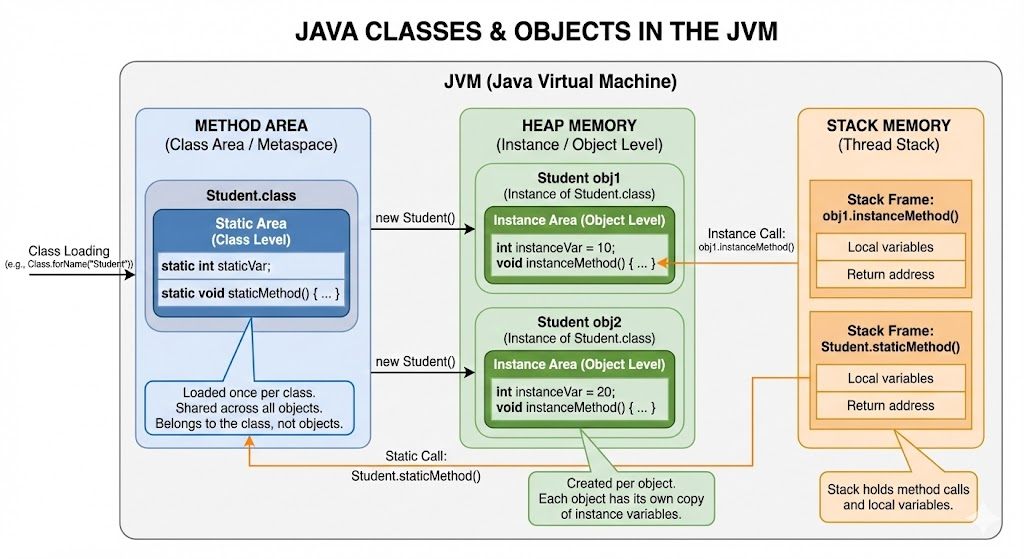
Static methods are part of class-level memory (Method Area of JVM).
3. Why Do We Use Static Methods?
Static methods are useful when:
- Logic does not depend on object state
- You want to perform general-purpose utility operations
- You want quick access without creating objects
Examples:
- Mathematical operations (
Math.max,Math.pow) - Conversion (
Integer.parseInt) - Factory methods (like
List.of())
4. Syntax and Example
class Calculator {

    static int add(int a, int b) {   // static method
        return a + b;
    }

    int multiply(int a, int b) {     // instance method
        return a * b;
    }
}
Calling static method:
int result = Calculator.add(5, 3);Calling instance method:
Calculator c = new Calculator();
int result = c.multiply(5, 3);
Important difference:
| Feature | Static Method | Instance Method |
|---|---|---|
| Belongs to | Class | Object |
| Call using | Class name | Object |
| Can access instance variables? | No | Yes |
| Can access static variables? | Yes | Yes |
5. Restrictions of Static Methods (Very Important)
Static methods cannot access instance members directly.
5.1 Static methods cannot use this or super
static void test() {
    this.x = 5;  // ERROR
}
Reason: this refers to a specific object, and static methods do not run on objects.
5.2 Static methods cannot access instance variables or instance methods directly
class Demo {
    int a = 5;

    static void show() {
        System.out.println(a);  //  ERROR
    }
}
To access instance members, create an object:
static void show() {
    Demo d = new Demo();
    System.out.println(d.a);  // OK
}
6. When Should You Use Static Methods?
Use a static method when:
- Behavior does not depend on instance variables
- No need to modify or rely on object state
- You want shared utility logic
Examples:
Math.random()- Logging utilities
- File utility methods
- Validation helpers (
isEmpty,isValidNumber)
7. Real-World Example: Utility Class
class StringUtil {

    static boolean isNullOrEmpty(String s) {
        return s == null || s.isEmpty();
    }
}

public class Main {
    public static void main(String[] args) {
        System.out.println(StringUtil.isNullOrEmpty(""));      // true
        System.out.println(StringUtil.isNullOrEmpty("Hello")); // false
    }
}
Static methods help build reusable libraries.
8. Static Methods and Memory
Static methods are stored in the Method Area of JVM, not on the heap.
Lifecycle:
- Class is loaded into JVM
- All static methods and static variables are allocated
- They stay until class unloading (usually when program ends)
Instance methods, in contrast, rely on objects stored in heap memory.
9. Static Method Overloading
Static methods can be overloaded:
static void test() { }
static void test(int a) { }
But they cannot be overridden in the true sense. (What looks like overriding is actually method hiding-covered later.)
10. Static Blocks vs Static Methods (Short Preview)
Static blocks execute once when the class loads:
static {
    System.out.println("Static block run");
}
Static methods execute whenever they are called.
Full detail is inside static-block.mdx (if included in your structure).
11. Complete Example
class MathOperations {

    static int square(int n) {
        return n * n;
    }

    static int cube(int n) {
        return n * n * n;
    }

    void displayMessage() {
        System.out.println("Instance method");
    }
}

public class Main {
    public static void main(String[] args) {

        System.out.println(MathOperations.square(4)); // 16
        System.out.println(MathOperations.cube(3));   // 27

        MathOperations obj = new MathOperations();
        obj.displayMessage();
    }
}
12. Summary
- Static methods belong to the class, not objects.
- Called using class name:
ClassName.method() - Cannot access instance members directly.
- Cannot use
thisorsuper. - Ideal for utility, helper, and common operations.
- Stored in JVM Method Area.
- Can be overloaded but not overridden (only hidden).
This completes Static Methods in Java.
Written By: Shiva Srivastava
How is this guide?
Last updated on