
Constructors
1. Introduction
A constructor in Java is a special method that is automatically called when an object is created.
Its main purpose is to initialize the object, i.e., assign values to its fields and prepare it for use.
Constructors play a fundamental role in object-oriented programming because they allow objects to start in a valid state from the moment they are created.
Example:
Car c = new Car();Here, new Car() invokes the constructor of the Car class.
2. Characteristics of Constructors
A constructor:
- Has the same name as the class
- Does not have a return type, not even
void - Is executed automatically when an object is created
- Can be overloaded (multiple constructors allowed)
- Cannot be inherited, but child classes can call parent constructors using
super()
3. Syntax of a Constructor
class ClassName {
    ClassName() {
        // initialization code
    }
}
Example:
class Student {
    Student() {
        System.out.println("Student object created");
    }
}
Creating an object:
Student s = new Student();Output:
Student object created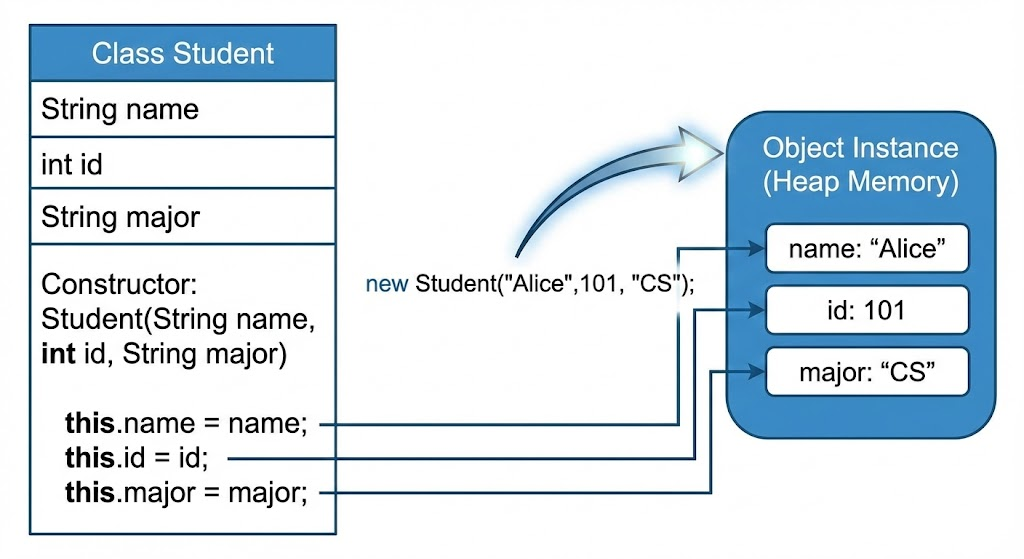
4. Types of Constructors in Java
Java provides two main types of constructors:
- Default Constructor (No-Arg Constructor)
- Parameterized Constructor
Both are essential for different situations.
4.1 Default Constructor (No-Argument Constructor)
A default constructor:
- Has no parameters
- Is inserted by the compiler only if no other constructor is present
Example:
class A {
    // compiler inserts: A() { }
}
Default values:
- Integer →
0 - Float/Double →
0.0 - Boolean →
false - Object references →
null
Example:
class Employee {
    int id;
    String name;

    // compiler provides default constructor
}

public class Main {
    public static void main(String[] args) {
        Employee e = new Employee();
        System.out.println(e.id);   // 0
        System.out.println(e.name); // null
    }
}
4.2 User-Defined No-Argument Constructor
If you define your own no-arg constructor, the compiler does NOT generate one.
class Car {
    Car() {
        System.out.println("Car created");
    }
}
4.3 Parameterized Constructor
A constructor that accepts parameters to initialize object values.
class Student {
    String name;
    int age;

    Student(String n, int a) {
        name = n;
        age = a;
    }
}
Creating object:
Student s = new Student("Ravi", 21);Parameterized constructors allow objects to be created with meaningful initial values.
5. Constructor Overloading
You can create multiple constructors with different parameters.
class Box {
    int width, height;

    Box() {
        width = 10;
        height = 10;
    }

    Box(int w, int h) {
        width = w;
        height = h;
    }
}
Calling:
Box b1 = new Box();
Box b2 = new Box(5, 8);
6. Rules of Constructors
- Constructor name must match class name.
- Constructors cannot have return types.
- Cannot use
returnto return a value. - Cannot be declared
static,final, orabstract. - Can call another constructor using
this()(constructor chaining). - Can call parent constructor using
super().
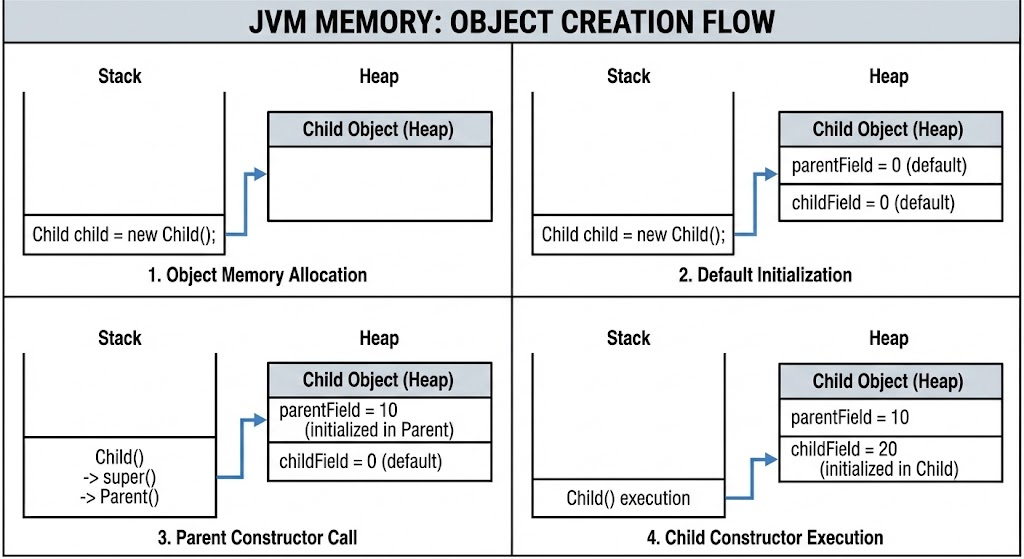
7. What Happens Behind the Scenes?
When you create an object:
Employee e = new Employee();Steps:
- Memory is allocated on heap.
- All fields are assigned default values.
- Parent class constructor runs first.
- Then the child class constructor runs.
- Reference
enow points to the fully initialized object.
This ensures objects are always initialized in a predictable way.
8. Real-World Example
class BankAccount {
    String holder;
    double balance;

    BankAccount(String holder, double balance) {
        this.holder = holder;
        this.balance = balance;
    }

    void display() {
        System.out.println(holder + " : " + balance);
    }
}

public class Main {
    public static void main(String[] args) {
        BankAccount b = new BankAccount("Amit", 5000);
        b.display();
    }
}
Output:
Amit : 50009. Complete Constructor Examples
Example 1: Default + Parameterized
class Person {
    String name;
    int age;

    Person() {
        this.name = "Unknown";
        this.age = 0;
    }

    Person(String name, int age) {
        this.name = name;
        this.age = age;
    }
}
Example 2: Overloading with Different Types
class Demo {
    Demo(int a) { }
    Demo(double a) { }
    Demo(String a) { }
}
10. Common Mistakes
Mistake 1: Adding return type
void Student() { } // Not a constructor - treated as a methodMistake 2: Calling constructor like a method
Student(); // ERROR - constructors are called only by newMistake 3: Forgetting that constructors do not inherit
Child classes do NOT inherit parent constructors.
11. Summary
-
Constructors are special methods used to initialize objects.
-
They have the same name as the class and no return type.
-
Types:
- Default constructor
- Parameterized constructor
-
Constructors can be overloaded.
-
Object creation triggers parent constructor first, then child constructor.
-
Constructors cannot be static, final, or abstract.
This completes Constructors in Java.
Written By: Shiva Srivastava
How is this guide?
Last updated on