
Constructor Chaining
1. Introduction
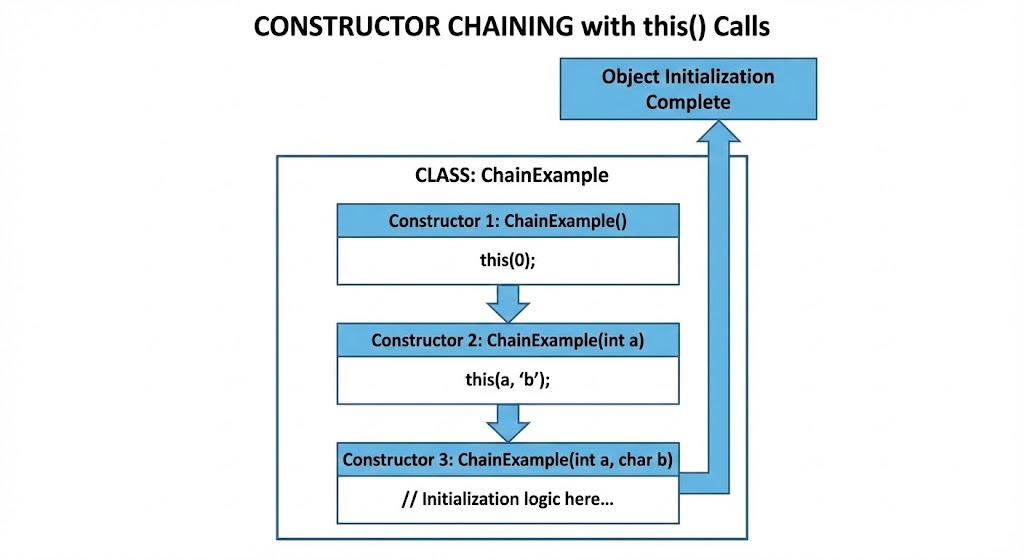
Constructor Chaining in Java refers to the process of calling one constructor from another constructor within the same class or from a parent class.
Java provides two ways to chain constructors:
- Using
this()→ Calls a constructor in the same class - Using
super()→ Calls a constructor in the parent class
Constructor chaining helps to avoid code duplication, improves readability, and ensures that object initialization happens in a controlled and structured manner.
2. Why Constructor Chaining?
Without constructor chaining, different constructors may repeat the same initialization code.
Example (bad design):
class Student {
    String name;
    int age;

    Student() {
        name = "Unknown";
        age = 0;
    }

    Student(String n) {
        name = n;
        age = 0;
    }
}
Both constructors duplicate age = 0.
Constructor chaining solves this by making constructors reuse each other.
3. Chaining Constructors Within the Same Class Using this()
this() is used to call another constructor in the same class.
Rules for this():
- Must be the first statement inside a constructor
- Only one
this()call allowed - Cannot appear in methods (only constructors)
Example:
class Student {

    String name;
    int age;

    Student() {
        this("Unknown", 0);  // calling parameterized constructor
    }

    Student(String name) {
        this(name, 18);      // calling another constructor
    }

    Student(String name, int age) {
        this.name = name;
        this.age = age;
    }
}
Flow for new Student():
Student() → Student(String, int)Flow for new Student("Amit"):
Student(String) → Student(String, int)4. Chaining Constructors from Parent Class Using super()
super() calls a constructor from the superclass.
Rules for super():
- Must be first statement in child constructor
- Java inserts
super()automatically if not written - Used to ensure parent properties are initialized first
Example:
class Parent {
    Parent() {
        System.out.println("Parent constructor");
    }
}

class Child extends Parent {
    Child() {
        super();   // calls Parent()
        System.out.println("Child constructor");
    }
}
Output:
Parent constructor
Child constructor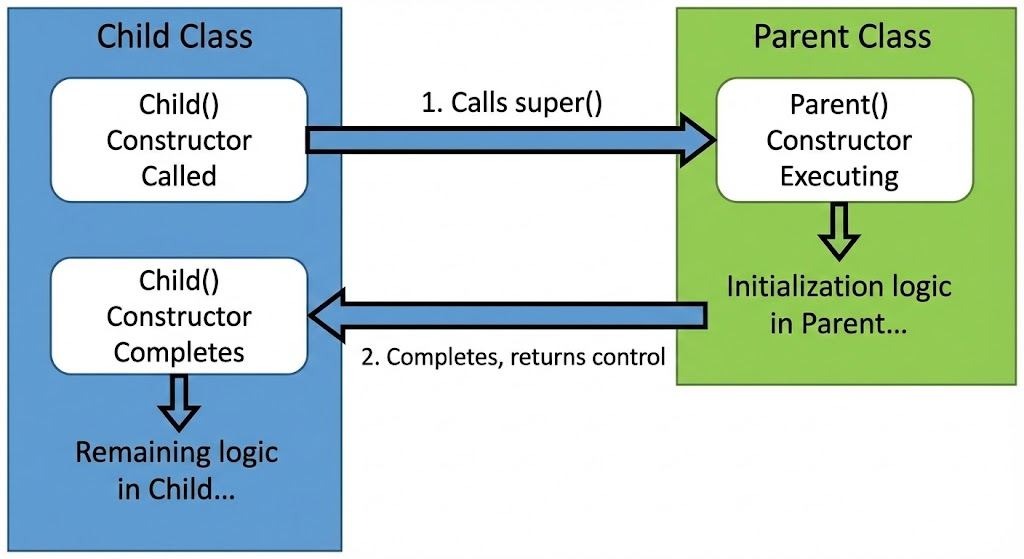
5. Mixing this() and super() - Important Rule
You cannot use this() and super() inside the same constructor because both must be the first statement.
Invalid:
Child() {
    this();   // ERROR
    super();  // ERROR
}
6. Real-World Example: Vehicle Inheritance
class Vehicle {
    String brand;

    Vehicle(String brand) {
        this.brand = brand;
        System.out.println("Vehicle constructor");
    }
}

class Car extends Vehicle {
    int speed;

    Car(String brand, int speed) {
        super(brand); // calling parent constructor
        this.speed = speed;
        System.out.println("Car constructor");
    }
}
Creating object:
Car c = new Car("Honda", 150);Output:
Vehicle constructor
Car constructor
Parent class always initializes before child class.
7. Constructor Chaining Pattern for Clean Code
Step 1: One main constructor does all the initialization
Step 2: Other constructors call the main constructor using this()
Example:
class Book {
    String title;
    int pages;

    Book() {
        this("Unknown", 0);
    }

    Book(String title) {
        this(title, 100);
    }

    Book(String title, int pages) {
        this.title = title;
        this.pages = pages;
    }
}
This eliminates all repeated initialization code.
8. Complete Example Demonstrating Full Chaining
class A {
    A() {
        this(10);
        System.out.println("A() constructor");
    }

    A(int x) {
        System.out.println("A(int) constructor: " + x);
    }
}

class B extends A {
    B() {
        super(20);
        System.out.println("B() constructor");
    }

    B(int y) {
        this();
        System.out.println("B(int) constructor: " + y);
    }
}

public class Main {
    public static void main(String[] args) {
        B obj = new B(50);
    }
}
Output:
A(int) constructor: 20
B() constructor
B(int) constructor: 50
Explanation:
B(int)callsthis()→B()B()callssuper(20)→A(int)- Flow completes back down the chain
9. Common Mistakes
Mistake 1: Calling this() after other statements
Student() {
    System.out.println("Hello");
    this(10); // ERROR
}
Mistake 2: Using this() and super() together
Not allowed.
Mistake 3: Confusing constructor chaining with method overloading
Constructor chaining is specifically for constructors, not methods.
10. Summary
- Constructor chaining enables reuse of initialization code.
this()→ Calls another constructor in the same class.super()→ Calls a constructor from the parent class.- Both must be the first statement in their constructors.
- Helps avoid code duplication and keeps initialization structured.
- Used heavily in real applications to maintain clean OOP patterns.
This completes Constructor Chaining in Java.
Written By: Shiva Srivastava
How is this guide?
Last updated on