
Method Overloading
1. Introduction
Method Overloading in Java allows a class to have multiple methods with the same name, as long as their parameter lists are different.
This is one form of compile-time polymorphism (also called static polymorphism).
It makes methods more readable and flexible because the same method name can perform related actions with different kinds of inputs.
Example from real life:
- A calculator can add()
- two integers
- two doubles
- three integers
- etc.
Instead of naming them addInt, addDouble, addThreeNumbers, Java lets you create multiple add() methods with different parameter lists.
2. What Is Method Overloading?
Method overloading means:
Same method name, different parameter list.
The compiler decides which method to call based on:
- Number of parameters
- Type of parameters
- Order of parameters
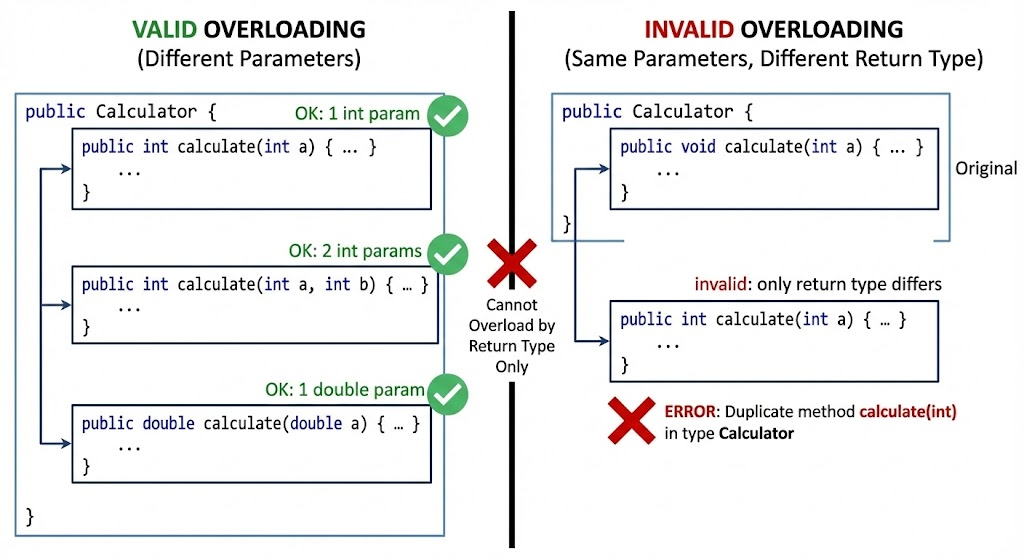
Return type is not considered for overload resolution.
3. Rules of Method Overloading (Very Important)
A method is considered overloaded when:
- Number of parameters differs, OR
- Type of parameters differs, OR
- Order of parameters differs
Examples:
void display(int a) { }
void display(double a) { }
void display(int a, double b) { }
void display(double a, int b) { }
NOT allowed:
Two methods differing only by return type.
int test() { return 1; }
double test() { return 2.0; } // ERROR
The compiler cannot distinguish them from the call.
4. Examples of Valid Method Overloading
4.1 Overloading by Changing Number of Parameters
void greet() {
    System.out.println("Hello");
}

void greet(String name) {
    System.out.println("Hello " + name);
}
Call:
greet();           // calls first method
greet("Rahul");    // calls second method
4.2 Overloading by Changing Data Type
int add(int a, int b) {
    return a + b;
}

double add(double a, double b) {
    return a + b;
}
Call:
add(3, 4);        // calls int version
add(3.5, 4.2);    // calls double version
4.3 Overloading by Changing Parameter Order
void show(int a, String b) { }
void show(String b, int a) { }
Both are allowed.
5. Real-World Example: Banking System
Imagine a bank where deposits can be made in different forms.
class Bank {

    void deposit(int amount) {
        System.out.println(amount + " deposited");
    }

    void deposit(double amount) {
        System.out.println(amount + " deposited (decimal amount)");
    }

    void deposit(int amount, String account) {
        System.out.println(amount + " deposited to " + account);
    }
}
Call:
Bank b = new Bank();
b.deposit(500);
b.deposit(250.75);
b.deposit(1000, "Saving Account");
6. Type Promotion in Overloading
Java may automatically promote smaller data types:
- byte → short → int → long → float → double
- char → int
Example:
void test(int a) {
    System.out.println("int");
}

void test(double a) {
    System.out.println("double");
}

test(5);     // prints "int"
test('c');   // prints "int" because char → int
test(5L);    // prints "double" because long → double
Promotion can influence which overloaded method is selected.
7. Overloading main() Method
Java allows overloading of the main method, but the JVM will call only the standard one:
public static void main(String[] args) {
    main(5);
}

public static void main(int x) {
    System.out.println("Overloaded main: " + x);
}
Output:
Overloaded main: 58. Constructor Overloading (Small Preview)
Constructors can also be overloaded:
class Student {
    Student() { }
    Student(String name) { }
    Student(String name, int age) { }
}
Complete details are covered in constructors.mdx.
9. Common Mistakes Students Make
Mistake 1: Overloading by return type only
int area() { }
double area() { } // invalid
Mistake 2: Assuming same parameter names means same signature
void show(int x) { }
void show(int y) { } // invalid, names don’t matter
Mistake 3: Confusing overloading with overriding
(Overriding requires inheritance and same signature.)
10. Complete Example Program
class Display {

    void show() {
        System.out.println("No parameters");
    }

    void show(int a) {
        System.out.println("Integer: " + a);
    }

    void show(double a) {
        System.out.println("Double: " + a);
    }

    void show(int a, double b) {
        System.out.println(a + " and " + b);
    }
}

public class Main {
    public static void main(String[] args) {
        Display d = new Display();

        d.show();
        d.show(10);
        d.show(5.5);
        d.show(10, 12.75);
    }
}
Output:
No parameters
Integer: 10
Double: 5.5
10 and 12.75
11. Summary
-
Method overloading means having multiple methods with the same name but different parameter lists.
-
Overloading provides flexibility and improves code readability.
-
It is a form of compile-time polymorphism.
-
Overloading can be achieved by changing:
- Number of parameters
- Types of parameters
- Order of parameters
-
Return type alone cannot overload a method.
-
Java may apply type promotion during method selection.
This completes Method Overloading in Java.
Written By: Shiva Srivastava
How is this guide?
Last updated on