
Higher Order Function
Introduction to Higher-Order Functions
In Python, a higher-order function is a function that can accept another function as an argument or return a function as its result. This is possible because Python treats functions as first-class citizens, meaning functions behave like regular objects.
As a result, functions can be:
- Assigned to variables
- Passed as parameters
- Returned from other functions
- Stored in data structures
This capability makes Python well-suited for functional programming concepts.
Why Higher-Order Functions Matter
Higher-order functions allow you to:
- Write generic and reusable code
- Separate what to do from how to do it
- Avoid writing multiple similar functions
- Dynamically change behavior by passing different functions
Instead of writing separate logic for squaring, cubing, or other operations, a single higher-order function can handle all cases.
Basic Example: Passing a Function as an Argument
A function can receive another function as a parameter and execute it dynamically.
def square(num):
    return num * num

def cube(num):
    return num * num * num

def operate(num, operation):
    return operation(num)

value = 5
result = operate(value, square)
print(result)
Output:
25Here:
operateis a higher-order functionsquareis passed as an argumentoperation(num)dynamically executes the passed function
Changing the behavior requires no change to the higher-order function:
result = operate(value, cube)
print(result)
Output:
125Higher-Order Function with Multiple Values
Higher-order functions can also process collections of data.
def square(num):
    return num * num

def cube(num):
    return num * num * num

def operate(nums, operation):
    for i in nums:
        print(operation(i))

nums = [5, 6, 7]
operate(nums, cube)
Output:
125
216
343
Here:
- A list of values is passed
- The same function works for any operation
- Only the behavior changes, not the structure of the code
Key Characteristics
- The higher-order function does not care about the logic of the operation
- It only knows when and how to call the passed function
- This enables abstraction and flexibility
Real-World Use Cases
Higher-order functions are widely used in:
- Data transformation pipelines
- Callback functions
- Event handling
- Functional utilities
- Clean and scalable code design
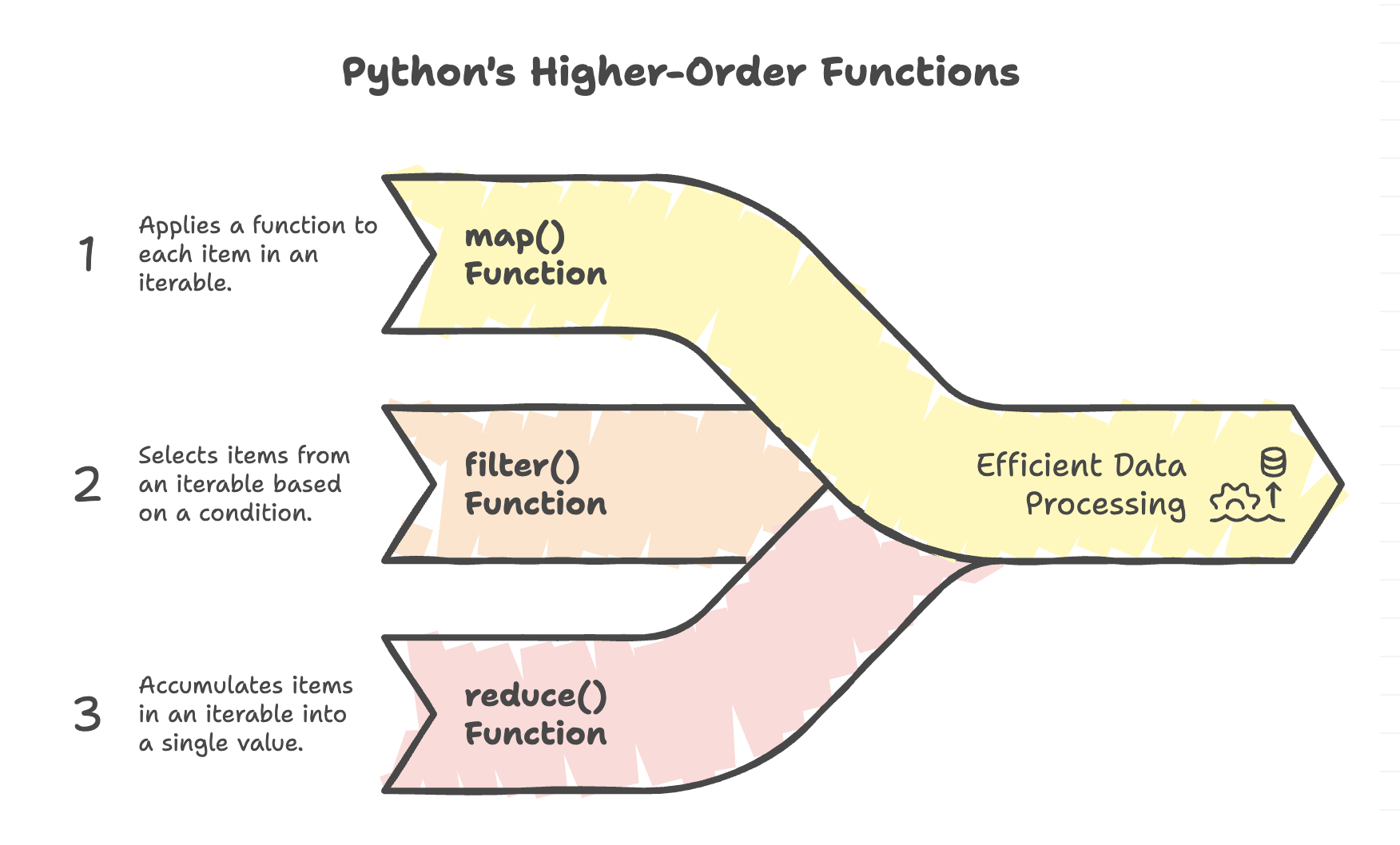
Summary
- Higher-order functions accept other functions as arguments.
- They rely on Python’s first-class function support.
- They enable abstraction, flexibility, and code reuse.
- The behavior can be changed dynamically without modifying core logic.
- Commonly used in functional programming and real-world applications.
Written By: Muskan Garg
How is this guide?
Last updated on