
Anonymous Function using Lambda
Introduction to Anonymous Functions
An anonymous function is a function that is defined without a name.
In Python, such functions are created using the lambda keyword.
Unlike regular functions defined using def, anonymous functions:
- Are usually short-lived
- Are written in a single line
- Focus on one specific operation
They are mainly used when a function is required temporarily and defining a full function would be unnecessary.
What Is a Lambda Function?
A lambda function is Python’s way of creating an anonymous function. It allows you to define a function using a single expression instead of a full function block.
Lambda functions:
- Do not have a name by default
- Return a value automatically
- Contain only one expression
- Improve code brevity and clarity when used correctly
Lambda Functions and First-Class Functions
In Python, functions are first-class citizens, meaning:
- Functions can be assigned to variables
- Functions can be passed as arguments
- Functions can be returned from other functions
Lambda Function Syntax
lambda parameters: expressionExplanation:
lambda→ keyword used to define the functionparameters→ input values (one or more)expression→ a single expression whose result is returned
-
No
returnkeyword -
No function body or indentation
Regular Function vs Lambda Function
Regular Function Example
def square(num):
    return num * num

print(square(5))
Lambda Function Equivalent
square = lambda num: num * num
print(square(5))
Output:
25Assigning Lambda Functions to Variables
Although lambda functions are anonymous, they can be assigned to variables and used like named functions.
fun = lambda num: num * num
print(fun(5))
Output:
25Here:
funreferences the lambda function- The function remains anonymous but is callable through the variable
Lambda Functions with Multiple Parameters
Lambda functions can accept multiple parameters, just like regular functions.
add = lambda a, b: a + b
print(add(4, 5))
Output:
9This is useful for quick arithmetic or comparison operations.
Lambda Functions with Higher-Order Functions
Lambda functions are commonly used with higher-order functions, which accept other functions as arguments.
def operate(num, operation):
    return operation(num)

result = operate(5, lambda x: x * x)
print(result)
Output:
25Here:
- The lambda function is passed directly
- No separate function definition is required
- Code becomes more compact and expressive
Advantages vs Limitations of Lambda Functions
Advantages:
- Reduce code length
- Improve readability for simple logic
- Eliminate unnecessary function definitions
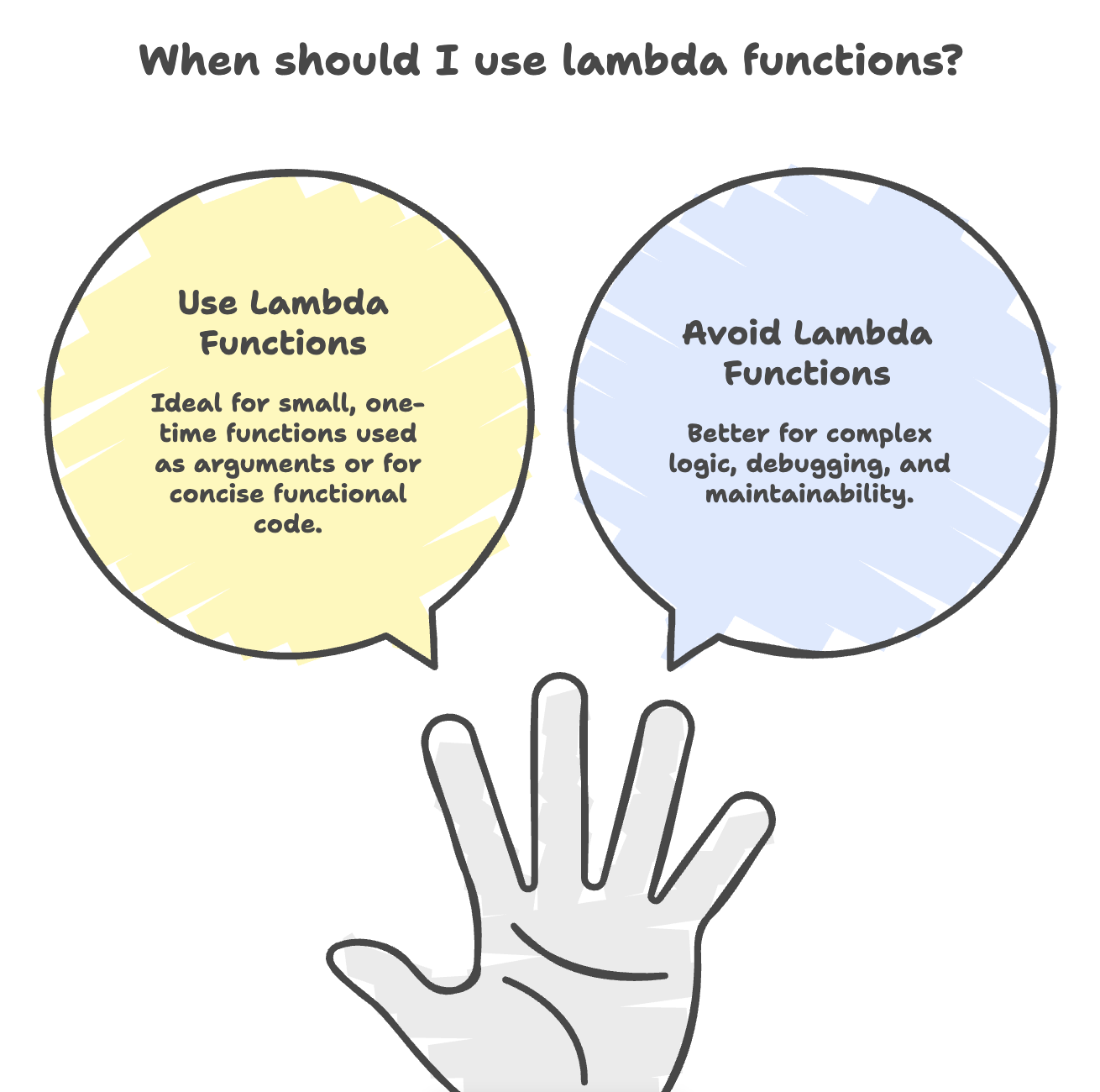
- Ideal for temporary and one-time use functions
- Frequently used with
map(),filter(), andreduce()
Limitations:
- Only one expression allowed
- Cannot contain multiple statements
- Not suitable for complex logic
- Overuse can reduce readability
Summary
- Lambda functions are anonymous, single-expression functions
- Anonymous functions are defined using the
lambdakeyword - They can automatically return the result of an expression
- They can take one or multiple parameters
- Lambda functions are often used with higher-order functions
- Lambda functions are best suited for short, simple, and temporary operations
Written By: Muskan Garg
How is this guide?
Last updated on