
Map and Reduce Function
Python supports functional programming concepts, where functions are treated as first-class objects.
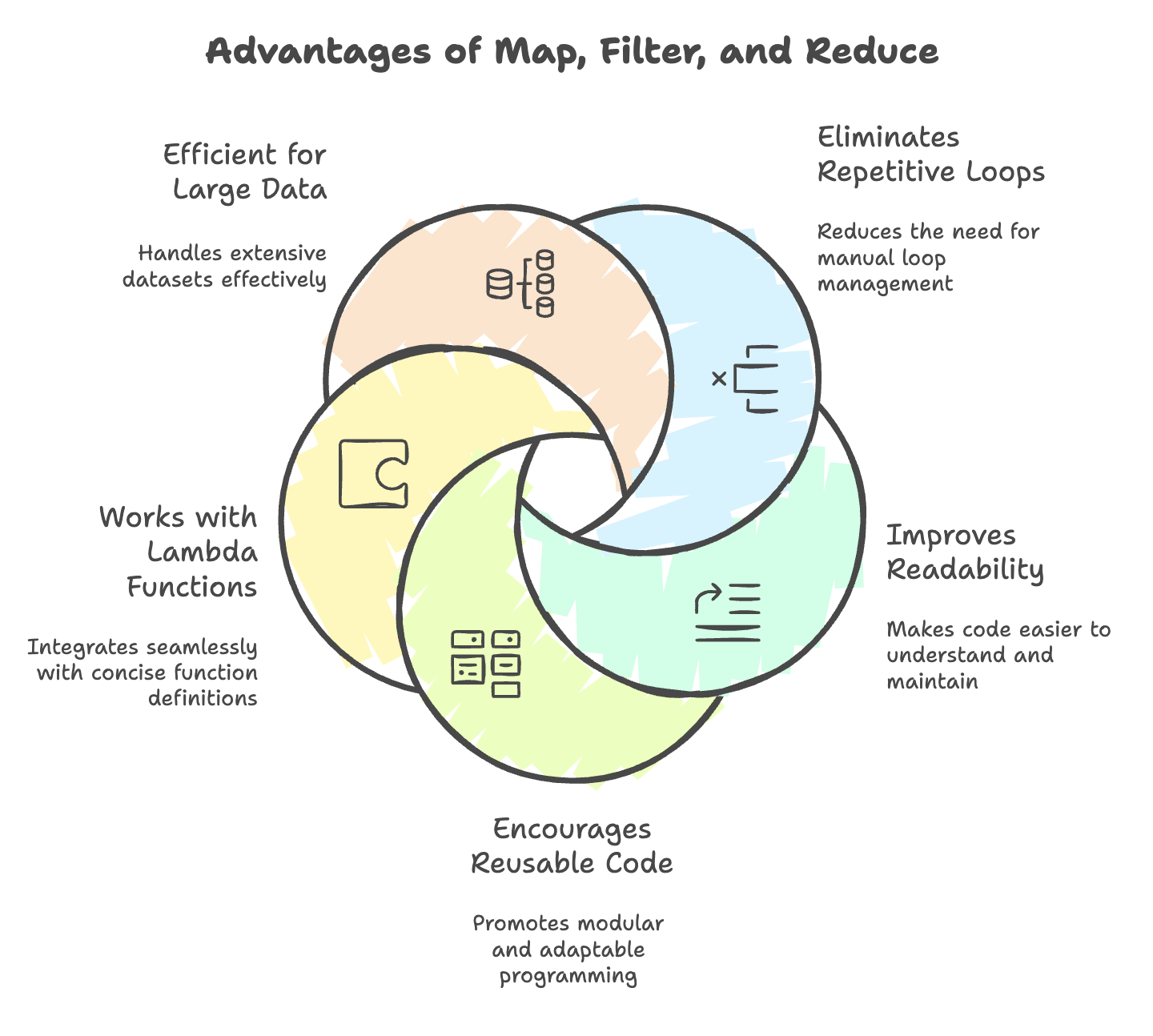
The built-in functions filter(), map(), and reduce() help process collections in a clean, concise, and efficient manner.
These functions are commonly used for:
- Data transformation
- Data filtering
- Data aggregation
Overview of Map, Filter, and Reduce
filter()
- Selects elements from an iterable based on a condition
- Keeps only values for which the function returns
True - Returns a filter object
map()
- Transforms each element of an iterable
- Applies the same function to every element independently
- Returns a map object
reduce()
- Combines all elements of an iterable into a single value
- Uses a function that takes two arguments
- Available in the functools module
Real-World Problem Statement
Given a list of numbers:
- Extract even numbers
- Double each even number
- Calculate the sum of the doubled values
Step 1: Filtering Even Numbers
nums = [4, 2, 9, 7, 5, 1, 6, 8]

evens = list(filter(lambda n: n % 2 == 0, nums))
print("Evens:", evens)
Output:
Evens: [4, 2, 6, 8]✔ filter() keeps only values that satisfy the condition
✔ Lambda function avoids defining a separate function
Step 2: Mapping (Doubling the Values)
Using a Named Function
def double_it(n):
    return n * 2

doubles = list(map(double_it, evens))
print("Doubles:", doubles)
Using Lambda
doubles = list(map(lambda n: n * 2, evens))
print("Doubles:", doubles)
Output:
Doubles: [8, 4, 12, 16]✔ map() applies the function to each element
✔ Each value is transformed independently
Step 3: Reducing (Summing the Values)
Using a Named Function
from functools import reduce

def sum_it(a, b):
    return a + b

total = reduce(sum_it, doubles)
print("Total:", total)
Using Lambda
total = reduce(lambda a, b: a + b, doubles)
print("Total:", total)
Output:
Total: 40✔ reduce() combines values step by step
✔ Final result is a single value
Complete Example
from functools import reduce

nums = [4, 2, 9, 7, 5, 1, 6, 8]

evens = list(filter(lambda n: n % 2 == 0, nums))
doubles = list(map(lambda n: n * 2, evens))
total = reduce(lambda a, b: a + b, doubles)

print("Evens:", evens)
print("Doubles:", doubles)
print("Total:", total)
Output:
Evens: [4, 2, 6, 8]
Doubles: [8, 4, 12, 16]
Total: 40
Summary
filter()selects elements from a collection based on a condition, keeping only the values that satisfy the given logic.map()transforms each element in a collection by applying a function, producing a new set of modified values.reduce()aggregates all elements of a collection into a single result by repeatedly combining values.- Lambda functions enable compact, one-line function definitions, making filter(), map(), and reduce() more concise and readable.
Together, these functions form a powerful functional programming pipeline for clean, efficient, and expressive data processing in Python.
Written By: Muskan Garg
How is this guide?
Last updated on