
Filter Function
When working with data, especially large datasets, it is common to:
- Select specific values based on conditions
- Remove unwanted elements
- Extract meaningful subsets of data
Python provides the filter() function to perform such operations efficiently and cleanly.
What is the filter() Function?
The filter() function is a built-in Python function used to extract elements from an iterable (such as a list or tuple) based on a condition.
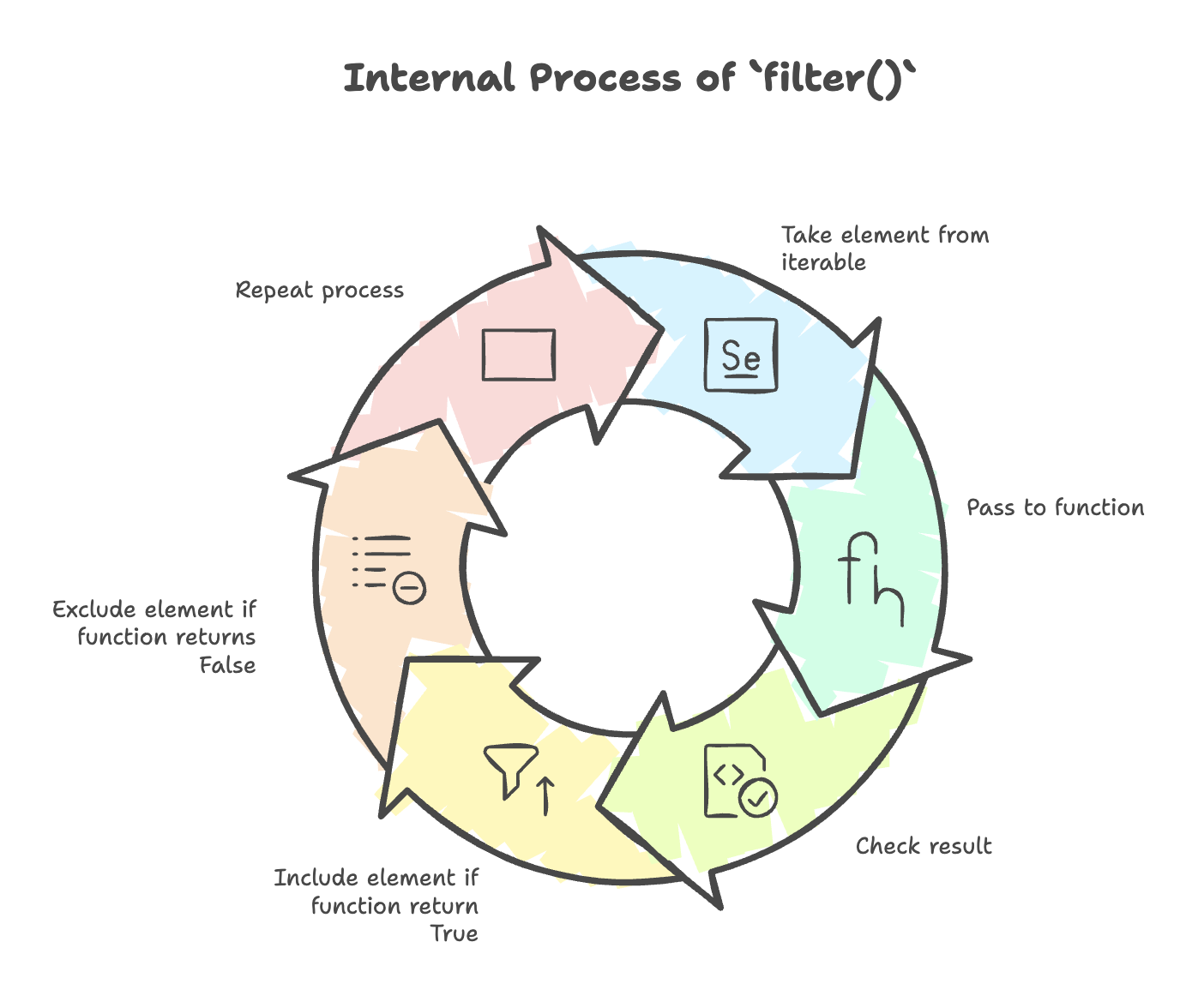
It works by:
- Applying a function to each element
- Keeping only those elements for which the function returns True
- Discarding all others
Syntax of filter()
filter(function, iterable)Explanation:
- function → A function that returns
TrueorFalse - iterable → A collection of elements (list, tuple, etc.)
- return value → A
filterobject (iterator)
To view the result, the filter object is usually converted into a list.
Using filter() with a Custom Function
Example 1: Function Always Returning True
nums = [4, 2, 9, 7, 5, 1, 6, 8]

def is_even(n):
    return True

evens = list(filter(is_even, nums))
print(evens)
Output:
[4, 2, 9, 7, 5, 1, 6, 8]- All values are included because the function always returns
True.
Example 2: Function Always Returning False
def is_even(n):
    return False

evens = list(filter(is_even, nums))
print(evens)
Output:
[]- No values are included because the function always returns
False.
Example 3: Filtering Even Numbers
def is_even(n):
    return n % 2 == 0

evens = list(filter(is_even, nums))
print(evens)
Output:
[4, 2, 6, 8]- Only values satisfying the condition are included.
Using filter() with Lambda Functions
Lambda functions allow filtering logic to be written inline, without defining a separate function.
Example Using Lambda
nums = [4, 2, 9, 7, 5, 1, 6, 8]

evens = list(filter(lambda n: n % 2 == 0, nums))
print(evens)
Output:
[4, 2, 6, 8]Benefits:
- More concise
- Improves readability for simple conditions
- Ideal for one-time filtering logic
Lazy Evaluation in filter()
The filter() function uses lazy evaluation, meaning elements are processed one at a time rather than all at once.
Results are produced only when requested, which helps optimize memory usage and improves performance when working with large datasets.
Advantages of Using filter()
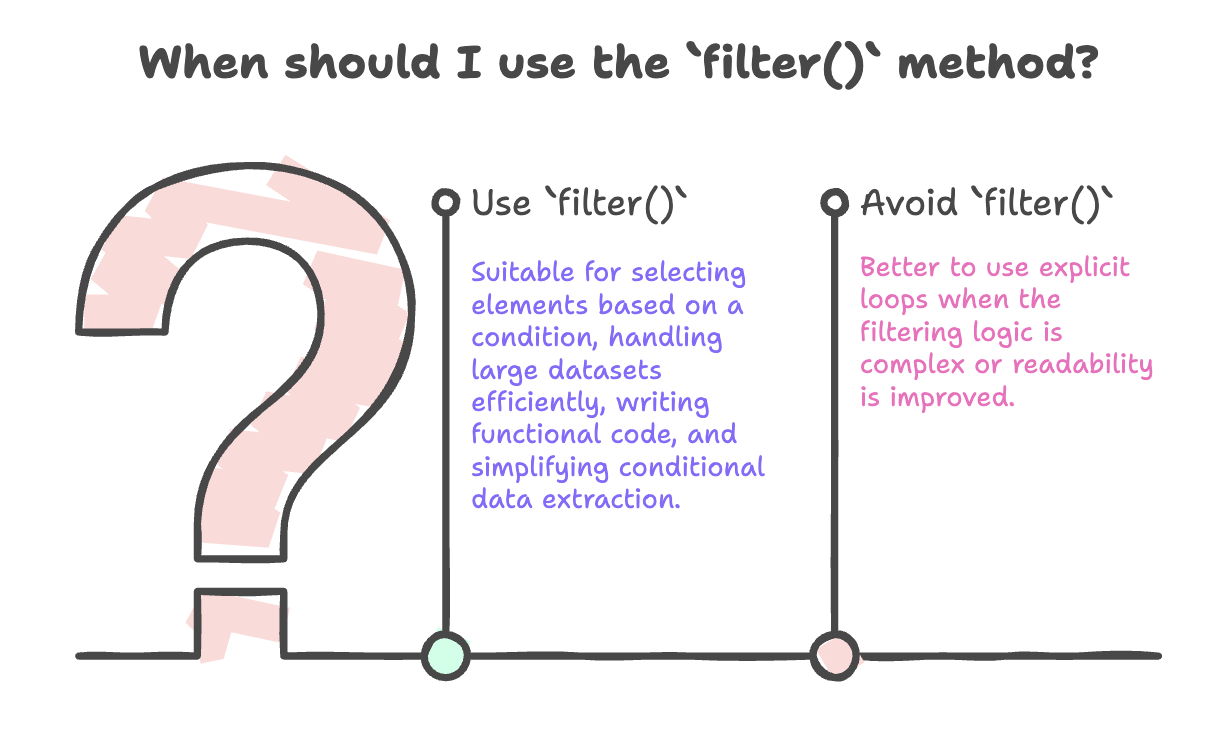
- Removes the need for explicit loops
- Produces cleaner and more readable code
- Efficient for large collections due to lazy evaluation
- Works seamlessly with lambda functions
- Keeps the original data unchanged
Summary
filter()selects elements based on a boolean condition- Accepts a function and an iterable as input
- Returns an iterator (commonly converted to a list)
- Supports concise logic using lambda expressions
- Processes data efficiently using lazy evaluation
- Frequently used alongside
map()andreduce()
The filter() function is a powerful and elegant tool for clean, efficient, and readable data filtering in Python.
Written By: Muskan Garg
How is this guide?
Last updated on