
Decorators
What is a Decorator?
A decorator in Python is a special function used to modify or extend the behavior of another function without changing its original code.
In simple terms:
- A decorator wraps an existing function
- Adds extra functionality before or after the function runs
- Keeps the original function logic untouched
This makes decorators a powerful tool for writing clean, reusable, and maintainable code.
Structure of a Decorator
A decorator typically has three layers:
- Outer function - accepts the target function
- Wrapper function - adds extra behavior
- Return statement - returns the wrapper
This structure enables function replacement without modifying original code.
Functions as First-Class Objects
Decorators are possible in Python because functions are first-class objects, meaning:
- Functions can be passed as arguments
- Functions can be returned from other functions
- Functions can be assigned to variables
This flexibility enables functions to wrap and enhance other functions dynamically
Why Decorators Are Used
Decorators help solve common programming problems such as:
- Eliminating repeated code
- Separating core logic from auxiliary behavior
- Applying the same functionality across multiple functions
- Improving readability and maintainability
They are especially useful for implementing cross-cutting concerns like logging, validation, and security checks.
Basic Problem Example (Without Decorators)
Consider functions like sub() and divide() where the larger number should always come first:
def sub(a, b):
    if a < b:
        a, b = b, a
    return a - b

def divide(a, b):
    if a < b:
        a, b = b, a
    return a / b
Here, the same logic is repeated in both functions.
Creating a Simple Decorator
A decorator:
- Accepts a function as input
- Defines an inner wrapper function
- Adds extra behavior inside the wrapper
- Returns the wrapper function
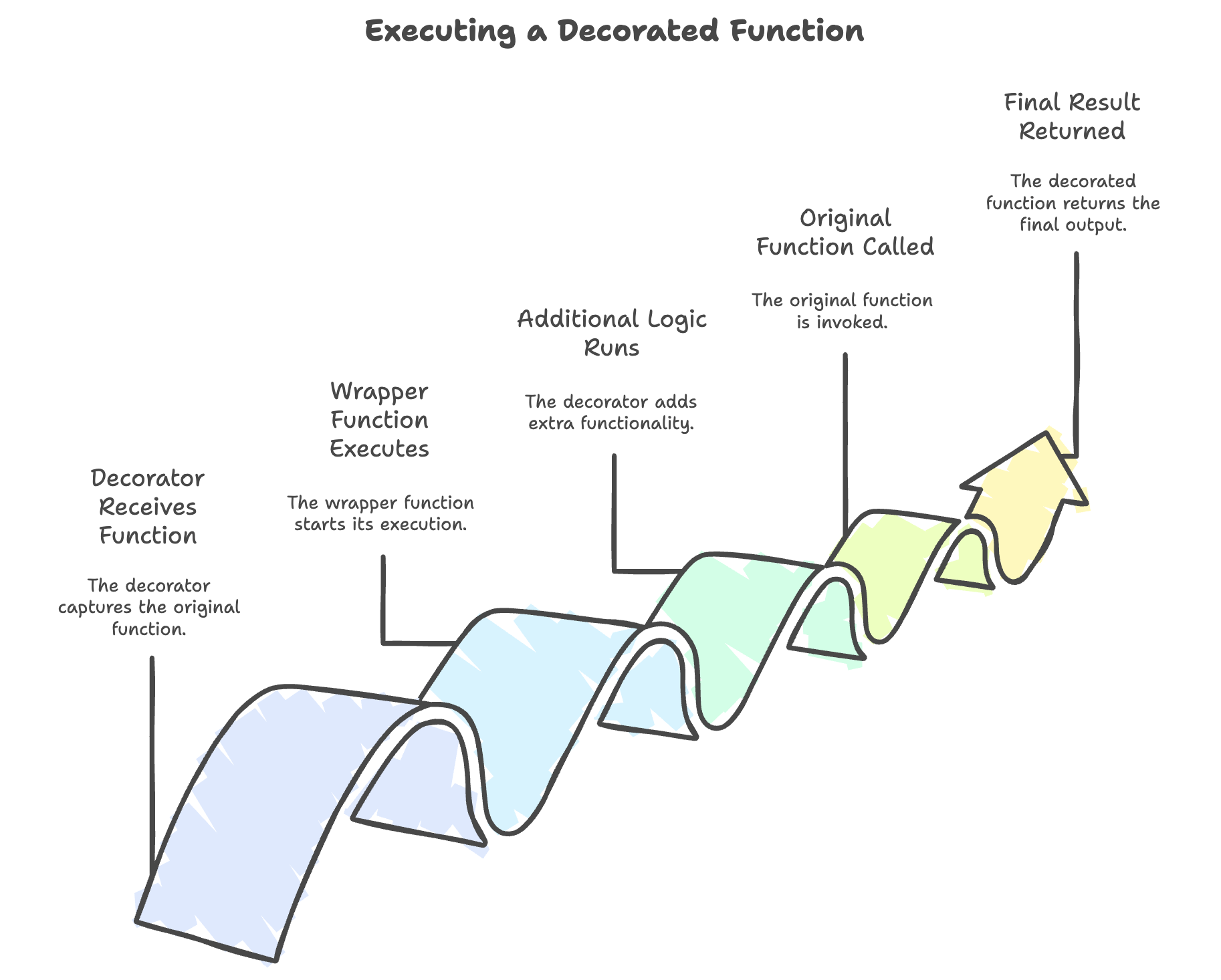
Example: greater_first Decorator
This decorator ensures the larger number is always the first argument.
def greater_first(func):
    def wrap(a, b):
        if a < b:
            a, b = b, a
        return func(a, b)
    return wrap
Applying a Decorator Using @ Syntax
@greater_first
def sub(a, b):
    return a - b

@greater_first
def divide(a, b):
    return a / b
Output:
print(divide(2, 4))  # 2.0
print(sub(2, 4))     # 2
This syntax is equivalent to:
sub = greater_first(sub)
divide = greater_first(divide)
Adding Logging Using Decorators
Decorators are commonly used for logging function calls.
Logging Decorator Example
def log_deco(func):
    def wrap(a, b):
        print("Values:", a, b)
        result = func(a, b)
        print("Result:", result)
        return result
    return wrap
@log_deco
def sub(a, b):
return a - bOutput:
Values: 2 4
Result: 2Decorators Are Function-Specific
A decorator affects only the function it is applied to.
@log_deco
def sub(a, b):
    return a - b
def divide(a, b):
return a / bHere:
sub()is loggeddivide()behaves normally
Making Decorators Generic with *args and **kwargs
To allow a decorator to work with any number of arguments, use *args and **kwargs.
def log_deco(func):
    def wrap(*args, **kwargs):
        print("Values:", args)
        result = func(*args, **kwargs)
        print("Result:", result)
        return result
    return wrap
This makes the decorator reusable for:
- Different argument counts
- Different function signatures
Example
@log_deco
def add(a, b, c):
    return a + b + c
Output:
Values: (5, 7, 6)
Result: 18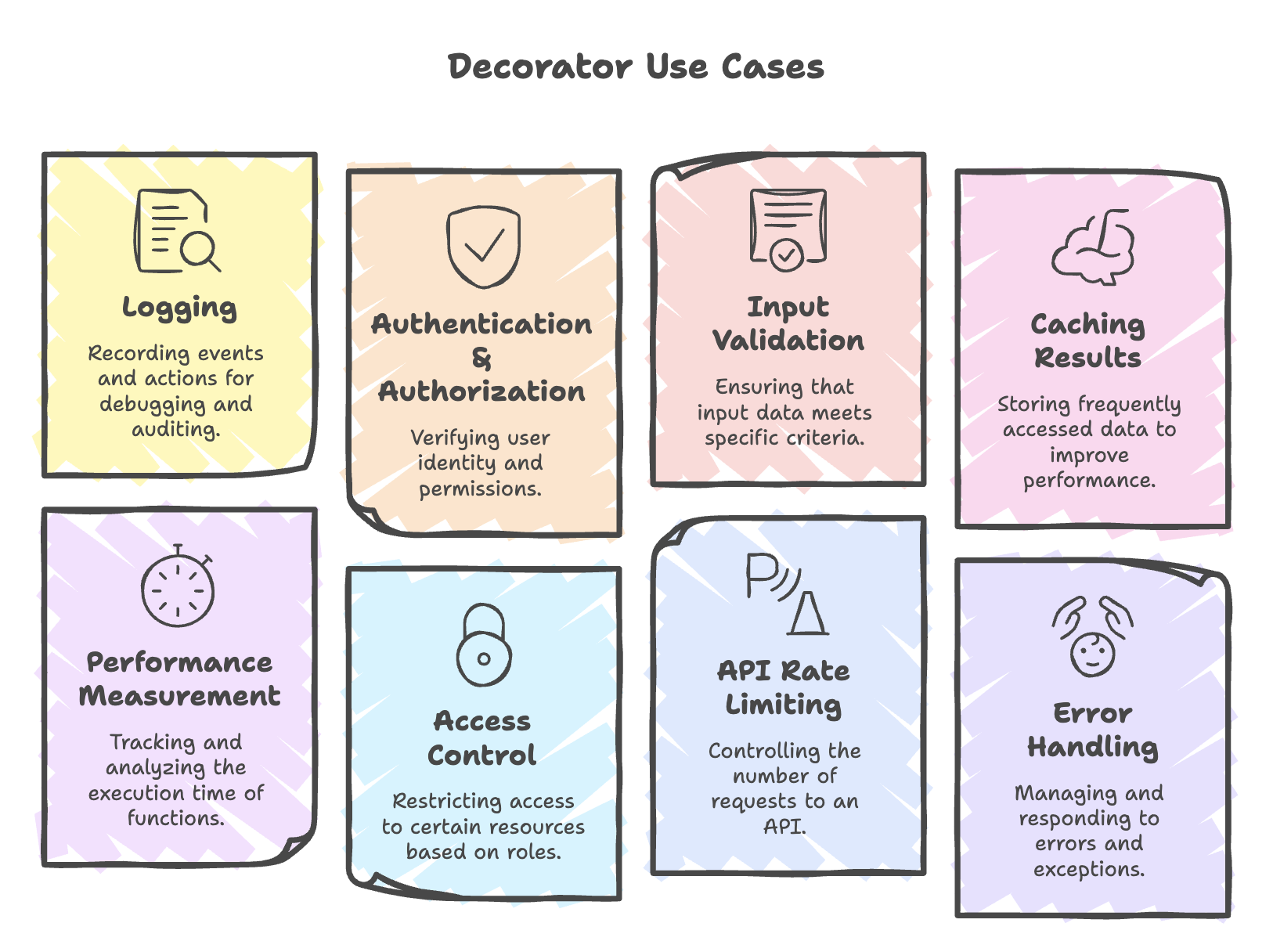
Summary
- Decorators allow you to modify or extend a function’s behavior without altering its original source code.
- They are implemented using inner functions and closures, enabling additional logic to wrap existing functions.
- Decorators are applied using the @decorator_name syntax, providing a clear and readable way to enhance functions.
- They promote code reuse, separation of concerns, and cleaner program design by eliminating repetitive logic.
- Decorators are a core feature of advanced Python programming, widely used in frameworks, libraries, and real-world applications.
Written By: Muskan Garg
How is this guide?
Last updated on