
Inner Function
What is an Inner Function?
An inner function is a function defined inside another function. It is local to the outer function and cannot be accessed directly from outside its scope.
- Inner functions help organize code logically.
- They are commonly used for helper logic, encapsulation, and decorators.
Scope and Accessibility
- An inner function is only accessible within its outer function.
- Trying to call it directly from outside results in a
NameError.
Example
def outer():
    print("In outer function")
    def inner():
        print("In inner function")

outer()
inner()
Output
In outer function
NameError: name 'inner' is not defined
This happens because inner() exists only inside outer().
Calling an Inner Function from the Outer Function
An inner function can be called within the outer function itself.
def outer():
    print("In Outer function")
    def inner():
        print("In Inner function")
    inner()

outer()
Output
In Outer function
In Inner function
Returning the Result of an Inner Function
When the outer function calls the inner function and returns its result, the inner function is executed immediately, and its return value is passed back to the caller.
- The inner function runs during the execution of the outer function.
- The outer function does not return the function, only the final value produced by the inner function.
def outer():
    print("In Outer function")
    def inner():
        print("In Inner function")
        return 5
    return inner()

result = outer()
print(result)
Output
In Outer function
In Inner function
5
If no value is returned, Python returns None by default.
def outer():
    print("In Outer function")
    def inner():
        print("In Inner function")

    return inner()

result = outer()
print(result)
Output
In Outer function
In Inner function
None
Use this approach when the inner function is only needed to compute a value and does not need to be reused later.
Returning the Inner Function Itself (Closures)
When the outer function returns the inner function without parentheses, it returns a function reference, not its execution result.
- The inner function is not executed immediately.
- The returned function can be stored in a variable and called later.
- This creates a closure, where the inner function retains access to the outer function’s variables even after the outer function has finished executing.
def outer():
    print("In Outer function")
    def inner():
        print("In Inner function")
    return inner

func = outer()
print(func)
Output
In Outer function
<function outer.<locals>.inner at 0x...>
Here, func now holds a reference to the inner function.
Returning a function enables delayed execution and preserves the outer function’s context.
Calling the Returned Inner Function
Once an inner function is returned and assigned to a variable, it behaves like a normal function.
- The function can be invoked multiple times.
- It retains access to variables from the outer function (closure behavior).
- This enables flexible and reusable logic.
def outer():
    print("In Outer function")
    def inner():
        print("In Inner function")
    return inner

func = outer()
func()
Output
In Outer function
In Inner function
Calling a returned inner function allows execution outside the original scope, while still maintaining access to the outer function’s data.
Inner Functions with Parameters
Inner functions can accept parameters, just like regular functions.
- Parameters allow dynamic input during execution.
- Combined with closures, this allows functions to operate on both:
- Values passed during the outer function call
- Values passed during the inner function call
This design supports customizable behavior and is widely used in decorators and functional programming patterns.
def outer():
    print("In Outer function")
    def inner(num):
        print("In Inner function", num)
    return inner

func = outer()
func(5)
Output
In Outer function
In Inner function 5
Parameters make inner functions adaptable and reusable while preserving outer scope data.
Closures and Variable Access
When an inner function is returned, it forms a closure, meaning:
- It remembers and can access variables from the outer function even after the outer function has finished execution.
To modify outer variables, use the nonlocal keyword.
Summary
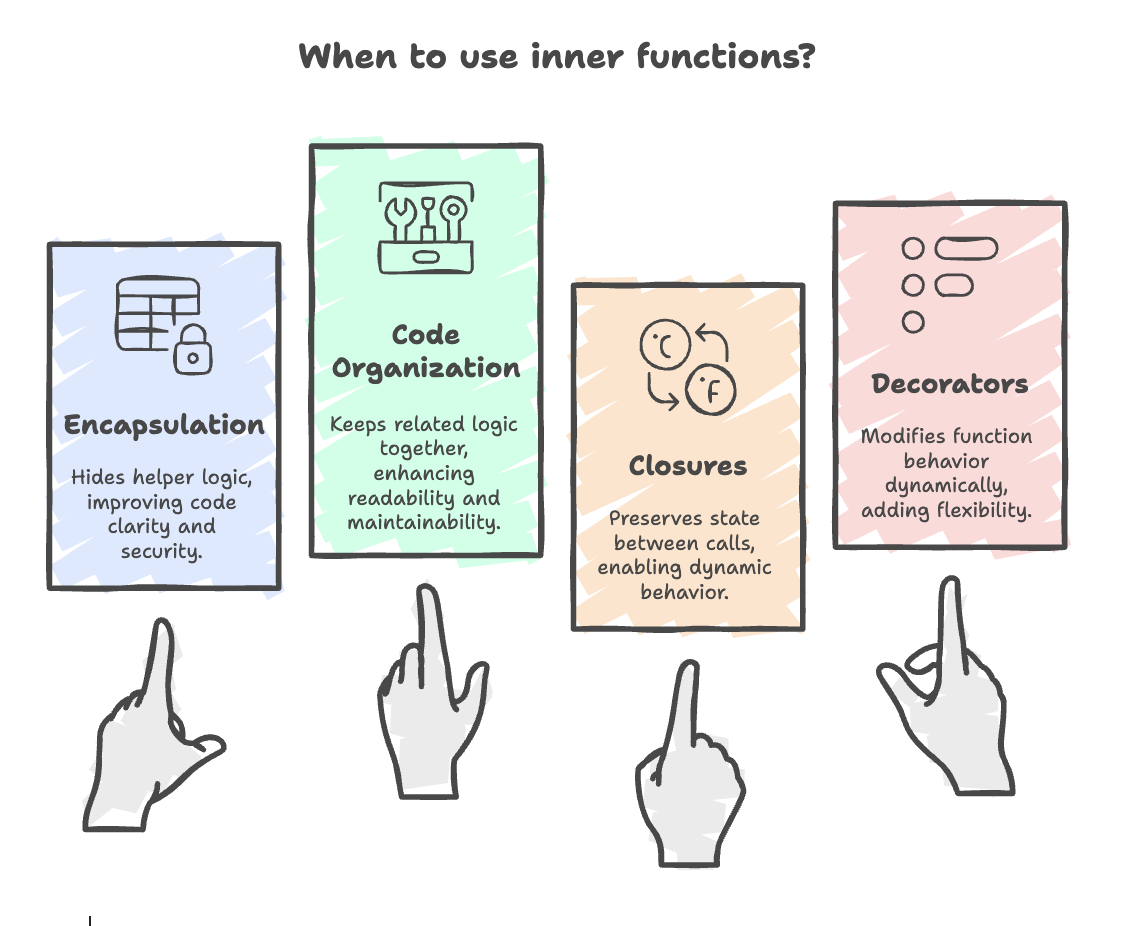
- Inner functions are defined inside outer functions to encapsulate logic and avoid polluting the global namespace.
- They are accessible only within the outer function, improving code safety and control.
- Inner functions can be called immediately or returned and stored for later execution.
- Returning an inner function creates a closure, preserving access to outer variables.
- They are commonly used in decorators, callbacks, and functional programming for reusable and flexible designs.
Written By: Muskan Garg
How is this guide?
Last updated on