
Factorial Using Recursion
What Is a Factorial?
The factorial of a positive integer n (denoted as n!) is the product of all positive integers from n down to 1.
Example:
5! = 5 × 4 × 3 × 2 × 1 = 120
Mathematically, a factorial is defined as:
n! = n × (n − 1)!- Base case:
1! = 1
Why Recursion Fits Factorial
Recursion is well-suited for factorial because:
- The factorial of a number depends on the factorial of the previous number.
- The problem naturally breaks into smaller sub-problems, and each step depends on the result of the previous step
- The recursive definition directly mirrors the mathematical formula.
Recursive Breakdown of Factorial
For 5!, the recursive flow looks like this:
5! = 5 × 4!
4! = 4 × 3!
3! = 3 × 2!
2! = 2 × 1!
1! = 1   ← Base Case
Each step reduces the problem until it reaches the base case (1!).
Recursive Factorial Function
Every recursive solution must include:
1. Base Case Stops the recursion and prevents infinite calls
if num == 1:
    return 1
2. Recursive Case Calls the function with a smaller input
return num * fact(num - 1)Python Implementation
def fact(num):
    if num == 1:
        return 1
    return num * fact(num - 1)

result = fact(5)
print(result)
Output:
120How the Call Stack Works
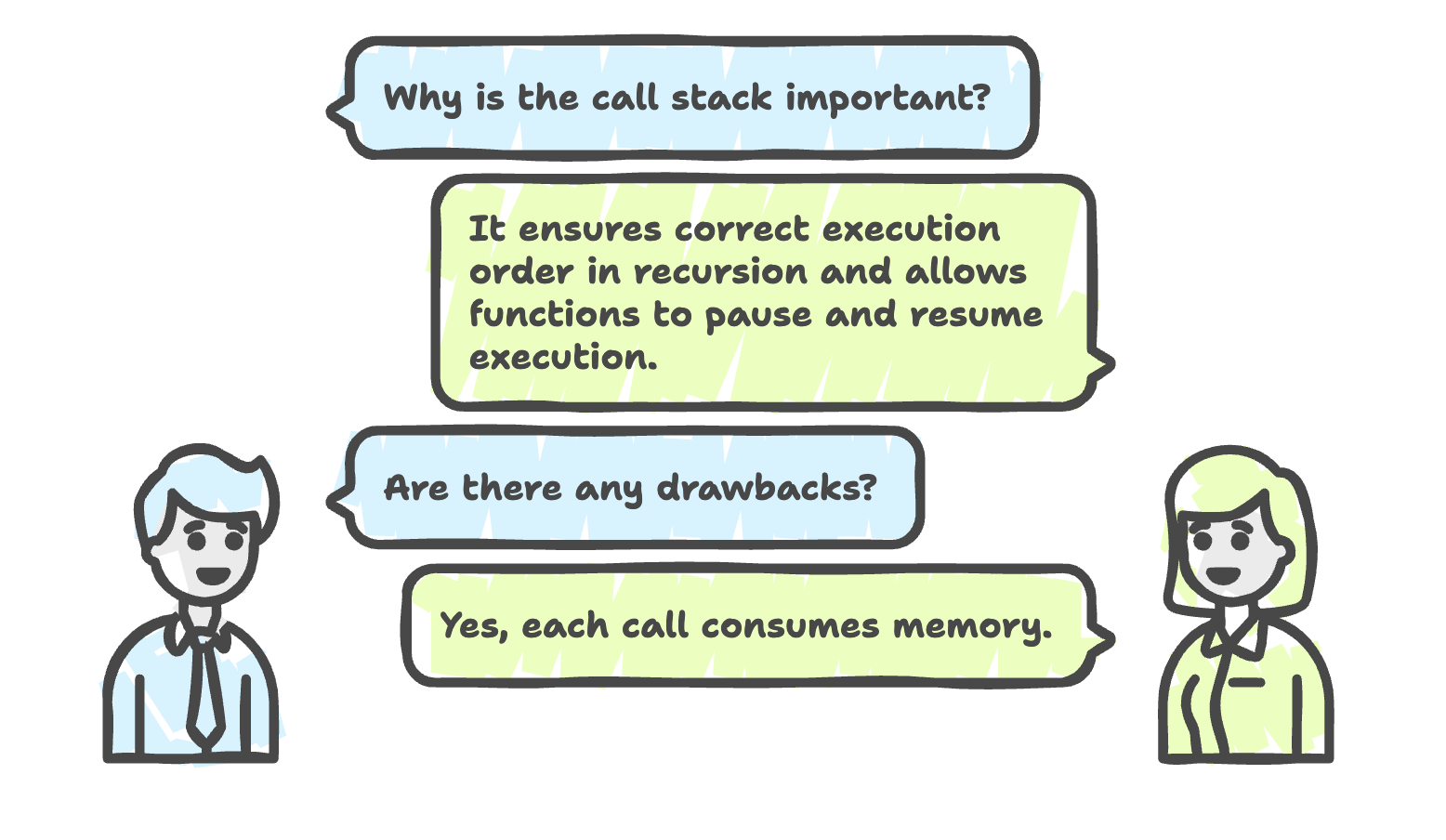
The call stack is a memory structure that keeps track of active function calls in a program. In recursion, it plays a crucial role in managing repeated function calls.
What Happens When a Function Is Called
-
Each time a function is called, Python creates a new stack frame.
-
This frame stores:
- Function parameters
- Local variables
- The point to return to after execution
-
The frame is pushed onto the call stack.
Call Stack in Recursive Functions
- In recursion, a function keeps calling itself.
- Each recursive call is added on top of the previous one in the stack.
- This continues until the base case is reached.
Reaching the Base Case
- The base case (
fact(1)) stops further recursive calls. - It returns a value (here,
1) to the previous function call.
Unwinding the Call Stack
-
After the base case returns, the stack starts unwinding.
-
Each function:
- Resumes execution
- Uses the returned value
- Computes its result
- Returns to the caller
Return order:
fact(1) → 1
fact(2) → 2 × 1 = 2
fact(3) → 3 × 2 = 6
fact(4) → 4 × 6 = 24
fact(5) → 5 × 24 = 120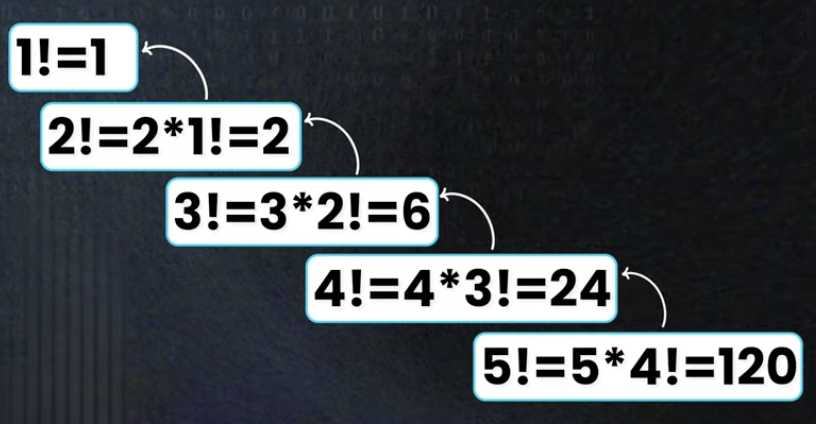
Stack Overflow and Recursion Limits
-
If recursion goes too deep without a proper base case:
- The call stack grows excessively
- Python raises a
RecursionError
-
This protects the system from memory exhaustion.
Summary
- Factorial can be implemented using recursion by reducing the problem size.
- The base case
1! = 1prevents infinite recursion. - Recursive calls build a call stack and resolve in reverse order.
- The recursive approach offers clarity and aligns well with the mathematical definition.
Written By: Muskan Garg
How is this guide?
Last updated on