
Recursion
Introduction to Recursion
Recursion is a programming technique where a function calls itself to solve a problem by breaking it down into smaller subproblems.
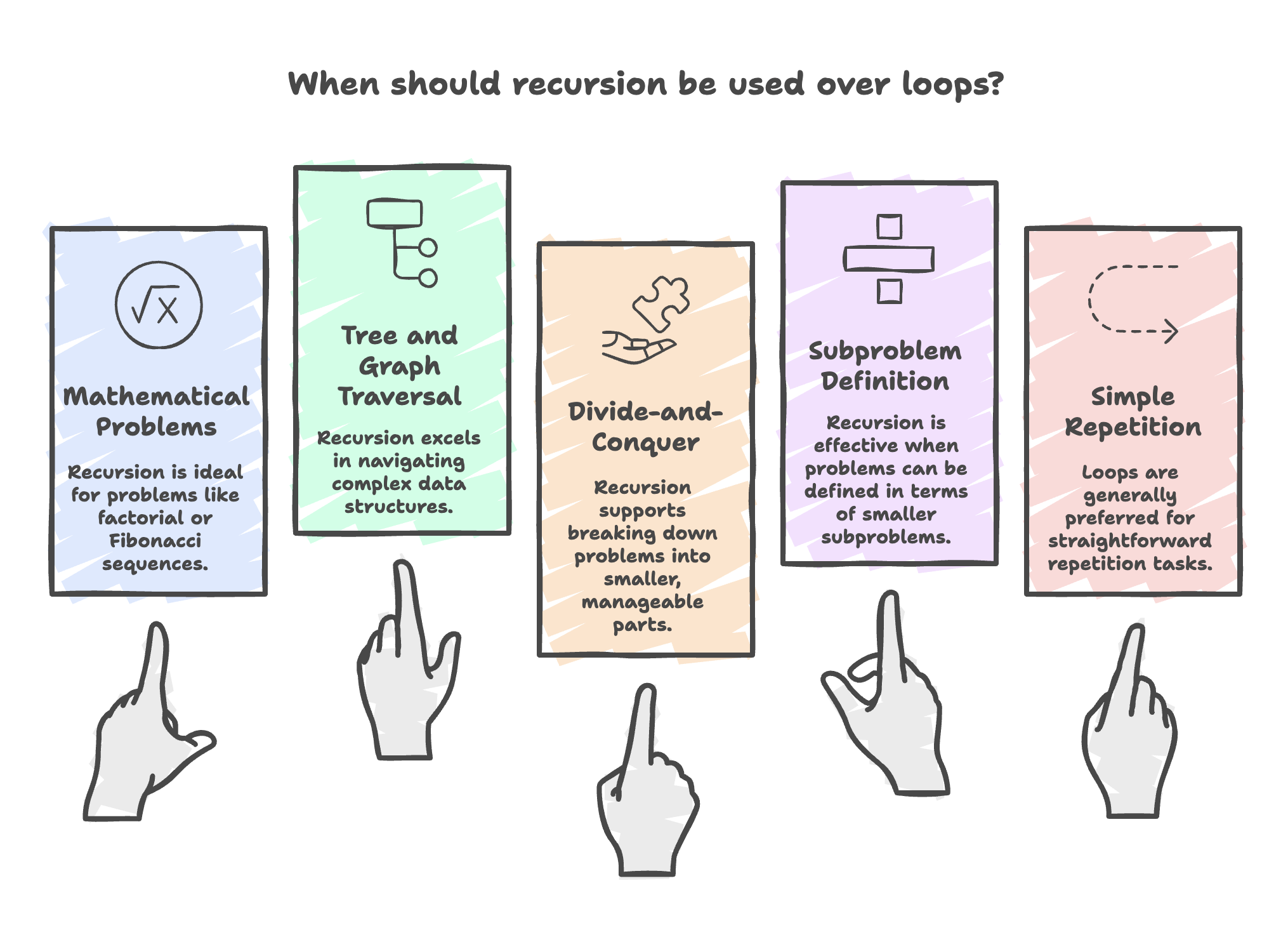
It is commonly used for problems that have a repetitive or self-similar structure, such as factorials, tree traversal, and mathematical sequences.
In Python, recursion must be handled carefully to avoid infinite calls and runtime errors.
Basic Concept of Recursion
A recursive function typically consists of two essential parts:
-
Base Case A condition that stops the recursion. Without this, the function will call itself indefinitely.
-
Recursive Case The part where the function calls itself with modified arguments.
Without a base case, recursion leads to a runtime error.
Example: Infinite Recursion (Without Base Case)
def greet():
    print("Hello")
    greet()

greet()
Output
Hello
Hello
Hello
...
RecursionError: maximum recursion depth exceeded
Explanation
- The function
greet()calls itself continuously. - There is no base condition to stop execution.
- Python eventually raises a
RecursionErrorto prevent system crash.
Recursion Depth Limit in Python
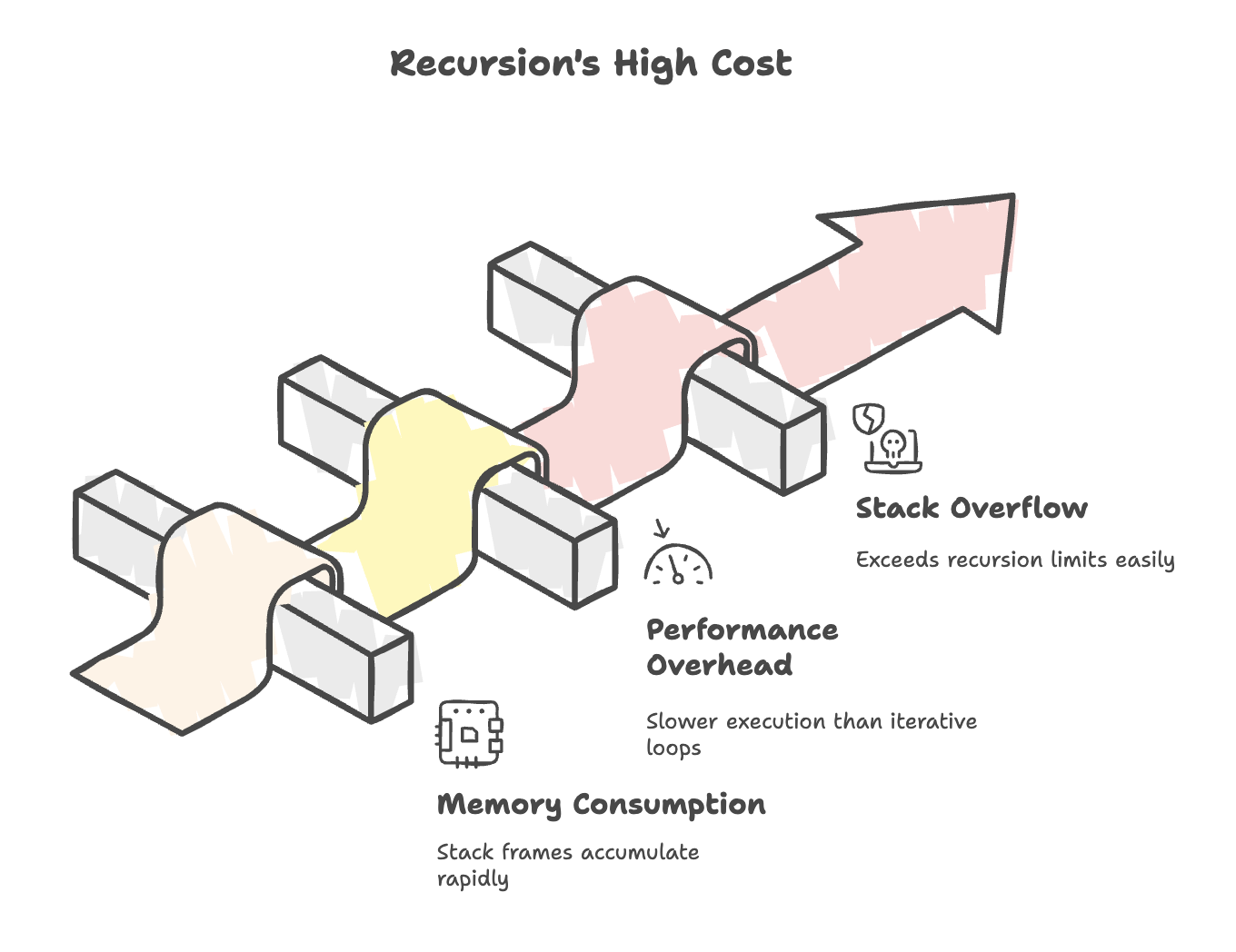
Python restricts the maximum number of recursive calls to prevent excessive memory usage and stack overflow.
Checking the Recursion Limit
import sys
print(sys.getrecursionlimit())
Output:
1000This means Python allows up to 1000 nested function calls by default.
Modifying the Recursion Limit
You can increase the recursion limit if required (with caution):
import sys
sys.setrecursionlimit(10000)
print(sys.getrecursionlimit())
Output:
10000Warning: Increasing the recursion limit too much may cause:
- Stack overflow
- High memory consumption
- Program or system crash
Recursion Using sleep()
You can slow down recursive execution to better understand how recursion works.
Example with Delay
from time import sleep

count = 1

def greet():
    global count
    print("Hello", count)
    count += 1
    sleep(0.02)
    greet()

greet()
Explanation
sleep(0.02)pauses execution for 20 milliseconds.- This helps visualize recursive calls step by step.
- The
globalkeyword allows modification of the global variablecount.
Use of global in Recursion
- Variables inside functions are local by default.
- To modify a global variable inside a recursive function, you must declare it using
global.
global countWithout this declaration, Python treats count as a local variable and raises an error.
Summary
- Recursion involves a function calling itself and must always include a base case to stop execution.
- Python enforces a recursion depth limit (default 1000) to prevent stack overflow and runtime errors.
- Recursive solutions are often clear and elegant, but usually less efficient than iterative approaches.
- Recursion should be used only when it naturally models the problem, such as in tree structures or divide-and-conquer logic.
Written By: Muskan Garg
How is this guide?
Last updated on