
Factorial
What is a Factorial?
The factorial of a non-negative integer n, written as n!, is the product of all positive integers from 1 to n.
Example:
5! = 5 × 4 × 3 × 2 × 1 = 120Mathematical Definition
For any integer n ≥ 1:
n! = 1 × 2 × 3 × ... × nSpecial case:
0! = 1Factorial is a fundamental mathematical concept that helps build logical thinking and is widely used in programming to understand loops, functions, and recursion.
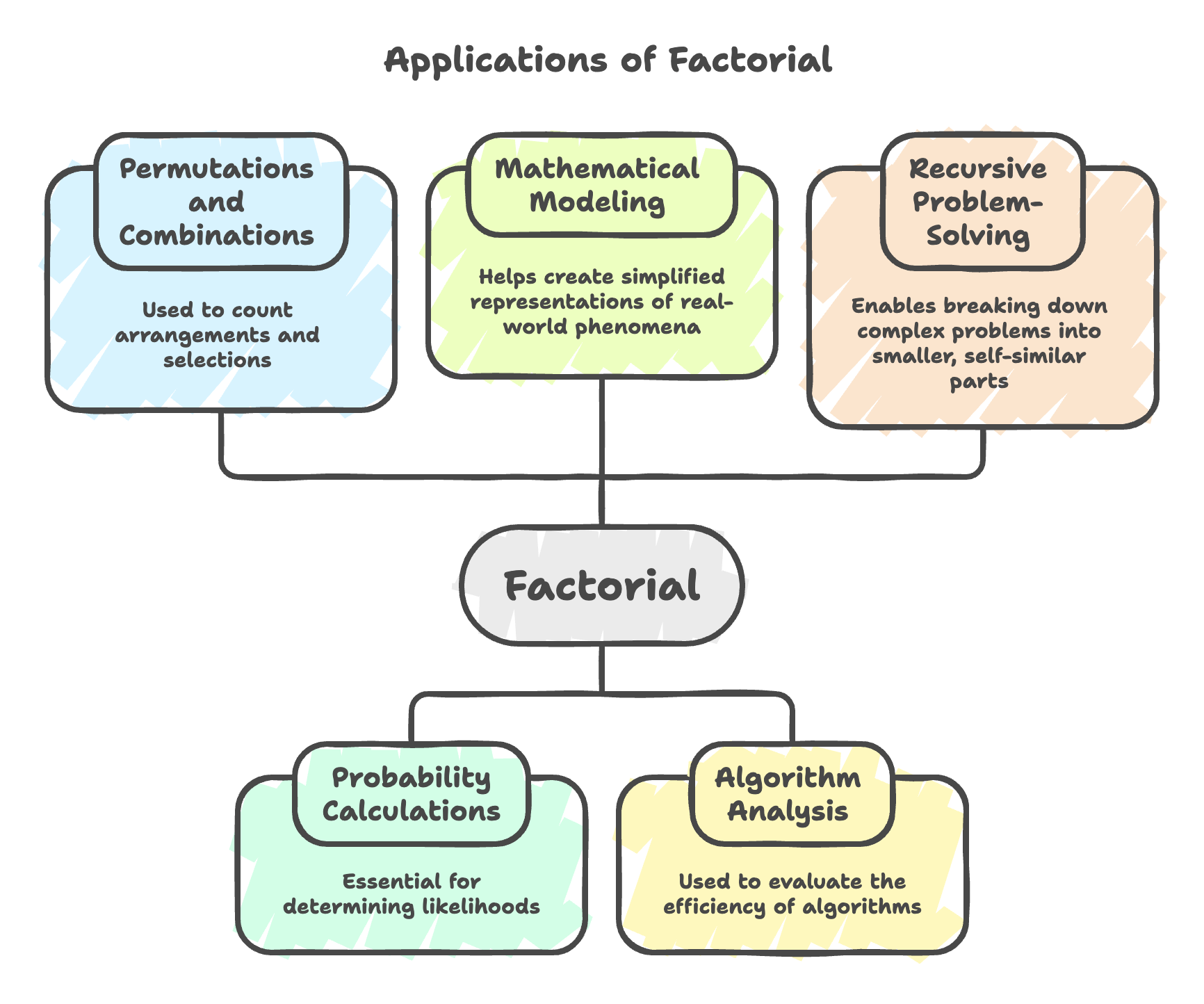
Why Factorial is Important in Programming?
- Strengthens understanding of loops and iteration
- Acts as a stepping stone to recursion
- Commonly used in combinatorics, probability, and algorithm design
- Demonstrates how programs handle large numbers
Implementing Factorial Using a Loop (Iterative Approach)
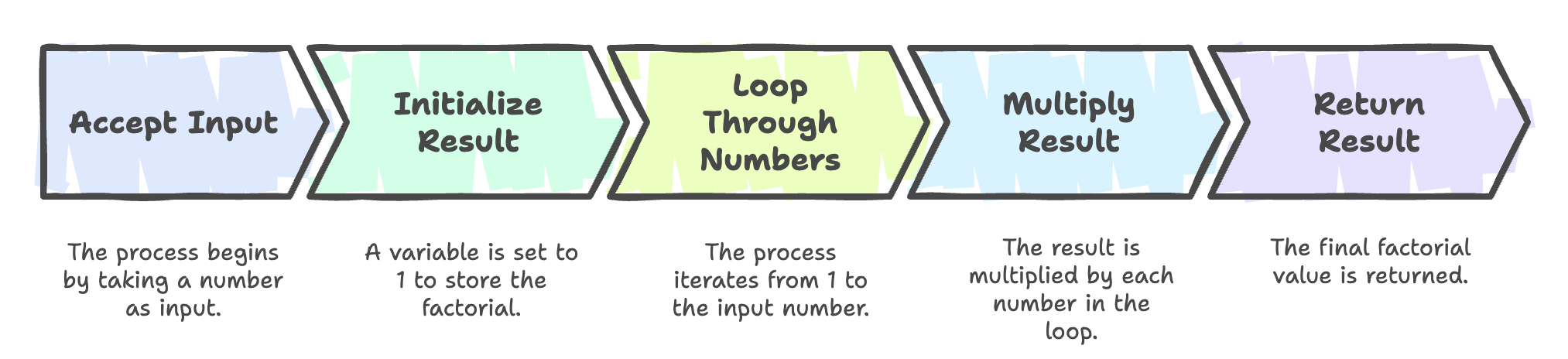
Step-by-Step Logic
- Accept a number
numas input. - Initialize a result variable (
res) to1. - Loop from
1tonum(inclusive). - Multiply
resby each number in the loop. - Return the final result.
Example
def fact(num):
    res = 1
    for i in range(1, num + 1):
        res = res * i
    return res

result = fact(5)
print(result)
Output:
120Here,
-
res = 1Initializes the accumulator for multiplication. -
range(1, num + 1)Ensures all numbers from1tonumare included. -
res = res * iContinuously multiplies values to build the factorial.
More Examples
print(fact(12))Output:
479001600Handling Large Factorials in Python
-
Factorials grow very rapidly (non-linear growth).
-
Example:
20! = 2,432,902,008,176,640,000 -
Python supports arbitrary-precision integers, so it can handle very large factorials such as
100!or even1000!. -
However, extremely large factorials may consume significant memory and time, depending on system limits.
Summary
- Factorial multiplies all positive integers up to a given number.
- It can be implemented easily using a for loop.
- Python handles large factorials efficiently due to dynamic integer sizing.
- Factorial is foundational for understanding loops, functions, and recursion.
- Widely used in mathematics and real-world programming problems.
Written By: Muskan Garg
How is this guide?
Last updated on