
Data Types
1. Introduction
Data types define the type of data a variable can store and how much memory it occupies.
Java is a strongly typed language, which means every variable must have a declared type.
Understanding data types is essential because they determine:
- The memory size required
- The values allowed
- The operations permitted
- How data is stored and processed by the JVM
Java provides two categories of data types:
- Primitive Data Types
- Non-Primitive (Reference) Data Types
This document covers both with detailed explanations and examples.
2. Categories of Data Types in Java
Java data types are divided into:
            Data Types
            /        \
     Primitive     Non-Primitive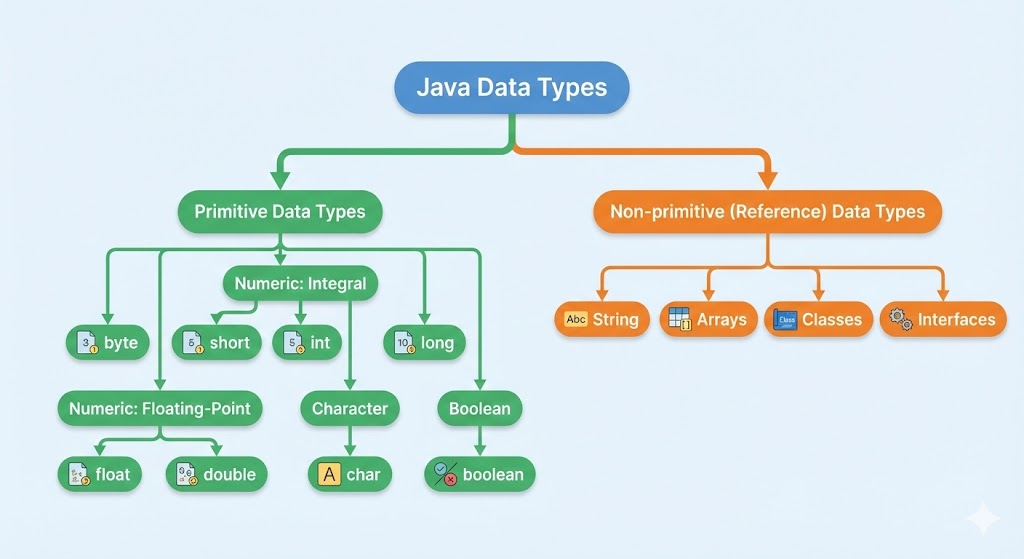
3. Primitive Data Types
Primitive types store simple values and are not objects.
They are pre-defined by Java and stored directly in stack memory (except arrays inside heap).
There are 8 primitive data types:
| Type | Size | Range | Example |
|---|---|---|---|
| byte | 1 byte | -128 to 127 | byte b = 10; |
| short | 2 bytes | -32,768 to 32,767 | short s = 200; |
| int | 4 bytes | -2^31 to 2^31-1 | int x = 50000; |
| long | 8 bytes | -2^63 to 2^63-1 | long l = 900000L; |
| float | 4 bytes | ~7 decimal digits | float f = 10.5f; |
| double | 8 bytes | ~15 decimal digits | double d = 99.99; |
| char | 2 bytes | Single Unicode character | char grade = 'A'; |
| boolean | 1 bit (JVM-dependent) | true or false | boolean isAdmin = true; |
4. Detailed Explanation of Each Primitive Type
4.1 byte
Used for small integers, memory saving in arrays.
byte age = 25;4.2 short
Rarely used, but useful in large arrays to reduce memory.
short temperature = 280;4.3 int
Default choice for integers.
int salary = 75000;4.4 long
Use when integer value exceeds int range.
Must end with L or l.
long population = 7800000000L;4.5 float
Used for fractional values with less precision. Must end with f or F.
float rating = 4.5f;4.6 double
Default for decimal values.
double price = 999.99;4.7 char
Stores a single Unicode character.
char grade = 'A';
char symbol = '#';
4.8 boolean
Stores true or false.
boolean isActive = true;5. Non-Primitive Data Types
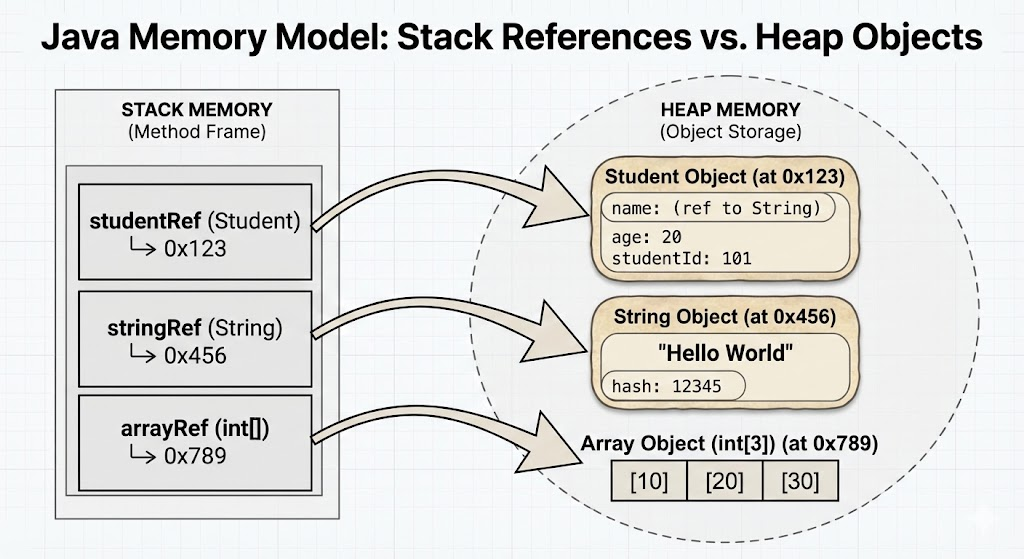
These types refer to objects, not primitive values. They are stored in heap memory, and the variable stores a reference.
Examples include:
- String
- Arrays
- Classes
- Interfaces
- Enums
- Wrapper Classes
5.1 String
String name = "John";Strings are objects in Java, even though they behave like primitives.
5.2 Arrays
int[] numbers = {1, 2, 3, 4};5.3 Classes & Objects
class Student { }
Student s = new Student();
5.4 Wrapper Classes
Every primitive has a corresponding wrapper:
| Primitive | Wrapper |
|---|---|
| byte | Byte |
| short | Short |
| int | Integer |
| long | Long |
| float | Float |
| double | Double |
| char | Character |
| boolean | Boolean |
6. Type Ranges and Memory Usage
Memory allocation helps JVM optimize performance.
Example:
int a = 10;
double b = 20.5;
char c = 'X';
JVM stores these in stack memory with fixed sizes.
Non-primitive example:
String city = "Mumbai";Here, city (reference) is in stack, the actual string object is stored in heap.
7. Type Casting
Sometimes you need to convert one type to another.
7.1 Implicit Casting (Widening)
Small → large type (safe)
byte → short → int → long → float → doubleExample:
int x = 10;
double y = x;  // implicit
7.2 Explicit Casting (Narrowing)
Large → small type (risk of data loss)
double → float → long → int → short → byteExample:
double d = 99.9;
int i = (int) d; // i becomes 99
8. Default Values of Primitive Types (Instance Variables)
Local variables do NOT get default values.
| Type | Default |
|---|---|
| int | 0 |
| double | 0.0 |
| boolean | false |
| char | '\u0000' |
| Object | null |
9. Examples
Primitive Example
int age = 21;
double height = 5.9;
char section = 'A';
boolean isEligible = true;
Non-Primitive Example
String course = "Java Programming";
int[] marks = {85, 90, 78};
Student st = new Student();
10. Common Mistakes
- Using
floatwithoutfsuffix - Using
longwithoutLsuffix - Confusing
charwith String type - Thinking boolean stores 1/0
- Using uninitialized local variables
11. Summary
- Java has 8 primitive and many non-primitive data types.
- Primitive types store values; non-primitives store references.
- Memory for primitives is fixed; objects grow dynamically.
- Type casting allows conversion between types.
- Understanding data types is essential for efficient memory and performance.
Written By: Shiva Srivastava
How is this guide?
Last updated on