
JavaBasics
Naming Conventions
1. Introduction
Naming conventions are standard rules for how we name classes, methods, variables, and other elements in Java.
Even though the compiler does not enforce naming conventions, following them is very important because:
- It makes code easier to read and understand.
- It helps multiple developers work on the same project.
- It matches industry standards and expectations (interviews, real projects).
- It reduces confusion and mistakes in large codebases.
In this document, you will learn the recommended Java naming conventions and see examples of good and bad names.
2. General Rules
Before getting into each Java element, there are some general rules:
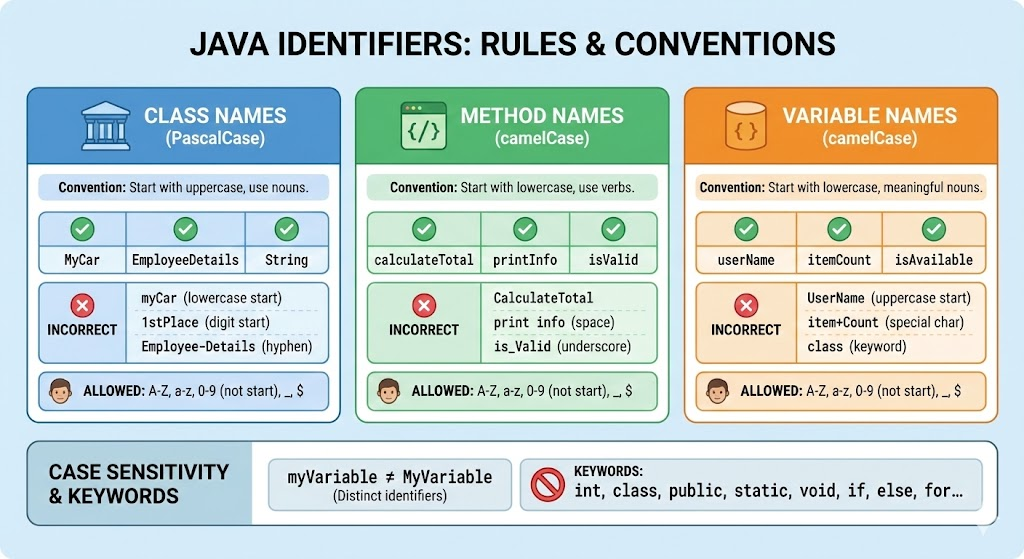
- Java is case-sensitive
studentNameandStudentNameare different identifiers. - Names can contain:
- Letters:
A–Z,a–z - Digits:
0–9 - Symbols:
_(underscore),$(dollar), though$is rarely used by developers.
- Letters:
- Names cannot start with a digit
student1is valid,1studentis not. - Avoid using special characters or spaces in identifiers.
3. Naming Conventions by Element
3.1 Class Names
- Use PascalCase (also called UpperCamelCase).
- Start with an uppercase letter.
- If the name has multiple words, each word starts with a capital letter.
- The name should be a noun or noun phrase.
Examples:
- Good:
Student,BankAccount,OrderService,EmployeeManager - Bad:
student,bank_account,bankaccount,doWorkClass
3.2 Interface Names
- Also use PascalCase.
- Often describe a capability or role.
- Sometimes start with an adjective or noun.
Examples:
- Good:
Serializable,Comparable,Runnable,PaymentProcessor - Bad:
iserializable,iPayment,paymentprocessor
3.3 Method Names
- Use camelCase (lowerCamelCase).
- Start with a verb or verb phrase.
- First word is lowercase, each subsequent word starts with uppercase.
Examples:
- Good:
getName,calculateTotal,printReport,findStudentById - Bad:
GetName,calculate_total,Printreport,do
3.4 Variable and Field Names
- Also use camelCase.
- Names should be descriptive and indicate the purpose of the variable.
- Avoid single-letter names except for very small scopes (like
iin a simple loop).
Examples:
- Good:
studentName,totalAmount,maxScore,isActive - Acceptable in loops:
i,j,k - Bad:
sname,t,x1,StudentName(starts with uppercase like a class)
3.5 Constant Names (static final)
- Use ALL_UPPERCASE letters.
- Separate words with underscores.
- Used for values that do not change.
Examples:
- Good:
MAX_STUDENTS,PI,DEFAULT_TIMEOUT_MS - Bad:
MaxStudents,maxStudents,defaulttimeout
3.6 Package Names
- Use all lowercase.
- No underscores, no uppercase letters.
- Typically use reversed domain name + project structure.
Examples:
com.example.schoolorg.mycompany.project.servicecom.learnjava.basics
Bad examples:
com.Example.Schoolcom.example_Schoolcom.example.SchoolProject
3.7 Enum Names and Enum Constants
- Enum type name: PascalCase (like a class).
- Enum constants: ALL_UPPERCASE with underscores.
Example:
enum DayOfWeek {
    MONDAY,
    TUESDAY,
    WEDNESDAY,
    THURSDAY,
    FRIDAY,
    SATURDAY,
    SUNDAY
}
4. Summary Table
| Element | Style | Example |
|---|---|---|
| Package | lowercase | com.example.myapp |
| Class | PascalCase | StudentRecord |
| Interface | PascalCase | PaymentService |
| Method | camelCase | calculateTotal() |
| Variable/Field | camelCase | studentCount |
| Constant (final) | UPPER_SNAKE | MAX_RETRY_COUNT |
| Enum Type | PascalCase | OrderStatus |
| Enum Constant | UPPER_SNAKE | PENDING, COMPLETED |
5. Examples: Good vs Bad Names
Variables and Methods
// Good
int studentAge;
double totalSalary;
boolean isRegistered;

void printReport() { }
double calculateInterest(double principal, double rate) { ... }

// Bad
int s;
double ts;
boolean flag;

void Printreport() { }      // starts with uppercase, inconsistent
double calc(double p, double r) { ... }  // unclear meaning
Classes and Interfaces
// Good
class BankAccount { }
class EmployeeService { }
interface Shape { }
interface Drawable { }

// Bad
class bankaccount { }
class employee_service { }
interface IShape { }        // prefix "I" is not a common Java convention
interface drawable { }
Constants
// Good
public static final int MAX_USERS = 100;
public static final double PI = 3.14159;

// Bad
public static final int maxUsers = 100;
public static final double Pi = 3.14159;
6. Small Complete Example
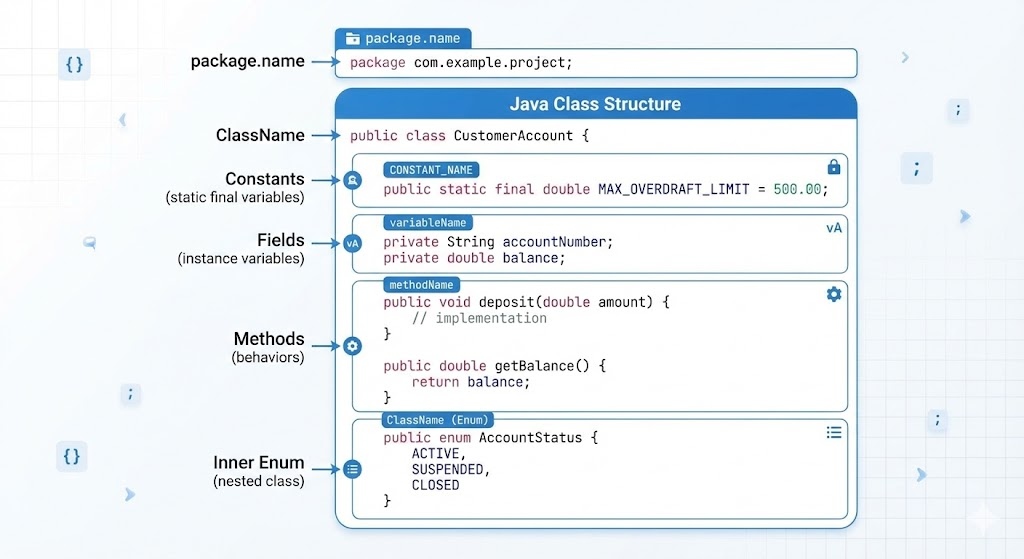
package com.example.schoolmanagement;

public class StudentRecord {

    // Constants
    public static final int MAX_SUBJECTS = 6;

    // Fields (variables)
    private String studentName;
    private int rollNumber;
    private double averageScore;

    // Constructor
    public StudentRecord(String studentName, int rollNumber) {
        this.studentName = studentName;
        this.rollNumber = rollNumber;
    }

    // Getter method
    public String getStudentName() {
        return studentName;
    }

    // Setter method
    public void setStudentName(String studentName) {
        this.studentName = studentName;
    }

    public double calculatePercentage() {
        return (averageScore / MAX_SUBJECTS);
    }
}
This example shows:
- Package in lowercase:
com.example.schoolmanagement - Class name in PascalCase:
StudentRecord - Constant in UPPER_SNAKE_CASE:
MAX_SUBJECTS - Fields in camelCase:
studentName,rollNumber,averageScore - Methods in camelCase:
getStudentName,setStudentName,calculatePercentage
7. Common Mistakes to Avoid
- Using class-style names for variables (e.g.,
StudentNameinstead ofstudentName). - Mixing naming styles in the same project.
- Using unclear one-letter names in large scopes.
- Using uppercase letters in package names.
- Not using constants for fixed values and hardcoding them multiple times in code.
8. Summary
- Java naming conventions are not enforced by the compiler, but they are extremely important for readability and professionalism.
- Use PascalCase for classes, interfaces, and enums.
- Use camelCase for methods, variables, and fields.
- Use UPPER_SNAKE_CASE for constants.
- Use lowercase for package names.
- Consistency is key: follow the same pattern throughout your project.
Written By: Shiva Srivastava
How is this guide?
Last updated on