
Maven Terminologies
Learn the core Maven vocabulary (archetype, groupId, artifactId, version, packaging, dependencies, goals and repositories) and how the GAV coordinates identify every artifact.
Maven conversations use a small set of words again and again. You already met most of them in the archetype:generate command. Once these terms are clear, Maven documentation, build logs and Stack Overflow answers become much easier to read. Some of them we have used already, and the rest are covered in detail in the coming lessons.
The terms from our first command
| Term | Meaning | In our project |
|---|---|---|
| Archetype | A template that defines the starting structure of a Maven project | maven-archetype-quickstart (standalone JAR) or maven-archetype-webapp (web app, WAR) |
| groupId | The organisation or group that owns the project. Follows the reverse domain name convention | com.telusko (from telusko.com) |
| artifactId | The name of this project (module). Must be unique inside the group | telusko-app |
| version | Which release of the project this is | 1.0-SNAPSHOT |
| packaging | The format the build produces | jar (the default) or war |
groupId: who owns it
Companies own a domain name, and domain names are unique worldwide. Reversing it (telusko.com becomes com.telusko) gives a unique prefix that also works as a Java package name. Large organisations add more parts, for example org.springframework.boot or com.telusko.payments.
artifactId: what it is
The artifactId is the project's name. The file produced by the build is named after it, followed by the version:
target/telusko-app-1.0-SNAPSHOT.jarUse lowercase letters, digits and hyphens. Avoid spaces.
version: SNAPSHOT or release
| Version | Meaning |
|---|---|
1.0-SNAPSHOT | Work in progress. The code is still changing. A SNAPSHOT can be rebuilt many times under the same version |
1.0, 1.0.0, 2.3.1 | A release. Final and fixed. Once a release version is published, it should never change |
New projects start as a SNAPSHOT. When the team is ready to deliver to the client or production, the version becomes a release number such as 1.0.0, and the next development cycle starts as 1.1.0-SNAPSHOT.
Small correction to the video
The video describes the release version as "1.0 release". In Maven you simply write 1.0 (or 1.0.0). There is no -RELEASE suffix in your own versions, although some older libraries such as Spring 4 used one in their names.
packaging: jar or war
If you do not specify <packaging>, Maven uses jar. A web project created from the webapp archetype sets <packaging>war</packaging>, and you will build one in Maven Web App.
GAV: the address of every artifact
Together, groupId, artifactId and version are called the coordinates or GAV of a project. They identify an artifact uniquely across the whole world, the same way a full postal address identifies one house.
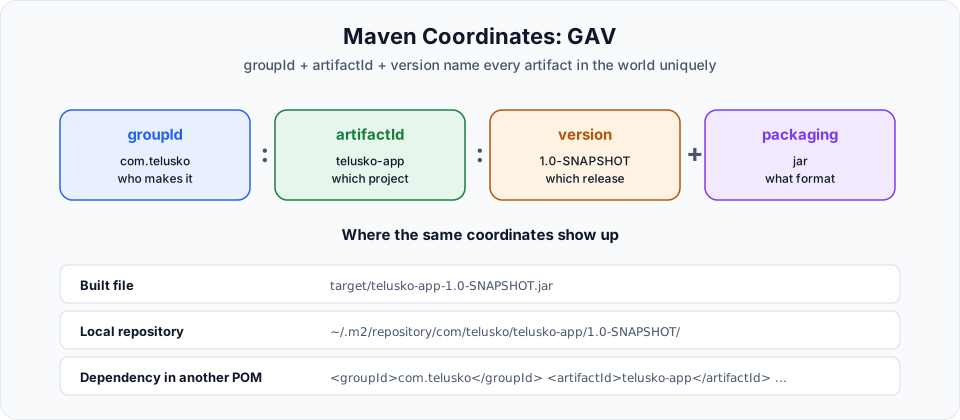
You often see them written on one line, separated by colons:
com.telusko:telusko-app:1.0-SNAPSHOT
org.springframework:spring-core:6.2.8
An artifact is any file Maven produces or uses, identified by its coordinates: your JAR, a library JAR, a WAR, a plugin.
The terms coming next
| Term | Short meaning | Full lesson |
|---|---|---|
| Dependency | A library (someone else's code, packaged as a JAR) that your project needs, such as Spring, Hibernate, JUnit or a Redis client. Declared in pom.xml | Maven Dependencies |
| Goal | One unit of work Maven performs, such as compiling or running tests. Part of the build lifecycle: clean, compile, test, package | Maven Goals |
| Repository | A storage place for artifacts. Maven downloads dependencies from the central repository into a local repository on your machine. Companies also run private remote repositories | Maven Repositories |
| POM | Project Object Model, the pom.xml file where you tell Maven everything above | Maven POM.xml file |
| Plugin | The code that actually does the work behind each goal, for example the compiler plugin or the Surefire test plugin | Maven Goals |
A useful way to connect them: you describe your project's coordinates and dependencies in the POM, you ask Maven to run goals, the plugins do the work, and every artifact involved is fetched from or stored in a repository.
Try It Yourself
- Open
telusko-app/pom.xmland write down its full GAV in thegroupId:artifactId:versionform. - Search Maven Central at central.sonatype.com for
junit-jupiterand write down its GAV for the latest version. - Decide the GAV you would use for a payments library at a company called
acme.in, version 2 still in development. - Explain to a friend in two sentences the difference between
1.0-SNAPSHOTand1.0.
Official references
Written By: Shramik Masti
How is this guide?
Last updated on
Maven Java Project Linux VM
Generate the same Maven Java project on the Amazon Linux VM, inspect it with ls and tree, and understand the Maven standard directory layout that every project follows.
Maven Goals
Set the Java version in pom.xml, then run mvn compile, mvn clean, mvn test, mvn package and mvn clean package, and see exactly what each one creates in the target folder.