
Introduction
AI Engineering is a distinct field that enables the development of intelligent applications by integrating pre-trained AI models, fine-tuning them to specific needs, and leveraging specialized skills and tools to provide businesses with customized solutions and competitive advantages.
AI Engineering emerged as a distinct role with OpenAI's release of ChatGPT in 2022, making AI technology accessible to normal users and transforming software engineers into AI engineers.
AI Engineering vs Traditional Software Engineering
Traditional Software Development
Building software involves solving a problem through a defined process following the Software Development Life Cycle (SDLC):
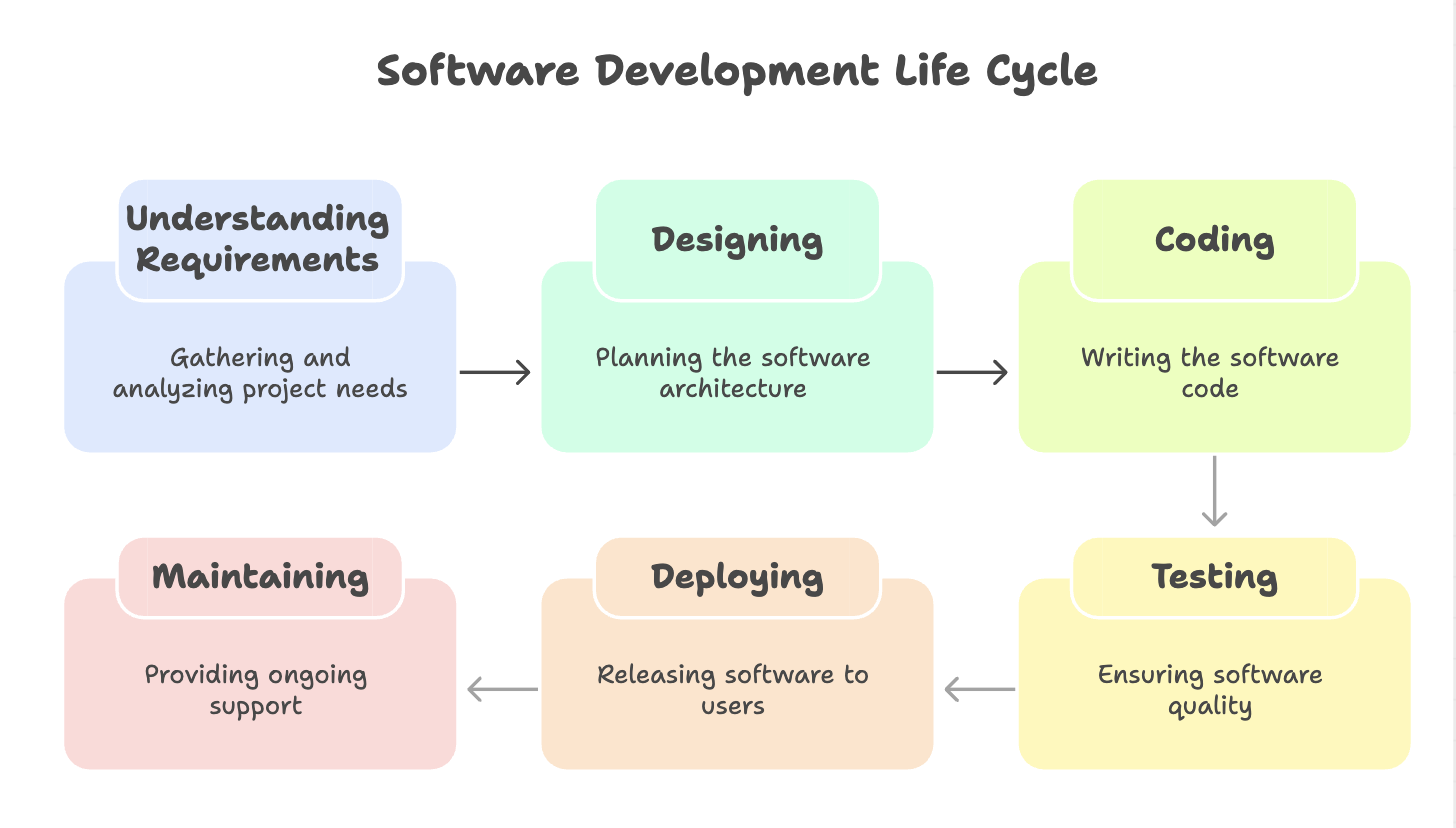
In traditional development, developers manually specify logic to produce desired outcomes.
AI Engineering Approach
AI Engineering enables AI systems to generate logic from learned data, allowing users to define desired outcomes without manually specifying the logic.
| Traditional Development | AI Engineering |
|---|---|
| Logic is manually coded by developers | Logic is generated by AI models from learned data |
| Static rules and conditions | Dynamic, data-driven responses |
| Developer defines every decision path | User defines the outcome; AI determines the path |
What Does an AI Engineer Do?
AI Engineering focuses on:
- Integrating existing pre-trained AI models into applications
- Fine-tuning models for specific use cases and business needs
- Understanding limitations of AI models (hallucinations, biases)
- Injecting domain-specific data into models for accurate, tailored responses
- Deploying and maintaining AI-powered applications
The focus is on integration and application - not building models from scratch.
Key Components of AI Engineering
| Component | Purpose |
|---|---|
| Prompt Engineering | Crafting effective inputs to guide AI model responses |
| Embeddings | Converting text/data into numerical vector representations |
| Vector Databases | Storing and retrieving embeddings for efficient similarity search |
| RAG (Retrieval-Augmented Generation) | Injecting specific documents into AI models to ensure accurate, context-aware responses |
| Fine-Tuning | Training pre-trained models to behave in a specific way (e.g., teaching style, tone) |
| LLMOps | Specialized DevOps practices for deploying and managing AI/LLM applications |
How AI Engineering Solves Real Problems
Example - Company Chatbot
A company wants a chatbot that answers questions about its products accurately.
Problem: General AI models (like ChatGPT) don't know company-specific information and may hallucinate (generate incorrect answers).
AI Engineering Solution:
- Inject company-specific documents into the model using RAG
- Convert documents into embeddings and store in a vector database
- Use prompt engineering to guide the model's behavior
- The chatbot now provides accurate, company-specific responses
Fine-Tuning and Proprietary Models
- AI Engineering allows companies to fine-tune pre-trained models to behave in specific ways.
- This enables creating proprietary models tailored to business needs.
- Building models from scratch is not necessary but creating custom fine-tuned models can provide a competitive edge.
Knowledge Requirements for AI Engineers
| Required (Basics) | Not Required (In-Depth) |
|---|---|
| Neural networks (conceptual understanding) | Building neural networks from scratch |
| Machine learning fundamentals | Advanced mathematical proofs |
| How models learn from data | Research-level model architecture design |
| Software development skills | PhD-level deep learning expertise |
The primary focus is on integration and application, not on building foundational models.
AI, Machine Learning, and Deep Learning - Relationship
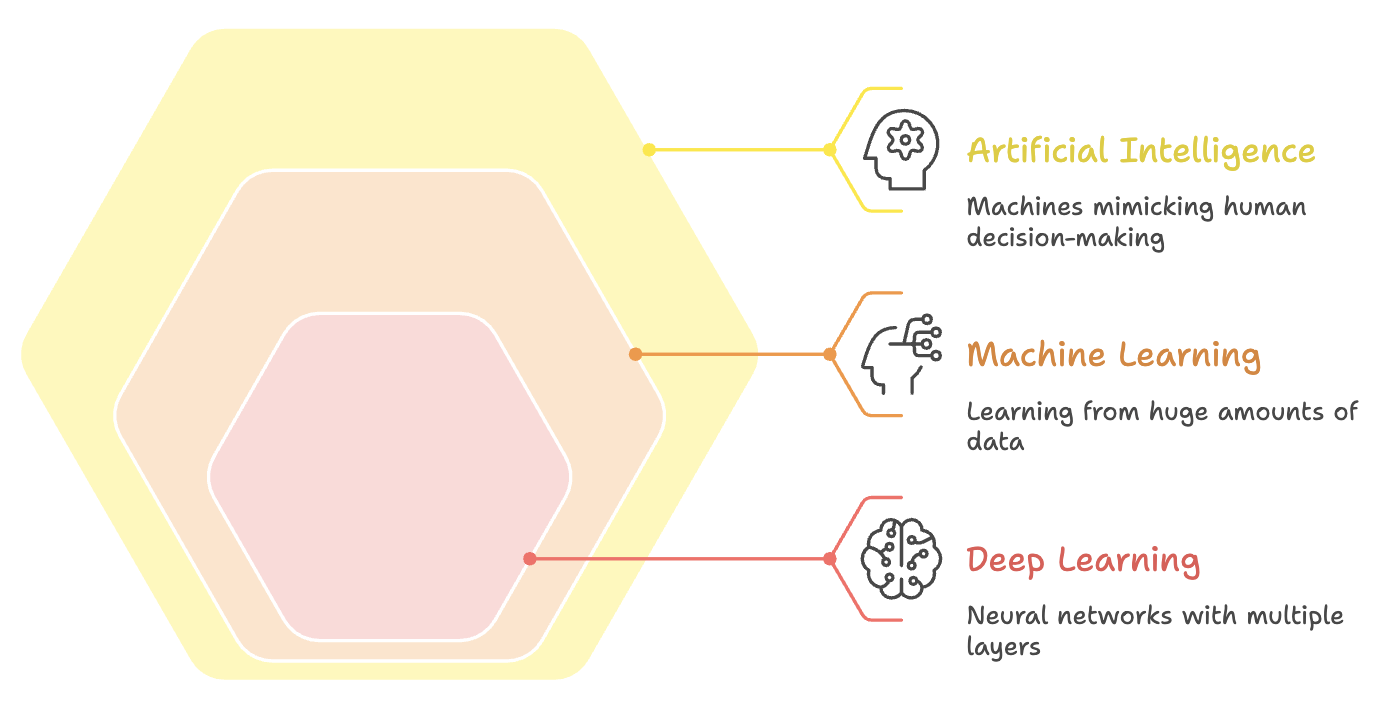
- AI - Broadest concept (enabling machines to mimic human decision-making)
- Machine Learning - Subset of AI (uses large datasets to train models)
- Deep Learning - Subset of ML (utilizes neural networks with multiple layers)
Business Value of AI Engineering
- Provides competitive advantage through customized, intelligent solutions
- Keeps customers satisfied with AI-powered products and experiences
- AI integration costs are typically passed on to customers willing to pay for enhanced products
- Companies can differentiate by fine-tuning models to their specific domain
Summary
- AI Engineering is about integrating and fine-tuning existing AI models, not building them from scratch.
- It transforms traditional software development by enabling systems to generate logic from data rather than requiring manual coding.
- Core skills include prompt engineering, embeddings, vector databases, RAG, and fine-tuning.
- AI Engineering provides measurable business value through customization and intelligent automation.
- The future belongs to developers who leverage AI, they will have a significant advantage in creating advanced applications.
Written By: Muskan Garg
How is this guide?
Last updated on