
Vector Embeddings and Tokens
AI models can only process numerical representations, they cannot understand text, images, or audio directly. To bridge this gap, input text is first broken into tokens, then converted into vector embeddings (numerical representations) that capture meaning, context, and relationships between words.
What Are Vector Embeddings?
Vector embeddings are a way to represent words (or text) as numerical values in a high-dimensional space. They allow AI models to understand relationships, context, and semantic meaning between words.
Core Idea: Words with similar meanings are mapped close together in vector space, while dissimilar words remain far apart.
Example
- "cat", "kitty", "feline" → clustered close together
- "cat" and "automobile" → far apart in vector space
This enables searching for "kitty" and finding results about "cat" even without an exact text match.
How AI Processes Text
The pipeline from text input to AI response:
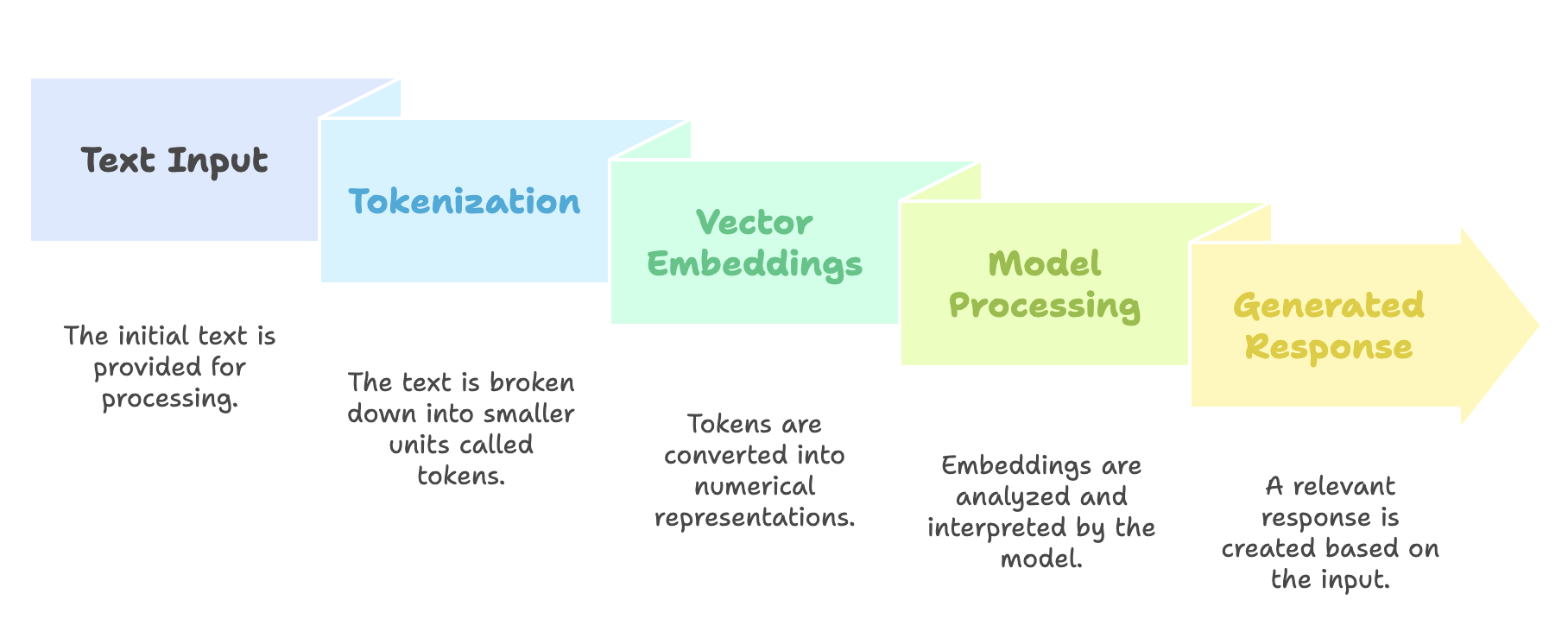
- Tokenization - Text is broken into tokens (subword units)
- Embedding - Each token is converted into a numerical vector
- Processing - The model operates on these vectors to generate output
Tokenization
What Are Tokens?
A token is the smallest unit of text processed by an AI model.
A token is not always a complete word.
Depending on the tokenizer, a token can be:
- A word
- Part of a word
- A character
- A punctuation symbol
Understanding Tokenization
Tokenization is the process of breaking text into smaller units called tokens.
Example:
Artificial IntelligenceMay be tokenized as:
["Artificial", "Intelligence"]or
["Art", "ificial", "Intelligence"]Example:
googlingMay become:
["go", "ogling"]Key Facts
| Aspect | Detail |
|---|---|
| Token-to-word ratio | 1 token ≈ 3/4 of a word |
| 100 tokens | ≈ 75 words on average |
| Word vs token count | A 7-word sentence can produce ~11 tokens |
| Cost implication | More tokens = higher API cost |
How Tokenization Works
- Common words may be a single token (e.g., "hello" → 1 token)
- Unfamiliar or compound words are split into parts (e.g., "googling" → "go" + "ogling")
- Different models (e.g., GPT-4) use different tokenization algorithms, producing varying token counts from the same text
Why It Matters
- Cost: OpenAI charges per token (both input and output)
- Context limits: Models have maximum token limits per request
- Optimization: Understanding tokenization helps optimize prompts for efficiency
Vector Embeddings
Why Not Single Numbers?
Representing each word as a single number is insufficient because:
- Vocabularies are massive (hundreds of thousands of words)
- Multiple languages exist
- Words have nuanced relationships that a single dimension cannot capture
Solution: Use multi-dimensional vectors (e.g., 1536 or 3072 dimensions) to represent each token, capturing rich semantic relationships.
Dimensionality
The number of dimensions determines how much nuance and context the embedding can capture.
| Model | Dimensions | Use Case |
|---|---|---|
| OpenAI text-embedding-small | 1536 | Cost-effective, general purpose |
| OpenAI text-embedding-large | 3072 | Higher accuracy, more detail |
| Other models (e.g., some open-source) | 1024 | Varies by provider |
Higher dimensionality = more accuracy but increased cost and computation.
Dimensionality Reduction
High-dimensional embeddings can be reduced to lower dimensions (e.g., 2D or 3D) for visualization and analysis purposes, though some information is lost.
Semantic Understanding with Embeddings
Context-Aware Relationships
Embeddings capture that words can have different meanings based on context:
- "Python" (programming language) vs "Python" (snake) → different vector positions based on surrounding context
Word Grouping
Words with similar meanings appear closer together.
Words with different meanings appear farther apart.
Example Animals, cluster together.:
Dog
Cat
Lion
Tiger
Technology terms, form different clusters:
Software
Code
Programming
Algorithm
Search Example
User searches:
kittyDocument contains:
catTraditional search:
No matchEmbedding-based search:
Match foundbecause the vectors are semantically similar.
Analogical Reasoning
Vector embeddings enable mathematical operations on word meanings:
king - man + woman = queenThis demonstrates that embeddings capture gender relationships, hierarchies, and other semantic patterns through arithmetic operations on vectors.
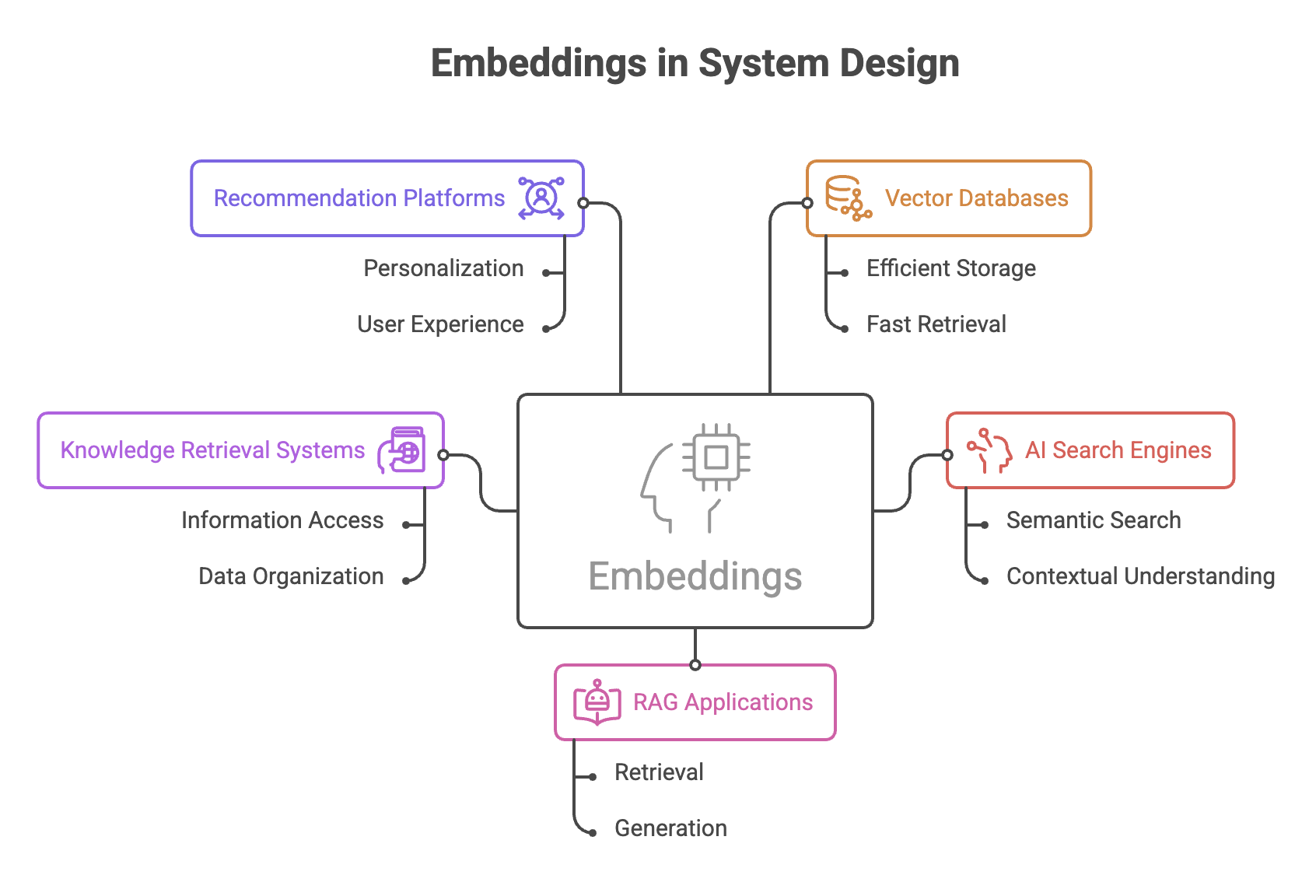
Applications of Embeddings
| Application | Description |
|---|---|
| Search | Rank results by semantic relevance to a query |
| Clustering | Group text strings by similarity |
| Recommendations | Suggest items with related text content |
| Anomaly Detection | Identify outliers with low relatedness |
| Diversity Measurement | Analyze similarity distributions |
| Classification | Classify text by most similar label |
Creating Embeddings via API
You can generate embeddings using API clients (curl, Insomnia, Postman) or programmatically (Python, Java, JavaScript).
API Request Structure
{
  "input": "Your text here",
  "model": "text-embedding-3-large"
}
Required Components
| Component | Purpose |
|---|---|
| Endpoint | Embedding API URL |
| Authorization | API Key |
| Input Text | Text to convert |
| Model | Embedding model |
Response
The API returns a vector (array of floating-point numbers) representing the input text in the specified dimensional space.
{
  "embedding": [
    0.123,
    -0.456,
    0.789,
    ...
  ]
}
The array may contain:
- 1536 numbers
- 3072 numbers
depending on the selected model.
Tokens vs Embeddings
| Aspect | Tokens | Embeddings |
|---|---|---|
| Purpose | Break text into units | Represent meaning numerically |
| Output | Text fragments | Numerical vectors |
| Used For | Model input processing | Semantic understanding |
| Example | "Artificial" | [0.23, -0.41, 0.88, ...] |
| Impact | Cost and context limits | Search and reasoning quality |
Summary
-
AI models cannot process raw text directly; text must first be converted into numerical representations.
-
Tokenization breaks text into smaller units called tokens, which are the fundamental inputs consumed by language models.
-
Token count affects API cost, processing time, and context window limitations.
-
Vector embeddings convert tokens, words, or entire documents into high-dimensional numerical vectors that capture semantic meaning.
-
Similar concepts are positioned close together in vector space, enabling semantic search and intelligent retrieval.
-
Higher-dimensional embeddings generally provide richer semantic understanding but require additional storage and computation.
-
Embeddings power critical AI capabilities such as semantic search, recommendations, clustering, anomaly detection, and Retrieval-Augmented Generation (RAG).
-
Understanding tokens and embeddings is fundamental for designing efficient, scalable, and intelligent AI-powered systems.
Official Document Reference: OpenAI Embeddings Guide
Written By: Muskan Garg
How is this guide?
Last updated on