
Introduction
A comprehensive introduction to Spring AI
What is Spring AI?
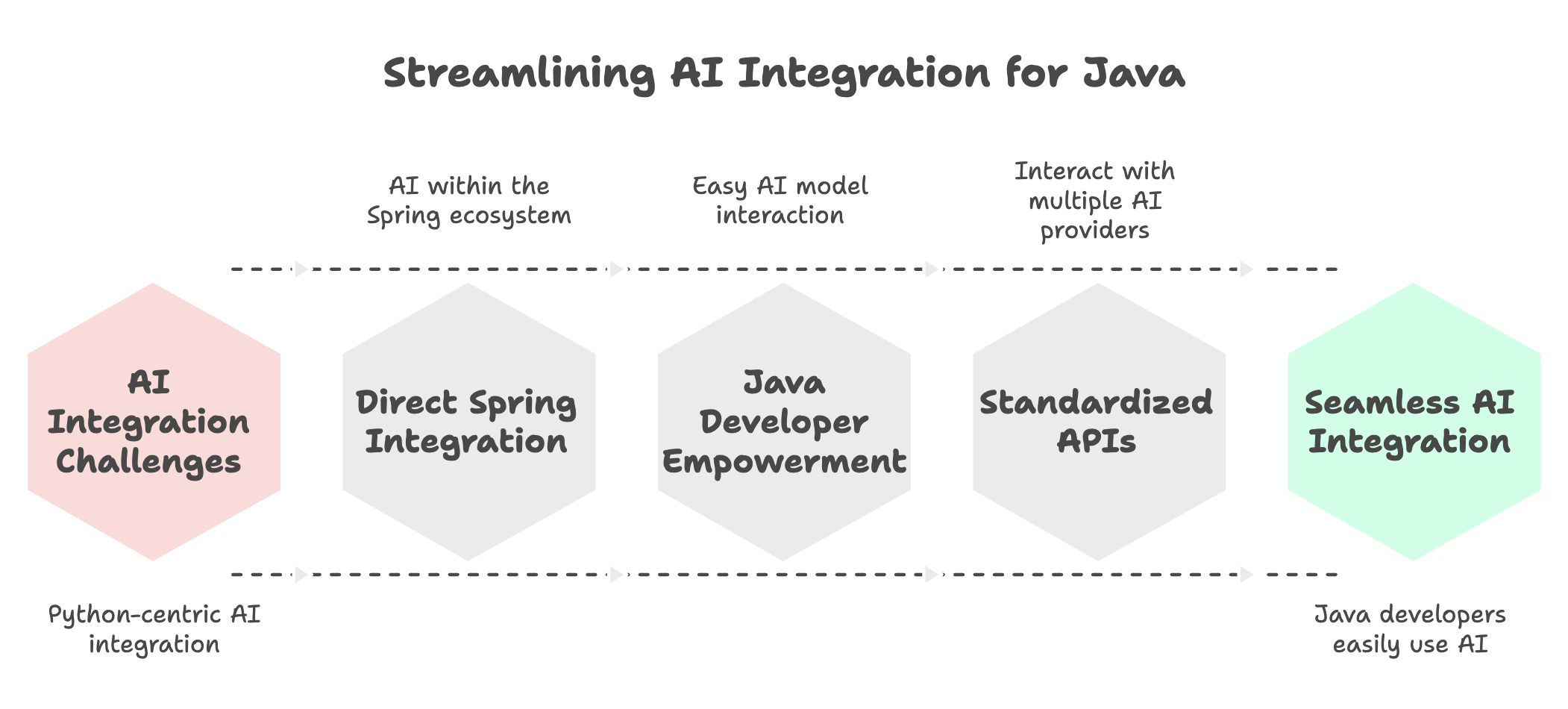
Spring AI is an application framework for AI engineering that enables developers to integrate Artificial Intelligence features into existing Java-based applications. It provides a seamless way to connect Large Language Models (LLMs) with Java applications without requiring Python dependencies or migration to Python ecosystems.
Core Purpose
Spring AI bridges the gap between enterprise Java applications and Generative AI models, allowing developers to:
- Add AI capabilities to existing products
- Connect applications with Generative AI services
- Feed enterprise data to GenAI models
- Leverage AI features using familiar Spring Boot patterns
Key Concepts
Large Language Model (LLM) Integration
Spring AI acts as a Java abstraction layer that connects your application to various LLM providers:
Java Application ← Spring AI → LLM Models (OpenAI, Anthropic, Ollama)Data Flow:
- Frontend sends a prompt
- Spring Boot receives the request
- Spring AI communicates with AI models
- LLM processes the prompt
- Response is returned to the user
AI Engineering Framework
Spring AI is inspired by LangChain but designed specifically for the Java ecosystem. It focuses on making AI integration straightforward for Java developers familiar with Spring framework conventions.
What is an LLM (Large Language Model)?
A Large Language Model (LLM) is an AI model trained on massive datasets that can:
- Understand natural language
- Generate human-like responses
- Answer questions
- Summarize text
- Generate code
- Translate languages
Supported AI Models
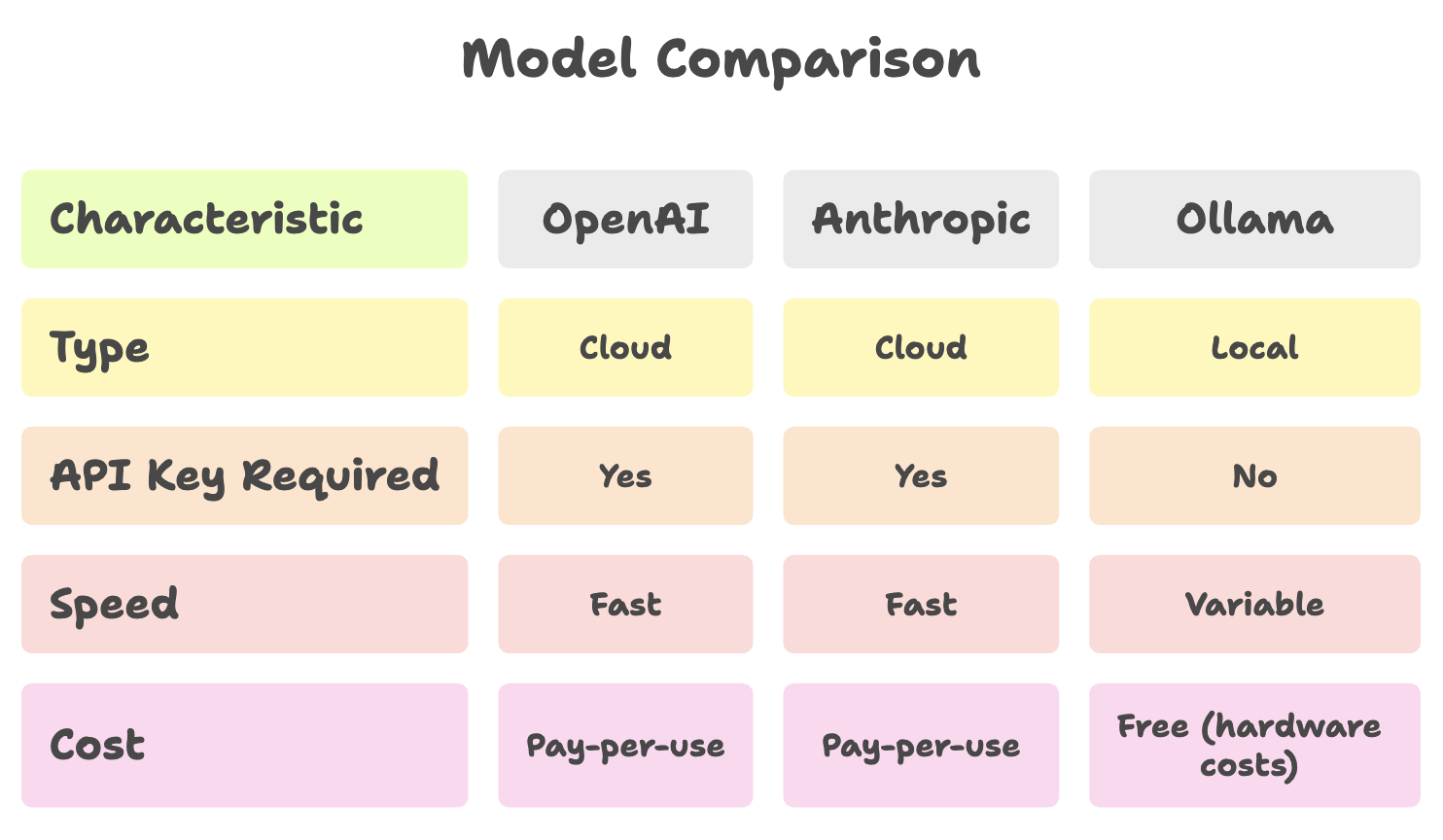
Spring AI supports a wide range of AI models across different providers:
1. Cloud-Based Models
OpenAI
- Model: GPT-4o, GPT-4, GPT-3.5
- Requirement: API Key
- Use Case: Advanced language understanding and generation
Anthropic
- Model: Claude (Claude 3 Opus, Sonnet, Haiku)
- Requirement: API Key
- Use Case: Long-context conversations and analysis
Other Cloud Providers
- Google Vertex AI
- Azure OpenAI
- Amazon Bedrock
- Mistral AI
- Stability AI
2. Local Models
Ollama
- Models: Gemma 2, Llama, Deepseek, and others
- Requirement: Local installation (no API key needed)
- Use Case: Privacy-sensitive applications, offline capabilities
- Advantage: No cloud costs, complete data control
Core Features
1. Chat Completion
The primary feature demonstrated in Spring AI:
- One-time interaction: User sends prompt, receives response
- Not continuous chat: Each request is independent (no conversation context by default)
- Simple flow: Input → Process → Output
Example Flow:
User Input: "Explain Spring AI"
     ↓
Spring AI Framework
     ↓
LLM Model (GPT-4o/Claude/Gemma)
     ↓
Generated Response
2. Multiple Provider Support
Test and compare responses from different models:
- Compare response quality
- Compare response speed
- Choose best model for specific use cases
3. Flexible Configuration
- Configure providers through Spring properties
- Switch models without code changes
- Control parameters (temperature, max tokens, etc.)
Architecture Overview
Framework Components
Integration Layer
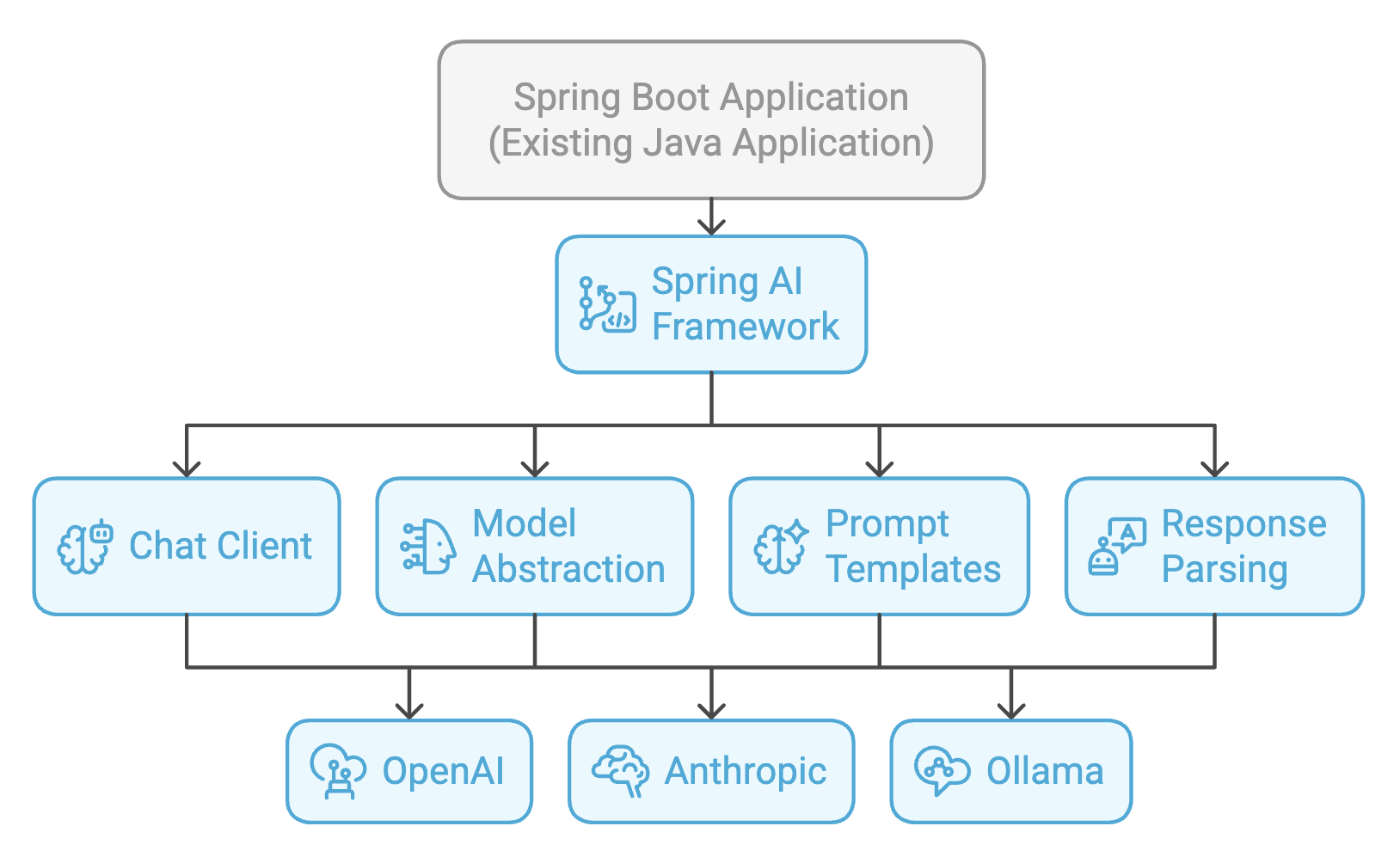
Spring AI provides:
- Abstraction: Unified interface across different LLM providers
- Configuration: Spring-native configuration management
- Error Handling: Consistent error handling and retry mechanisms
- Streaming: Support for streaming responses
- Type Safety: Strong typing for requests and responses
Enterprise AI Integration Benefits
1. No Python Migration Required
- Keep existing Java codebase
- Use familiar Spring patterns
- Leverage Java ecosystem tools
2. Production-Ready
- Built on battle-tested Spring Boot
- Enterprise support available
- Security and compliance features
3. Data Strategy
- Bring your enterprise data to GenAI
- Maintain data governance
- Control data flow and privacy
4. Scalability
- Leverage Spring's scalability features
- Load balancing and clustering support
- Cloud-native deployment options
Summary
Spring AI is a powerful framework that:
- Connects Java applications with LLM models
- Eliminates the need for Python migration
- Provides enterprise-grade AI integration
- Supports multiple providers (OpenAI, Anthropic, Ollama)
- Enables easy comparison and switching between models
- Maintains familiar Spring Boot patterns
- Focuses on practical AI engineering for Java developers
Written By: Muskan Garg
How is this guide?
Last updated on