
Prompt Engineering
Prompt Engineering is the practice of crafting effective prompts to obtain accurate, predictable, and specific outputs from AI language models. The quality of the response directly depends on the effectiveness of the prompt.
AI is like a very knowledgeable person who provides accurate answers when asked specific questions, but may give excessive or irrelevant information if not guided properly.
Why Prompt Engineering Matters
| Bad Prompting | Good Prompting |
|---|---|
| Uncertain, unpredictable outputs | Predictable, specific outputs |
| Excessive or irrelevant information | Focused, relevant responses |
| Generic answers | Tailored, actionable results |
Even as large language models improve, well-crafted prompts consistently produce better results than vague ones.
Four Components of a Good Prompt
Every effective prompt should include these key components:
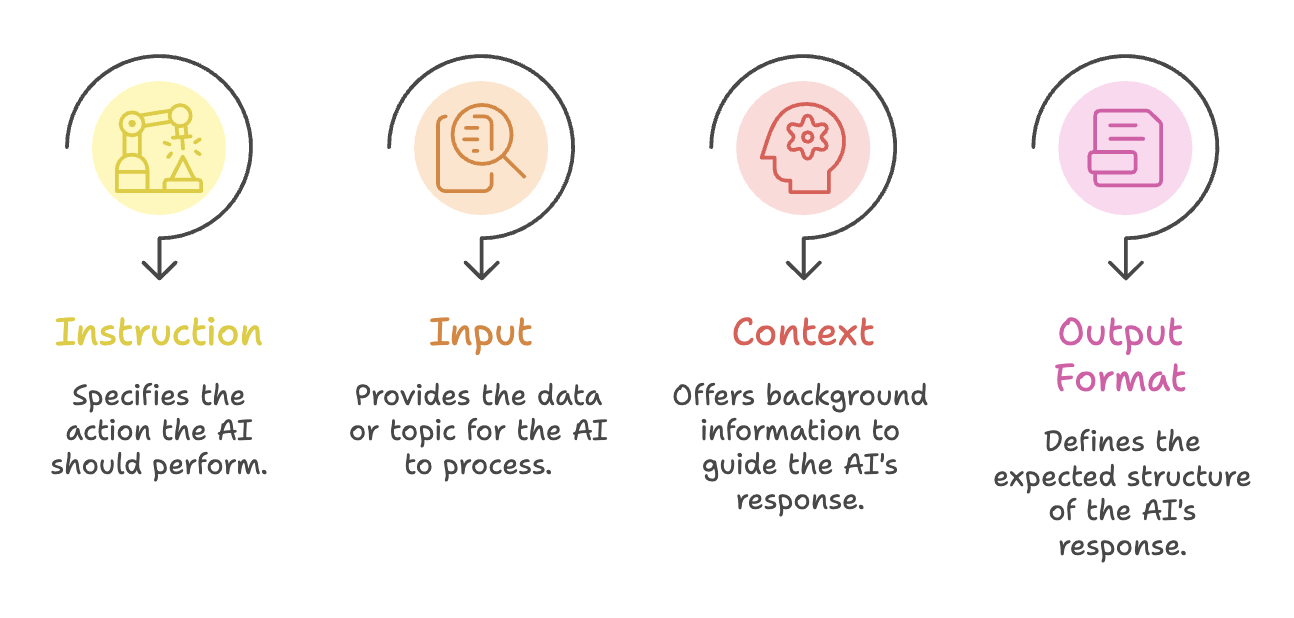
| Component | Purpose | Example |
|---|---|---|
| Instruction | What you want the AI to do | "Explain," "Generate," "Compare," "Summarize" |
| Input | The specific data or topic to work with | A code snippet, a paragraph, a question |
| Context | Background information to guide the response | User's expertise level, project details, constraints |
| Output Format | Expected structure of the response | JSON, table, bullet points, paragraph |
Example
Instruction: Compare the following frontend frameworks
Input: React, Angular, Vue
Context: I am a junior developer choosing my first framework
Output: Present as a markdown table with columns for learning curve,
        community size, and job market demand
Adding more context results in better output - a well-contextualized prompt provides the AI with necessary information to generate accurate and relevant responses.
Prompt Engineering Techniques
Zero-Shot Prompting
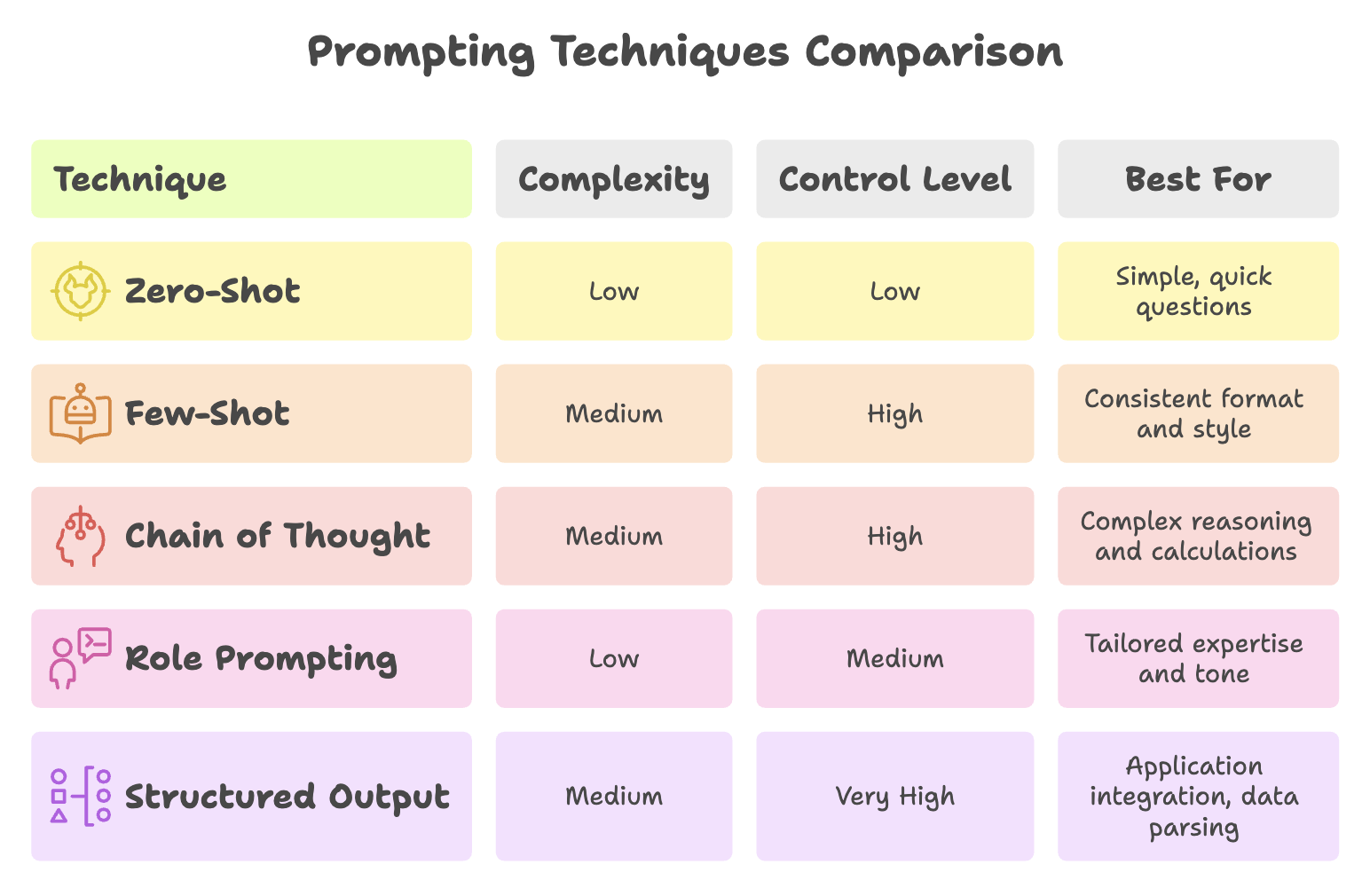
The simplest approach - a clear, concise instruction without any examples.
| Aspect | Detail |
|---|---|
| How it works | Relies solely on clear instructions to guide the response |
| When to use | Simple questions, quick answers, straightforward tasks |
| Limitation | Least controlled; output format may vary |
Example:
What is a smart contract in blockchain?Few-Shot Prompting
Providing examples of the desired output format along with the prompt, so the model learns the expected pattern.
| Aspect | Detail |
|---|---|
| How it works | Give 2-3 examples of the desired output before asking the actual question |
| When to use | When you need a specific format, structure, or style |
| Benefit | Guarantees consistent, structured outputs matching the desired format |
Example - Generating Commit Messages:
Generate a commit message for the following change.

Examples:
- Change: Added user authentication → Commit: feat: add user authentication with JWT tokens
- Change: Fixed navbar alignment → Commit: fix: resolve navbar alignment issue on mobile
- Change: Updated README → Commit: docs: update README with installation instructions

Now generate for:
- Change: Added login button to the homepage
Output: feat: add login button to homepage
Few-shot prompting establishes a pattern that the AI follows, ensuring consistent and predictable outputs.
Chain of Thought (CoT) Prompting
Forces the AI to break down complex problems into step-by-step reasoning, similar to showing work in mathematics.
| Aspect | Detail |
|---|---|
| How it works | Ask the model to "think step by step" or show its reasoning |
| When to use | Complex calculations, logical problems, multi-step reasoning |
| Benefit | Increases accuracy and allows verification of the logic path |
Example:
A store has 45 apples. They sell 12 in the morning and receive
a shipment of 30 in the afternoon. How many apples do they have now?

Think step by step.
Output:
Step 1: Start with 45 apples
Step 2: Sell 12 → 45 - 12 = 33 apples
Step 3: Receive 30 → 33 + 30 = 63 apples
Answer: 63 apples
Adding "think step by step" slows down the model's response, improving accuracy by forcing it to reason through each stage rather than jumping to an answer.
Role Prompting
Assigning a specific persona or role to the AI, causing it to adjust technical depth, terminology, and examples to match that role's expertise.
| Aspect | Detail |
|---|---|
| How it works | Prefix the prompt with a role assignment |
| When to use | When you need responses tailored to a specific expertise level or perspective |
| Benefit | Transforms the depth and style of responses |
Example:
You are a senior blockchain architect. Explain smart contracts
to a junior developer using relatable analogies.
The AI will adjust its response to be technically informed but accessible, using analogies appropriate for a beginner.
Structured Output Prompting
Specifying the exact output format (JSON, CSV, table, list) to get parseable, predictable data.
| Aspect | Detail |
|---|---|
| How it works | Explicitly state the desired format in the prompt |
| When to use | AI-powered applications that need machine-readable data |
| Benefit | Predictable, parseable output rather than free-form text |
Example:
List the top 3 JavaScript frameworks with their release year
and primary use case. Return the result as JSON.
Output:
[
  { "name": "React", "year": 2013, "useCase": "UI component libraries" },
  { "name": "Angular", "year": 2016, "useCase": "Enterprise SPAs" },
  { "name": "Vue", "year": 2014, "useCase": "Progressive web apps" }
]
Structured output prompting is critical for AI-powered applications that need to parse and process AI responses programmatically.
Context Optimization
Embedding contextual information about the user's background, goals, and expertise level enables AI to generate tailored responses rather than generic answers.
| Context Element | Impact |
|---|---|
| User's expertise level | Adjusts complexity of explanation |
| Project constraints | Focuses on relevant solutions |
| Desired outcome | Aligns response with goals |
| Industry/domain | Uses appropriate terminology |
Summary
- Prompt Engineering is a critical skill for AI Engineers, the quality of output directly depends on the quality of the prompt.
- A good prompt has four components: Instruction, Input, Context, and Output Format.
- Zero-shot is simplest but least controlled; few-shot ensures format consistency through examples.
- Chain of Thought improves accuracy on complex problems by forcing step-by-step reasoning.
- Role prompting tailors responses to specific expertise levels and perspectives.
- Structured output is essential for building AI-powered applications that need predictable, parseable data.
- Always provide clear instructions, relevant context, and specify the expected output format for best results.
Written By: Muskan Garg
How is this guide?
Last updated on