
Advanced Abstraction Concepts
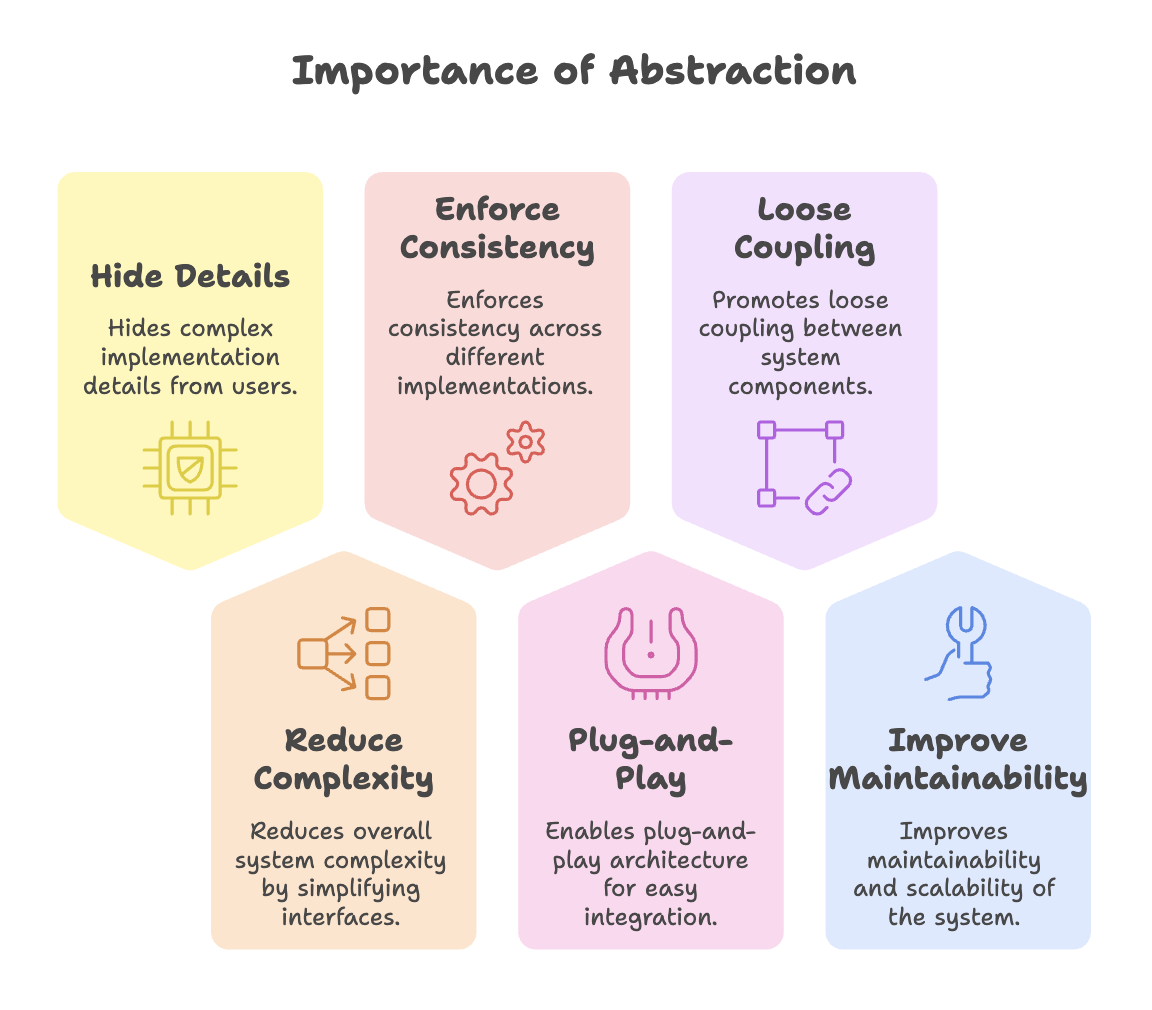
Advanced abstraction concepts helps to design flexible, scalable, and maintainable systems by defining clear contracts, enforcing consistency, and controlling how components interact with each other. Python achieves this through Abstract Base Classes (ABC), advanced abstract method patterns, and well-defined object hierarchies.
Multiple Abstract Methods in One Class
An abstract class in Python can define more than one abstract method. This allows the abstract class to specify multiple requirements that every concrete subclass must fulfill.
Why This Is Needed
- To define a complete contract for subclasses
- To ensure all required behaviors are implemented
- To avoid partially implemented services
Example
from abc import ABC, abstractmethod

class PaymentGateway(ABC):

    @abstractmethod
    def pay(self, amount):
        pass

    @abstractmethod
    def refund(self, amount):
        pass
Key Rule
A subclass must implement all abstract methods, otherwise object creation is not allowed.
class RazorPay(PaymentGateway):
    def pay(self, amount):
        print(f"Paying {amount} using RazorPay")

    def refund(self, amount):
        print(f"Refunding {amount} using RazorPay")
Abstract Properties (@property + @abstractmethod)
In addition to abstract methods, Python also supports abstract properties. These are useful when you want to enforce the presence of an attribute rather than a method.
Why Abstract Properties Are Needed
- To enforce read-only attributes
- To guarantee that subclasses expose certain data
- To define computed attributes as part of an interface
Example
from abc import ABC, abstractmethod

class Employee(ABC):

    @property
    @abstractmethod
    def salary(self):
        pass
Implementation
class Developer(Employee):
    @property
    def salary(self):
        return 60000
If the property is not implemented, instantiation will fail.
Why Python Doesn’t Have True Interfaces
Unlike Java or C#, Python does not have a separate interface keyword.
Reasons
- Python is dynamically typed
- Python supports duck typing (behavior over type)
- Enforcing strict interfaces is often unnecessary
How Python Solves This
Python uses Abstract Base Classes (ABC) to provide interface-like behavior.
Comparison
| Java Interface | Python Equivalent |
|---|---|
| interface keyword | ABC class |
| method declarations only | abstract methods |
| strict typing | flexible typing |
➡️ In Python, ABC + abstractmethod = Interface
Method Resolution Order (MRO) in Abstract Inheritance
MRO defines the order in which Python searches for methods in a class hierarchy.
Why MRO Matters?
- Multiple inheritance scenarios
- Abstract class hierarchies
- Understanding which method gets executed
Example
from abc import ABC, abstractmethod

class A(ABC):
    @abstractmethod
    def show(self):
        pass

class B(A):
    def show(self):
        print("B show")

class C(B):
    pass

obj = C()
obj.show()
Output
B showMRO Order
C → B → A → ABC → objectDifference: Abstraction vs Encapsulation
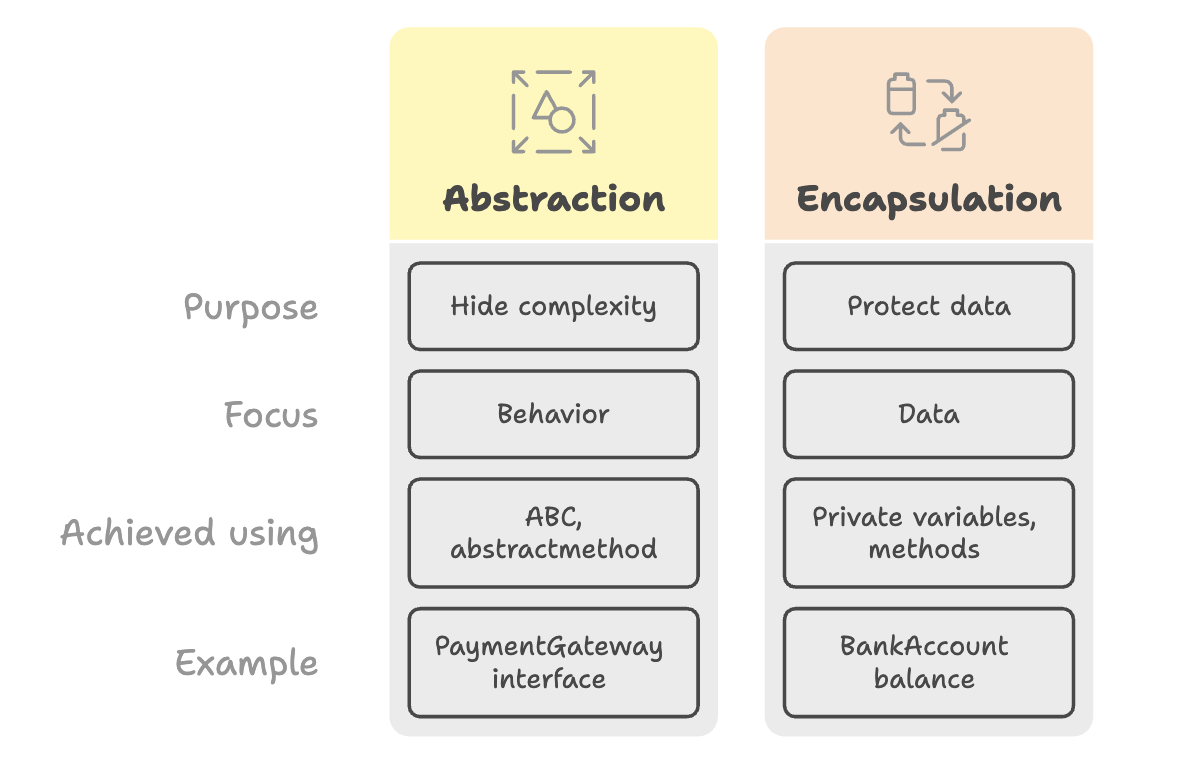
Although both are used to manage complexity, abstraction and encapsulation serve different purposes.
Abstraction
- Focuses on what an object does
- Hides implementation details
- Achieved using abstract classes and interfaces
Encapsulation
- Focuses on how data is protected
- Hides internal state
- Achieved using access control and methods
Example
class BankAccount:
    def __init__(self, balance):
        self.__balance = balance  # encapsulation

    def get_balance(self):
        return self.__balance
➡️ Abstraction defines what operations exist, encapsulation controls how data is accessed.
Summary
- Abstract classes can define multiple abstract methods to enforce a complete contract.
- Abstract properties ensure consistent attribute access across implementations.
- Python uses ABCs as interface-like structures instead of true interfaces.
- MRO controls method lookup order in abstract inheritance hierarchies.
- Abstraction hides behavior complexity by exposing essential operations.
- Encapsulation hides data and internal implementation to protect objects.
Written By: Muskan Garg
How is this guide?
Last updated on