
Operator Overloading
What is Operator Overloading?
Operator overloading in Python allows developers to redefine the behavior of operators (such as +, >, ==) for user-defined classes.
This enables objects to interact using operators in a natural and intuitive way, just like built-in data types.
Operator overloading allows the same operator to perform different operations depending on the types of operands, which is a practical example of polymorphism.
Polymorphism Through Operators
Python already uses operator overloading internally.
Example: + Operator
a = 5
b = 6
c = a + b
print(c)
Output
11Here, + performs integer addition.
a = '5'
b = '6'
c = a + b
print(c)
Output
56Here, the same + operator performs string concatenation.
✔️ Same operator
✔️ Different behavior
➡️ Polymorphism in action
Behind the Scenes: Magic (Dunder) Methods
In Python, operators are just method calls.
Example: Integer Addition
a = 5
b = 6

c = a.__add__(b)
print(c)
Output
11This proves:
a + b == a.__add__(b)Key Insight
intis a class- Integers are objects
- Operators call special (dunder) methods
The __str__() Method
- Returns a string representation of an object
- Automatically called when an object is printed
a = 5
print(a.__str__())
Output
5By default, Python provides a basic implementation, but we can override it for custom classes.
Custom Class Without Operator Overloading
Creating an Account Class
class Account:
    def __init__(self, name, balance):
        self.name = name
        self.balance = balance
If we print an object now:
print(user1)We would get a memory address, not meaningful data.
Overriding __str__() for Readable Output
class Account:
    def __init__(self, name, balance):
        self.name = name
        self.balance = balance

    def __str__(self):
        return f'{self.name} : {self.balance}'
Usage
user1 = Account('navin', 1000)
user2 = Account('kiran', 2000)

print(user1)
print(user2)
Output
navin : 1000
kiran : 2000- Improves readability
- Helps debugging
- Makes objects user-friendly
Overloading the + Operator with __add__()
Why Overload +?
To define domain-specific logic, such as:
- Combining balances
- Merging objects
Example: Combining Two Accounts
class Account:
    def __init__(self, name, balance):
        self.name = name
        self.balance = balance

    def __str__(self):
        return f'{self.name} : {self.balance}'

    def __add__(self, other):
        return Account('combined', self.balance + other.balance)
Usage
user1 = Account('navin', 1000)
user2 = Account('kiran', 2000)

combined = user1 + user2

print(user1)
print(user2)
print(combined)
Output
navin : 1000
kiran : 2000
combined : 3000
+now works with Account objects, not just numbers.
Overloading Comparison Operators (>, <, ==)
Example: Who Pays the Bill?
class Account:
    def __init__(self, name, balance):
        self.name = name
        self.balance = balance

    def __str__(self):
        return f'{self.name} : {self.balance}'

    def __add__(self, other):
        return Account('combined', self.balance + other.balance)

    def __gt__(self, other):
        return self.balance > other.balance
Usage
user1 = Account('navin', 1000)
user2 = Account('kiran', 2000)

if user1 > user2:
    print("navin pays the bill")
else:
    print("kiran pays the bill")
Output
kiran pays the bill- Custom logic
- Clean syntax
- Real-world meaning
Common Operator Overloading Methods
| Operator | Method |
|---|---|
+ | __add__(self, other) |
- | __sub__() |
* | __mul__() |
> | __gt__() |
< | __lt__() |
== | __eq__() |
print() | __str__() |
Summary
- In Python, operators such as
+,>, and==are implemented internally using special (magic) methods, also known as dunder methods. - Operator overloading allows developers to define or modify how operators behave for user-defined classes, enabling objects to interact naturally using standard operators.
- Magic methods like
__add__(),__gt__(), and__str__()act as a bridge between Python’s built-in operators and custom class logic. - Operator overloading demonstrates polymorphism, where the same operator performs different actions depending on the type of objects involved.
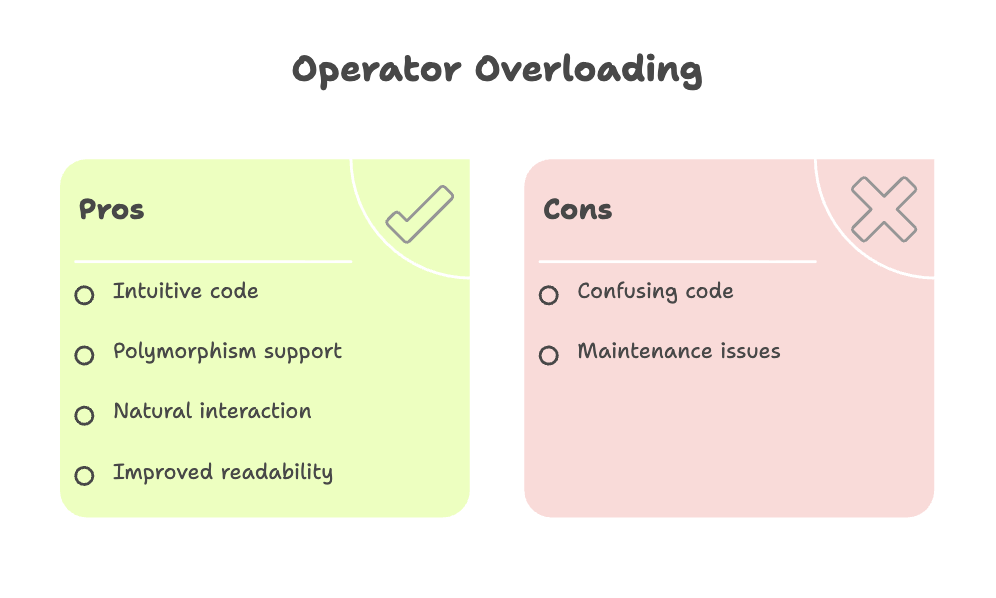
- When used thoughtfully, operator overloading improves code readability, expressiveness, and usability.
Written By: Muskan Garg
How is this guide?
Last updated on