
Polymorphism and Duck Typing
What is Polymorphism?
Polymorphism means “many forms”.
In Python, polymorphism allows the same method or function name to behave differently depending on the object that is passed to it.
Instead of checking an object’s type, Python focuses on what the object can do.
In simple terms:
Different objects can respond to the same method call in different ways.
Polymorphism in Python is Behavior-Based
Unlike some statically typed languages, Python does not require inheritance or strict type matching to achieve polymorphism.
Python supports polymorphism through:
- Dynamic typing
- Duck typing
As long as an object has the required methods or attributes, it can be used.
3. Duck Typing - The Core Idea
Duck typing follows this famous principle:
“If it looks like a duck and quacks like a duck, it is a duck.”
In Python:
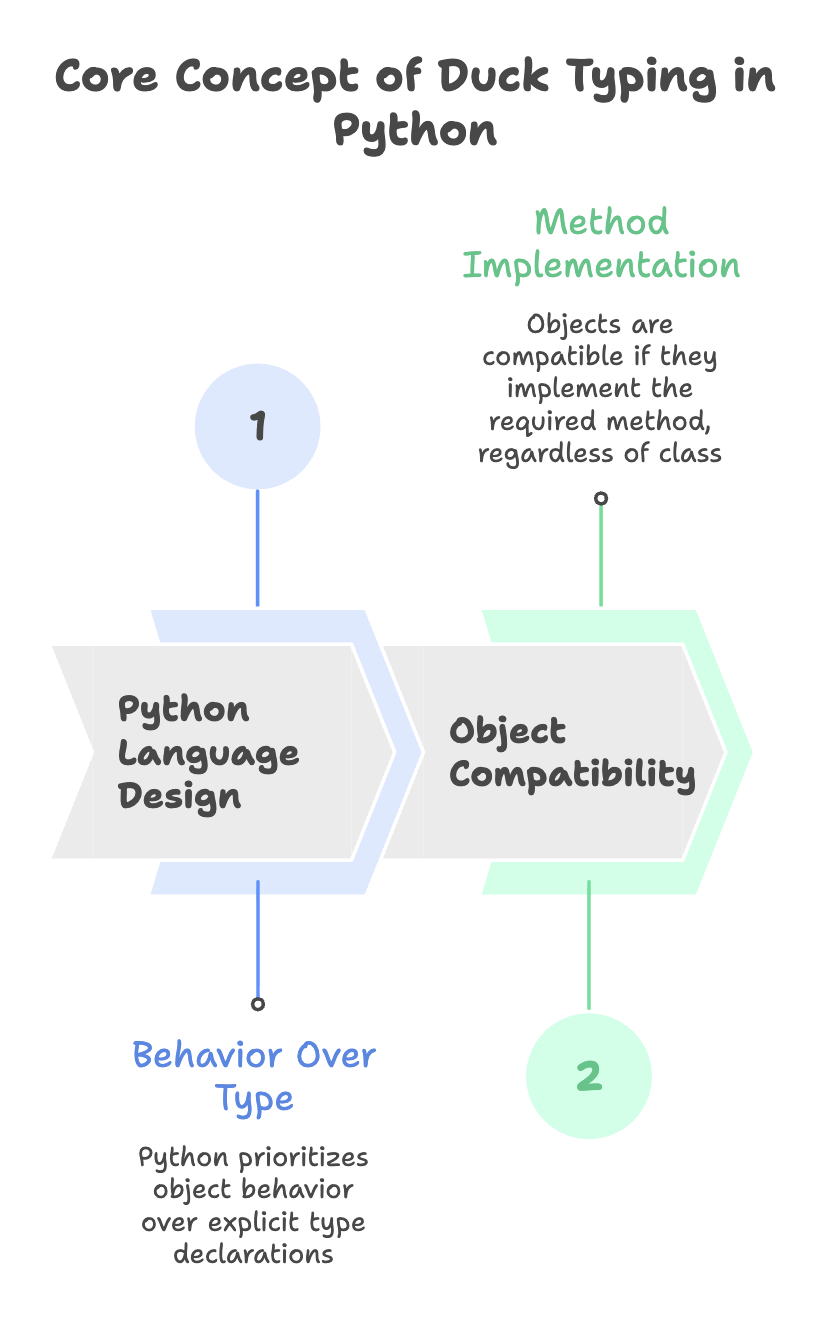
- The actual class or type of an object does not matter
- What matters is whether the object implements the required behavior (methods)
Key Rule:
✔️ If an object has the required method → it works
❌ If it does not → Python raises an error
4. Understanding with an Example
Classes with Similar Behavior
class Laptop:        # duck
    def build(self):
        print("Laptop builds")

class Desktop:       # crow
    def build(self):
        print("Desktop builds")

class Tablet:
    def open_pdf(self):
        print("Opening PDF")
Here:
LaptopandDesktopboth have a build() methodTabletdoes not have abuild()method
A Class That Uses Any “Machine”
class Alien:
    def code(self, machine: Laptop):
        print("Alien building...")
        machine.build()
Note:
- The type hint
machine: Laptopis not enforced at runtime - Python will only check whether
machine.build()exists
Object Usage and Output
asus_rog = Laptop()
beast = Desktop()
lenevo_tab = Tablet()

muskan = Alien()
Case 1: Laptop object
muskan.code(asus_rog)Output:
Alien building...
Laptop builds
✔️ Works because Laptop has build()
Case 2: Desktop object
muskan.code(beast)Output:
Alien building...
Desktop builds
✔️ Works even though Desktop is a different class
✔️ Because it also has build()
This is duck typing in action
Case 3: Tablet object
muskan.code(lenevo_tab)Output:
AttributeError: 'Tablet' object has no attribute 'build'❌ Fails because Tablet does not implement build()
Why This Is Polymorphism?
- The same method call:
machine.build()-
Different implementations:
-
Laptop → Laptop builds
-
Desktop → Desktop builds
-
-
Same interface, different behavior.
-
This is runtime polymorphism driven by duck typing.
Python prioritizes behavior over type. Objects are compatible only if they implement the required method, regardless of their class.
-
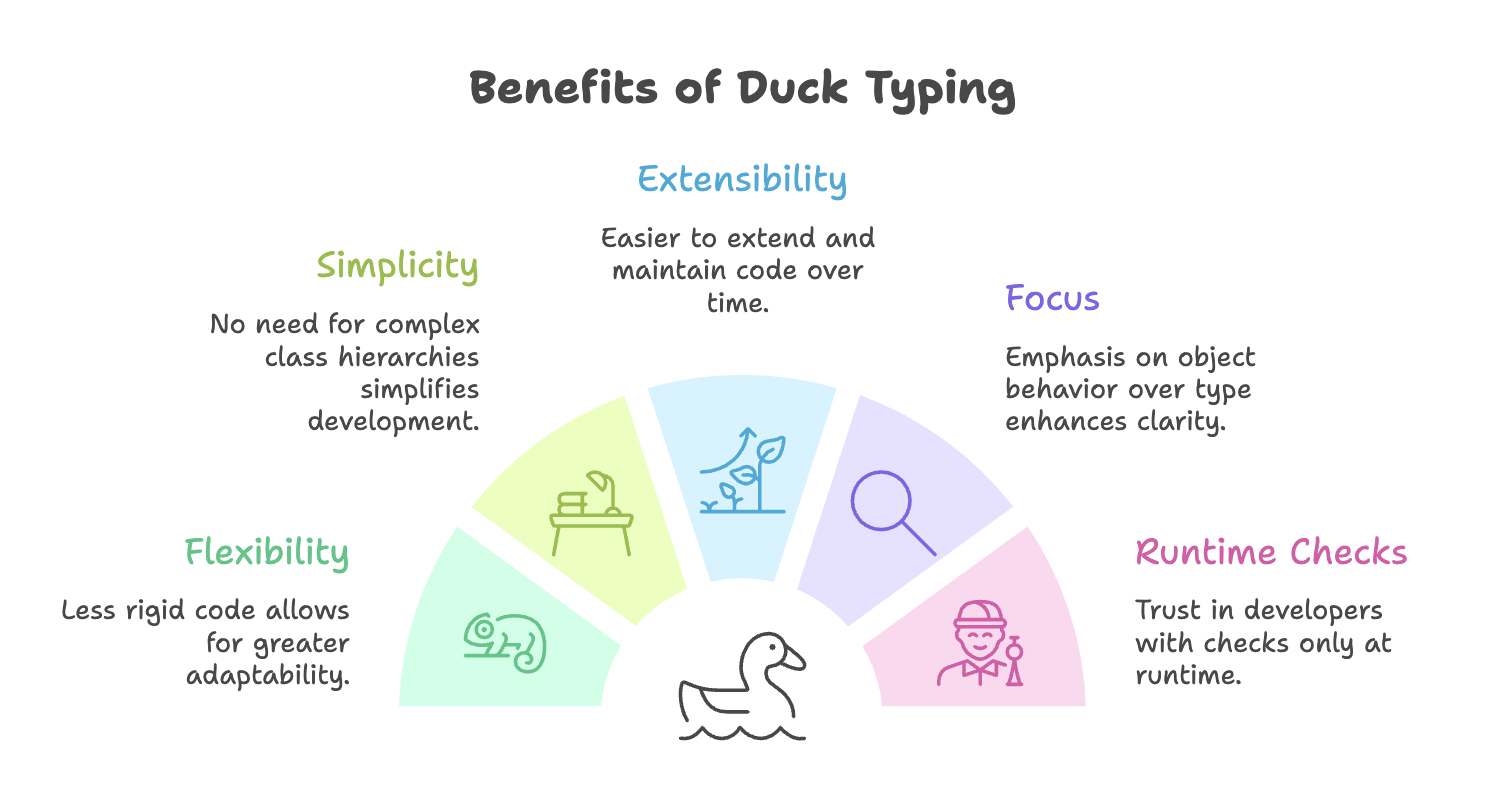
This makes code:
- Flexible
- Reusable
- Extensible
Real-World Analogy
You expect a duck that can quack. Someone gives you a crow that quacks.
Python says:
“I don’t care what it is. If it quacks, it’s acceptable.”
Summary
- Polymorphism in Python allows the same method call to produce different behaviors across objects.
- Duck typing enables polymorphism by focusing on behavior rather than inheritance or type.
- Python determines compatibility by checking for required methods, not class hierarchy.
- Runtime errors occur only when an object lacks the expected behavior.
- Dynamic typing makes Python flexible, expressive, and easy to extend.
Written By: Muskan Garg
How is this guide?
Last updated on