
Introduction to Exception Handling
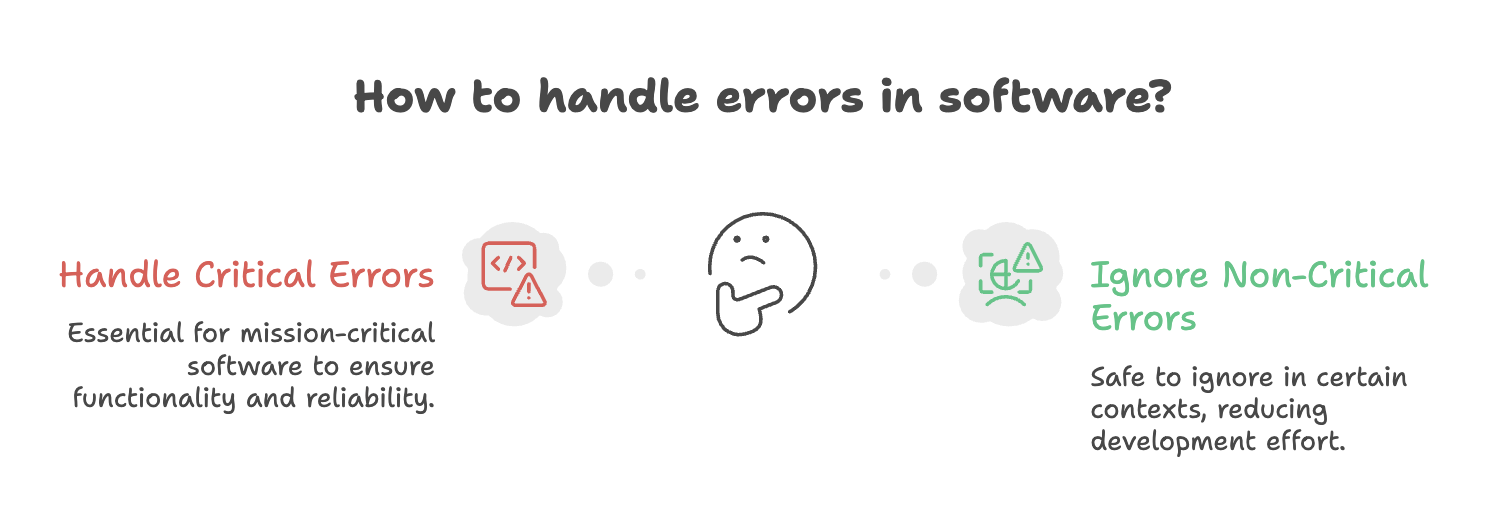
Exception handling is a core concept in Python that prevents applications from crashing due to unexpected runtime errors. It is especially critical in mission-critical applications where failures are unacceptable.
Examples include:
- Banking systems
- Medical devices
- Automotive software
- Aviation systems
Without proper exception handling, even a small runtime issue can terminate the entire application and lead to serious consequences.
Why Exception Handling Is Important
- Prevents sudden application crashes
- Ensures smooth execution even when errors occur
- Improves user experience
- Essential for reliable and fault-tolerant software
In real-world applications, developers cannot control:
- User inputs
- File deletions
- Network failures
Therefore, programs must be prepared to handle failures gracefully.
Types of Errors in Python
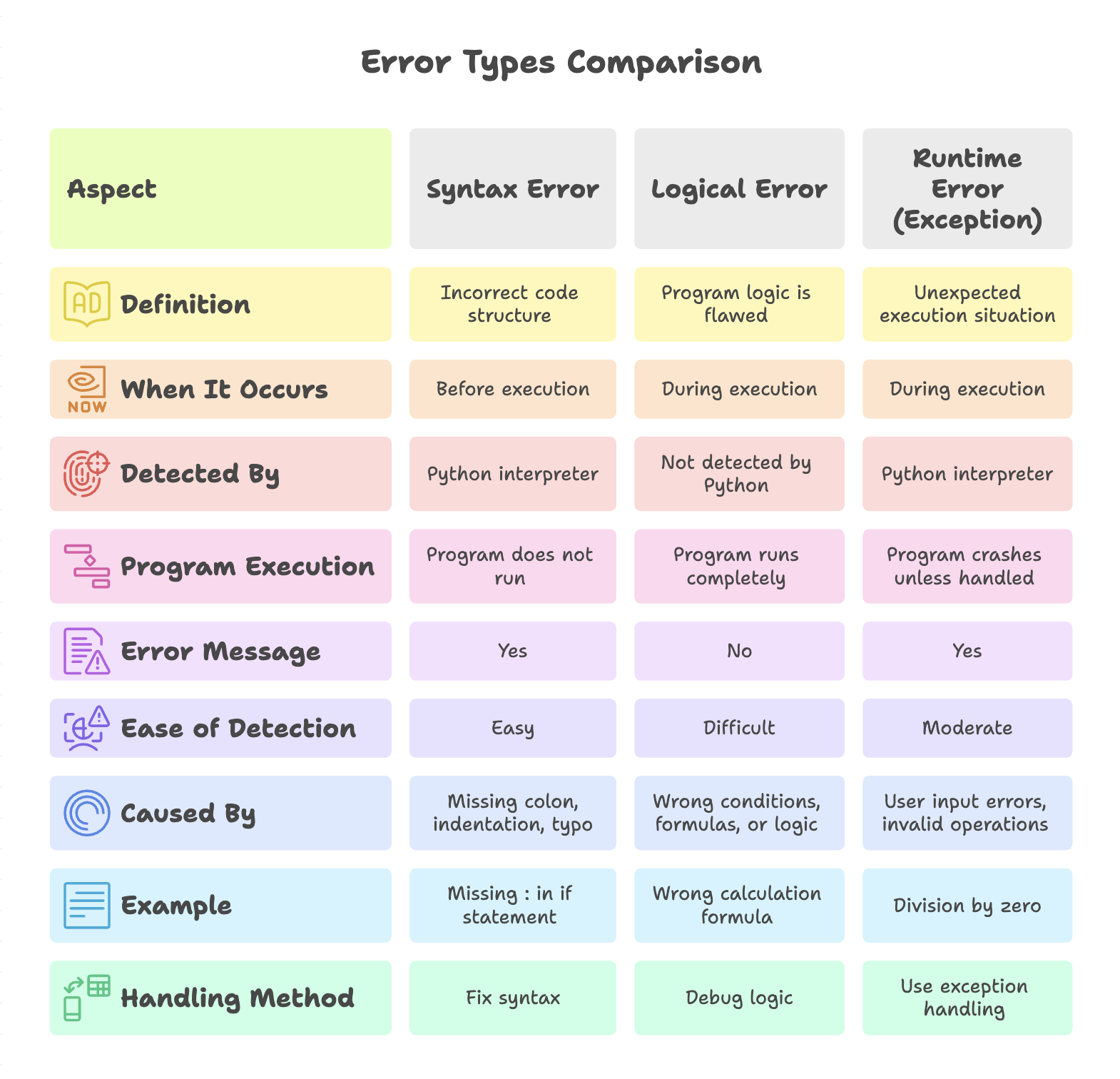
Python errors are broadly classified into three categories:
- Syntax Errors (Compile-Time Errors)
- Logical Errors
- Runtime Errors (Exceptions)
Syntax Errors (Compile-Time Errors)
Syntax errors occur when Python cannot understand the structure of the code due to incorrect syntax.
These errors are detected:
- By the Python interpreter
- Or by the IDE
- Before program execution
Examples
- Missing colon
: - Incorrect indentation
- Misspelled keywords
- Missing parentheses
if x > 5
    print("Hello")
Output:
SyntaxError: expected ':'Key Characteristics
- Program will not run
- Easy to identify and fix
- Caught immediately
Logical Errors
Logical errors occur when the program:
- Runs successfully
- But produces incorrect output
Python does not raise an error for logical mistakes.
Example
radius = 5
area = 2 * 3.14 * radius   # Wrong formula
print(area)
Output:
31.4Why Logical Errors Are Dangerous
- No error message
- Incorrect results may go unnoticed
- Hard to detect without expected output comparison
Runtime Errors (Exceptions)
`Runtime errors occur during program execution, even though:
- Syntax is correct
- Logic is intended correctly
They are often caused by:
- User input mistakes
- Missing files
- Invalid operations
Example: Division by Zero
a = 5
b = 0
result = a / b
print("Result is:", result)
print("End of execution")
Output:
ZeroDivisionError: division by zeroWhat Happens Internally?
- Python encounters an error
- Program crashes immediately
- Code after the error does not execute
Why Runtime Exceptions Must Be Handled
Consider this scenario:
- A required file is deleted by the user
- A number input is replaced with text
- A denominator becomes zero
If not handled:
- Application crashes
- Execution stops abruptly
Therefore, exception handling is mandatory for reliable software.
Summary
- Exception handling prevents Python applications from crashing due to unexpected runtime errors.
- Python errors are categorized into syntax errors, logical errors, and runtime exceptions, each requiring a different approach.
- Syntax errors stop execution immediately, while logical errors silently produce incorrect results.
- Runtime exceptions occur during execution and must be handled to ensure smooth program flow.
- Proper exception handling is essential for building reliable, user-friendly, and mission-critical applications.
Written By: Muskan Garg
How is this guide?
Last updated on