
Stateful Applications & StatefulSets Explained
Understand the difference between stateless and stateful applications, see why a Deployment is the wrong tool for a database, and learn what a StatefulSet adds.
Pods, ReplicaSets, Deployments and DaemonSets have carried us a long way. Every one of them works on the same idea: pods are cattle, not pets. If one dies, a fresh one with a new name takes its place and nobody notices.
That idea is perfect for a web application. It is a problem for a database. To see why, we first need two words: stateless and stateful.
A quick experiment with a stateless app
Start the telusko-deploy Deployment and the LoadBalancer Service from Rolling Updates & Rollbacks. Both files are already on the EKS home server:
kubectl apply -f k8s-deploy.yml
kubectl apply -f k8s-lbr-svc.yml
kubectl get pods
kubectl get svc
Open the EXTERNAL-IP hostname of webapp-lbr-svc in the browser. The Spring Boot app loads. Now delete one of the three pods:
kubectl get pods
kubectl delete pod telusko-deploy-6c8d9b7f4-x2k9p     # use one of your pod names
kubectl get pods
NAME READY STATUS RESTARTS AGE
telusko-deploy-6c8d9b7f4-7qmzt 1/1 Running 0 4m
telusko-deploy-6c8d9b7f4-h5lwd 1/1 Running 0 4m
telusko-deploy-6c8d9b7f4-p2c8r 0/1 ContainerCreating 0 3sTwo things happened:
- The ReplicaSet behind the Deployment noticed only two pods and created a third one. That is the self-healing you already know.
- The new pod has a different name. Its identity changed.
Refresh the browser. The site still works. The load balancer sent your request to one of the healthy pods, and the application did not care which one.
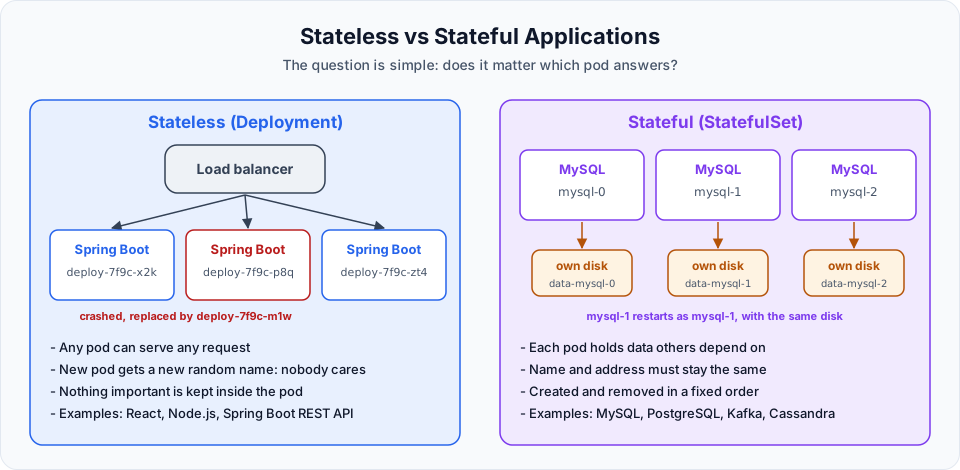
That is a stateless application: any pod can serve any request, nothing important lives inside a pod, and a replacement pod with a new name and a new IP is just as good as the old one. React and Angular front ends, Node.js services and Spring Boot REST APIs are usually stateless (they keep their data in a database outside the pod).
Now imagine the database
The same Spring Boot app needs MySQL. Suppose you run MySQL with a Deployment too. The MySQL pod crashes, the Deployment creates a new one, and:
- The new pod has a new name and a new IP. Anything that was talking to the old pod by name loses it.
- The data that MySQL wrote inside the container is gone, because a container's filesystem is thrown away with the pod.
- With three MySQL replicas, the Deployment starts all three at the same time, in no particular order. A primary and its replicas need a clear order: the primary first, then replicas that copy from it.
The "state" in stateful application is exactly this: information the application must remember between restarts (its data, and often who it is in a cluster). Databases, message brokers and distributed stores are stateful: MySQL, PostgreSQL, MongoDB, Kafka, Cassandra, Elasticsearch, ZooKeeper.
What a StatefulSet gives you
A StatefulSet is the workload resource made for stateful applications. Like a Deployment, it keeps a fixed number of pods running from a template. What it adds:
| Guarantee | What it means |
|---|---|
| Stable, predictable names | Pods are named <statefulset-name>-<ordinal>: mysql-0, mysql-1, mysql-2. If mysql-1 dies, the replacement is called mysql-1 again |
| Stable network identity | With a headless Service, each pod gets its own DNS name, for example mysql-0.mysql.default.svc.cluster.local, which does not change when the pod is recreated |
| Ordered creation | mysql-0 is created first. mysql-1 starts only when mysql-0 is Running and Ready, and so on |
| Ordered deletion | When scaling down, the highest ordinal goes first: mysql-2, then mysql-1, then mysql-0 |
| Stable storage per pod | Each pod gets its own PersistentVolumeClaim, and a recreated pod is reattached to the same volume |
That predictability is the whole point. You always know which pod is the first one, which name to connect to, and which disk belongs to which pod. The ordered start and stop is the default behaviour, called podManagementPolicy: OrderedReady. You will see all of this on a real cluster in Creating StatefulSets with Persistent Storage on Amazon EKS.
Where does the data actually live?
A stable name is only half the story. If the data still lives inside the container, a restarted mysql-0 comes back empty. The data has to sit on storage outside the pod. Kubernetes models that with PersistentVolumes and PersistentVolumeClaims, which are the topic of the next lesson.
Deployment vs StatefulSet
| Deployment | StatefulSet | |
|---|---|---|
| Best for | Stateless applications | Stateful applications |
| Pod names | Random: telusko-deploy-6c8d9b7f4-x2k9p | Stable: mysql-0, mysql-1 |
| Creation order | All pods in parallel | One by one, in order (by default) |
| Deletion order | Any order | Reverse order, highest ordinal first |
| Storage | Usually none, or one shared volume | One PVC per pod, kept across restarts |
| Network identity | One Service IP, load balanced | Headless Service, one DNS name per pod |
| Typical use | Web apps, REST APIs, front ends | Databases, Kafka, ZooKeeper, Elasticsearch |
A StatefulSet does not make a database highly available
A StatefulSet gives each pod a stable name, order and disk. It does not set up MySQL replication, elect a primary or take backups. That logic still has to come from the database itself, a Helm chart or an operator. For production databases on AWS, many teams use a managed service such as Amazon RDS and keep only stateless apps in the cluster. Run databases in Kubernetes when you have a good reason and a backup plan.
Clean up
kubectl delete -f k8s-lbr-svc.yml     # removes the AWS load balancer
kubectl delete -f k8s-deploy.yml
Try It Yourself
- Deploy
telusko-deploywith 3 replicas. Delete one pod and note the old and new pod names. Which part of the name stayed the same and which changed? - Run
kubectl get pods -o widebefore and after deleting a pod. Did the IP address change too? - Make a list of five applications your team uses. Mark each as stateless or stateful, and write one sentence on what "state" each stateful one keeps.
- Read the "Limitations" section of the official StatefulSet page and note which object you must create yourself for a StatefulSet to work.
Official references
Written By: Shramik Masti
How is this guide?
Last updated on
Kubernetes Pod Statuses
Understand the pod STATUS values you see in kubectl (ContainerCreating, Running, ErrImagePull, ImagePullBackOff, CrashLoopBackOff, Error), how they relate to pod phases, and the logs and describe routine for fixing them.
Kubernetes Storage Fundamentals: PV & PVC
Learn why data inside a pod disappears, and how PersistentVolumes, PersistentVolumeClaims and StorageClasses connect a pod to real storage such as an AWS EBS volume.