
Behind the Scenes of Kubernetes StatefulSets
See how a StatefulSet combines a headless Service, ordered pods and volumeClaimTemplates so that every pod gets a stable name, a stable DNS address and its own persistent volume.
We now have two separate ideas. From the first lesson of this section: a StatefulSet gives pods stable names and an ordered life cycle. From the PV and PVC hands-on: data survives a pod restart when it lives on a PersistentVolume.
A StatefulSet puts these two ideas together, and it removes the manual work we did last time. Before we build one, let us look at the architecture.
What we did by hand last time
In the hands-on lesson we:
- Created an EBS volume in the console
- Wrote a PV with its volume ID
- Wrote a PVC that claimed that PV
- Mounted the PVC into a Deployment
One PVC, shared by whatever pods the Deployment creates. That is fine for one replica. But a database with three replicas needs three separate disks, one per pod. mysql-0 must never write into mysql-1's data directory. Doing that by hand means three volumes, three PVs, three PVCs and three Deployments. Nobody wants that.
One PVC per pod, created for you
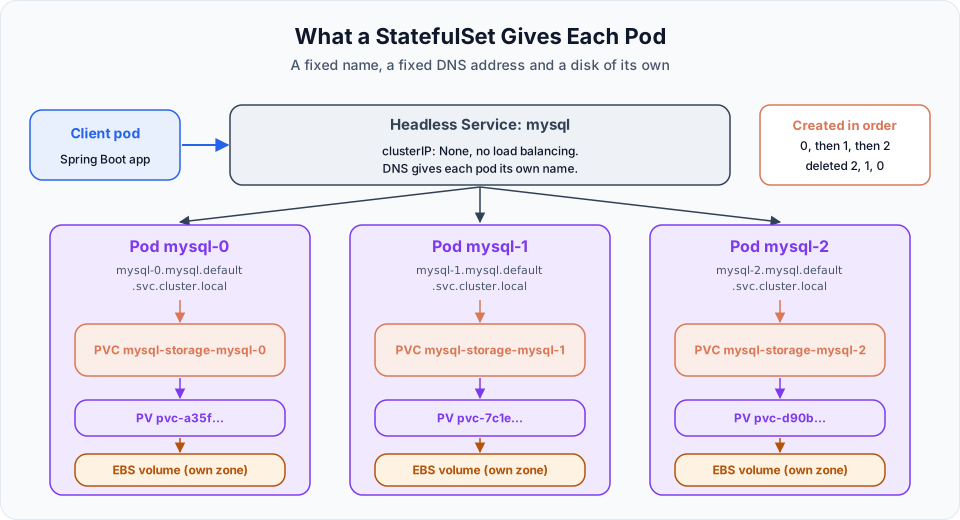
A StatefulSet has a field that a Deployment does not: volumeClaimTemplates. It is a PVC template. For every pod the StatefulSet creates, it stamps out a PVC from this template, with a predictable name:
<template-name>-<statefulset-name>-<ordinal>

mysql-storage-mysql-0
mysql-storage-mysql-1
mysql-storage-mysql-2
Each of those PVCs uses a StorageClass, and the StorageClass asks the EBS CSI driver to create a fresh EBS volume and a PV for it. This is dynamic provisioning: no console clicks, no copied volume IDs.
The binding is sticky. If mysql-1 is deleted, the replacement pod is again called mysql-1, and it mounts the same PVC mysql-storage-mysql-1, which still points at the same EBS volume. So the new pod finds the old pod's data.
| Deployment + PVC (last lesson) | StatefulSet + volumeClaimTemplates | |
|---|---|---|
| Who creates the PVC | You, by hand | The StatefulSet, one per pod |
| Who creates the PV and disk | You (static) | The StorageClass and CSI driver (dynamic) |
| Pods sharing a disk | All replicas would share one PVC | Each pod has its own |
| After a pod is recreated | New random pod name, same shared PVC | Same pod name, same own PVC |
The headless Service
A normal ClusterIP Service gives a group of pods one virtual IP and load balances across them. That is what you want for a web app. For a database cluster it is the wrong thing: a replica must connect to the primary, not to "any MySQL pod".
A headless Service is a Service with clusterIP: None. It has no virtual IP and does no load balancing. Instead, cluster DNS creates a record for each pod behind it:
<pod-name>.<service-name>.<namespace>.svc.cluster.local

mysql-0.mysql.default.svc.cluster.local
mysql-1.mysql.default.svc.cluster.local
These names stay the same when pods are recreated (the IP behind the name may change, the name does not). So an application, or another MySQL pod, can always reach mysql-0 directly. The StatefulSet's serviceName field points at this Service, and you must create the Service yourself.
Ordered, predictable behaviour
With the default podManagementPolicy: OrderedReady:
- Scale up / create:
mysql-0first.mysql-1is created only whenmysql-0is Running and Ready. Thenmysql-2. - Scale down: the highest ordinal goes first.
mysql-2must be fully terminated beforemysql-1is touched. - Rolling update (when you change the pod template): pods are replaced in reverse order,
mysql-2, thenmysql-1, thenmysql-0, one at a time.
If your application does not need the ordering, podManagementPolicy: Parallel starts and stops all pods at once, while still keeping the stable names and volumes.
What happens to the volumes later
This surprises many people: deleting or scaling down a StatefulSet does not delete its PVCs. Kubernetes keeps the data on purpose, because data loss is worse than a forgotten disk. If you scale from 3 to 2 and back to 3, mysql-2 comes back with its old data.
You can change this with persistentVolumeClaimRetentionPolicy (enabled by default since Kubernetes 1.27 and stable since 1.32):
spec:
  persistentVolumeClaimRetentionPolicy:
    whenDeleted: Retain   # or Delete: remove PVCs when the StatefulSet is deleted
    whenScaled: Retain    # or Delete: remove PVCs of pods removed by scale-down
The default for both is Retain. On AWS, every retained PVC is an EBS volume you are paying for, so clean up deliberately.
Where StatefulSets are used
Anything that needs a stable identity, stable storage and an ordered start:
- Relational databases: MySQL, PostgreSQL
- NoSQL and search: MongoDB, Cassandra, Elasticsearch
- Messaging and coordination: Apache Kafka, ZooKeeper, RabbitMQ, etcd
In practice these are usually installed with a Helm chart or an operator that builds on a StatefulSet and adds the replication logic. You will meet Helm later in Helm: Kubernetes Package Manager.
The pieces we will create
In the next lesson we build exactly this on EKS:
| Object | Name | Purpose |
|---|---|---|
| Headless Service | mysql | clusterIP: None, port 3306, DNS name per pod |
| StatefulSet | mysql | 2 replicas of mysql:8.0, serviceName: mysql |
| volumeClaimTemplate | mysql-storage | 10Gi, ReadWriteOnce, mounted at /var/lib/mysql |
| StorageClass | an EBS class | Lets the CSI driver create the EBS volumes |
Try It Yourself
- Without a cluster, write down the PVC names a StatefulSet called
kafkawith 3 replicas and a claim template calleddatawould create. - Write the full DNS name of the second pod of that StatefulSet if its headless Service is
kafka-hsin namespacestreaming. - A StatefulSet with 3 replicas is scaled to 1. Which pods are removed, in what order, and how many PVCs remain?
- Read the "Deployment and Scaling Guarantees" section of the StatefulSet docs and list the conditions that must be true before pod N+1 is created.
Official references
Written By: Shramik Masti
How is this guide?
Last updated on
Persistent Volumes (PV) and Persistent Volume Claims (PVC): Hands-On
Write a PersistentVolume for an existing EBS volume, claim it with a PVC, mount it into a Deployment, then delete the pod and prove the files survive.
Creating StatefulSets with Persistent Storage on Amazon EKS
Run MySQL as a StatefulSet on EKS with a headless Service and volumeClaimTemplates, watch EBS volumes get created dynamically, and prove that pods keep their name and data.