
Need of Inheritance
1. Introduction
Inheritance is one of the four major pillars of Object-Oriented Programming (OOP), alongside:
- Encapsulation
- Polymorphism
- Abstraction
Inheritance allows one class to acquire the properties and behaviors of another class.
But before learning how inheritance works, it is important to understand why inheritance is needed.
Java introduces inheritance to improve:
- Code reusability
- Maintainability
- Avoiding duplication
- Logical class structuring
- Extensibility of applications
This chapter focuses on the purpose and necessity of inheritance.
2. What Is Inheritance?
Inheritance is the mechanism where one class (child/subclass) inherits fields and methods of another class (parent/superclass).
Syntax:
class Child extends Parent {
}
3. Why Do We Need Inheritance?
3.1 To Avoid Code Duplication
Without inheritance, you might write the same fields and methods repeatedly.
Example:
class Car {
    void start() { }
    void stop() { }
}

class Bike {
    void start() { }
    void stop() { }
}
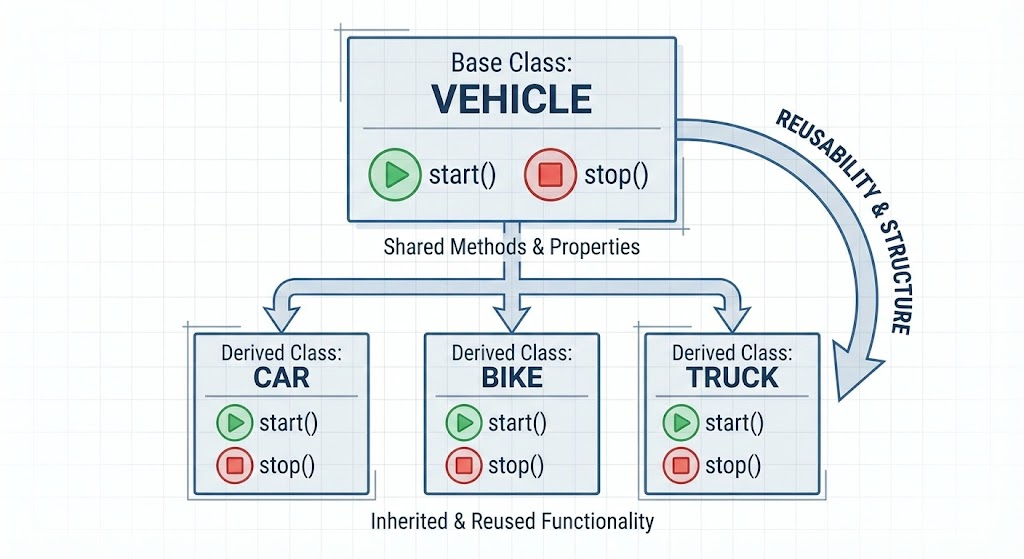
Both Car and Bike share common behaviors. Instead, inheritance allows:
class Vehicle {
    void start() { }
    void stop() { }
}

class Car extends Vehicle { }
class Bike extends Vehicle { }
Now Car and Bike automatically gain start() and stop() functionality.
3.2 To Improve Code Reusability
Instead of rewriting logic, the child class reuses the parent class code.
Benefits:
- Less code
- Faster development
- Reduced errors
- Easier updates
If a bug is fixed in the parent class, all subclasses benefit immediately.
3.3 To Create a Logical Class Hierarchy
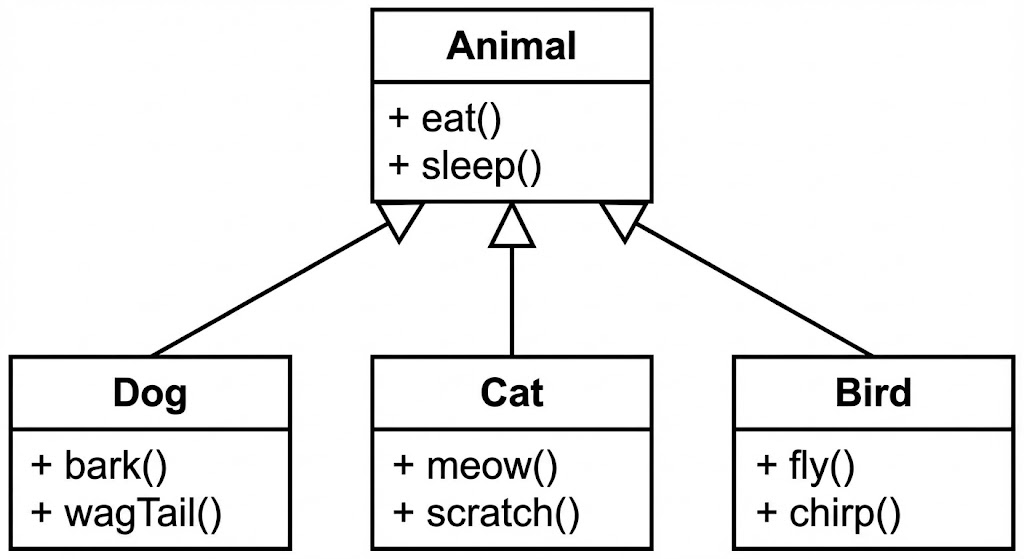
Example hierarchy:
Animal
 ├── Dog
 ├── Cat
 └── Horse
All animals share common attributes:
- eat()
- sleep()
But each subclass adds its own behavior.
Hierarchy makes the application easier to understand and maintain.
3.4 Supports Polymorphism
Inheritance enables method overriding, which is essential for runtime polymorphism.
Example:
class Animal {
    void sound() { System.out.println("Animal sound"); }
}

class Dog extends Animal {
    @Override
    void sound() { System.out.println("Bark"); }
}
Now you can do:
Animal a = new Dog();
a.sound(); // Bark
This flexibility is impossible without inheritance.
3.5 To Support Extensible Systems
Software grows over time.
Inheritance helps you extend existing functionality:
class OnlineAccount {
    void login() { }
}

class PremiumAccount extends OnlineAccount {
    void accessPremiumContent() { }
}
You don’t rewrite login() for every new account type.
3.6 Maintainability and Upgradability
Imagine 10 classes share a method.
Without inheritance:
- Fixing a bug = fixing in 10 places
- Updating logic = repeating updates everywhere
With inheritance:
- Fix once in superclass → applied to all subclasses
This drastically reduces maintenance efforts.
4. Real-World Examples of Why Inheritance Is Needed
Example 1 - Company Employees
Employee
 ├── Manager
 ├── Developer
 └── Intern
All employees share:
- name
- id
- salary
But each subclass has specific functionality.
Example 2 - UI Components
Component
 ├── Button
 ├── TextField
 └── Checkbox
All components need rendering and event-handling logic.
Example 3 - Game Characters
Character
 ├── Warrior
 ├── Archer
 └── Mage
Common behaviors:
- attack()
- defend()
Each subclass extends the behavior.
5. Key Advantages of Using Inheritance
| Benefit | Description |
|---|---|
| Code Reusability | Avoids duplication of repeated code |
| Maintainability | Fix/update logic in one place |
| Organization | Creates a clean class hierarchy |
| Flexibility | Supports polymorphism and method overriding |
| Extensibility | Systems can grow easily with new subclasses |
6. Misconceptions About Inheritance
Misconception 1: Inheritance is always needed
No - often composition is better than inheritance.
Misconception 2: Inheritance automatically solves all duplication
Only good for shared behavior, not unrelated features.
Misconception 3: Use inheritance everywhere
Inheritance should be used only when:
- Relationship is IS-A
- Behavior of superclass applies to subclass
7. Summary
- Inheritance allows one class to acquire the properties and methods of another.
- It reduces code duplication and improves reusability.
- It helps build logical hierarchies and enables polymorphism.
- It improves maintainability and supports long-term software growth.
- Inheritance should be used judiciously and only where appropriate.
This completes Need of Inheritance in Java.
Written By: Shiva Srivastava
How is this guide?
Last updated on