
HAS-A vs IS-A Relationship
1. Introduction
Object-Oriented Programming (OOP) models real-world entities using relationships between classes.
Two fundamental relationships in Java are:
- IS-A Relationship (Inheritance)
- HAS-A Relationship (Composition / Aggregation)
Understanding these relationships helps you design clean, maintainable, and scalable systems.
2. IS-A Relationship (Inheritance)
Definition
IS-A represents inheritance.
It means one class is a type of another class.
Example:
Dog IS-A Animal
Car IS-A Vehicle
Manager IS-A Employee
In Java, IS-A is implemented using the extends keyword.
Example
class Animal {
    void eat() { }
}

class Dog extends Animal {
    void bark() { }
}
Dog inherits from Animal. Therefore, Dog is an Animal.
When to Use IS-A?
Use IS-A when:
- The subclass is a specialized version of the parent class
- The relationship is logically correct
- You want to enable polymorphism and method overriding
Example:
Circle IS-A Shape
SavingsAccount IS-A BankAccount
Pitfall: Misusing IS-A
Not every relationship should be inheritance.
Example:
Bird IS-A Animal  → correct
Bird HAS-A Wing   → correct
Bird IS-A Wing    → incorrect
3. HAS-A Relationship (Composition / Aggregation)
Definition
HAS-A means one class contains another class as a field.
It represents:
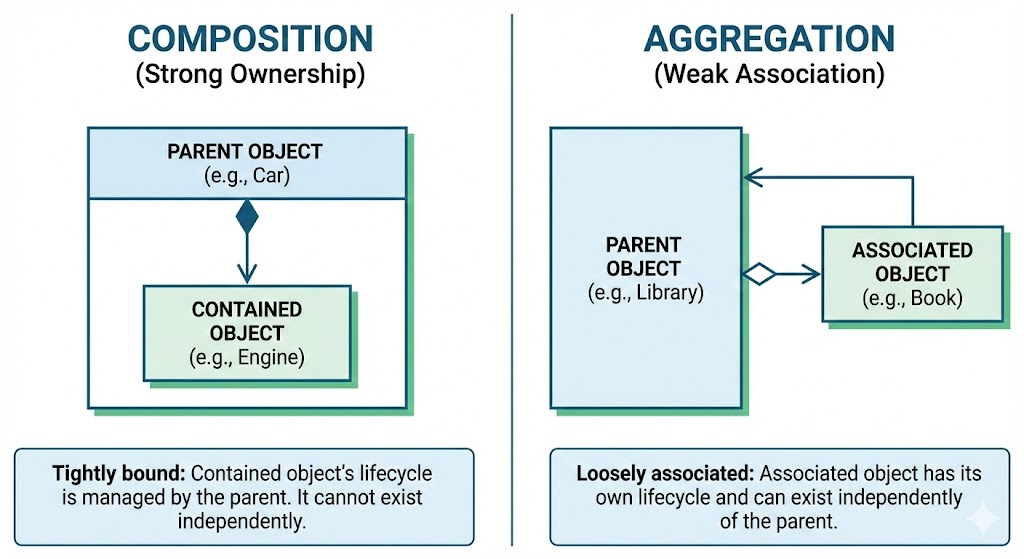
- Composition (strong ownership)
- Aggregation (weak ownership)
Examples:
Car HAS-A Engine
Library HAS-A Book
Student HAS-A Address
Example: Composition
class Engine {
    void start() { }
}

class Car {
    private Engine engine = new Engine(); // HAS-A relationship
}
Car has an Engine.
4. Composition vs Aggregation (Under HAS-A)
4.1 Composition (Strong HAS-A)
- Child cannot exist without parent
- Lifecycle is tightly dependent
- Example: House HAS-A Room
Code:
class Room { }

class House {
    private Room room = new Room();
}
If the House object is destroyed, the Room object is also destroyed.
4.2 Aggregation (Weak HAS-A)
- Child can exist independently
- Loose relationship
- Example: Department HAS-A Student
class Student { }

class Department {
    private List<Student> students;
}
Students can exist even without a Department.
5. Differences Between IS-A and HAS-A
| Feature | IS-A | HAS-A |
|---|---|---|
| Meaning | Inheritance | Composition/Aggregation |
| Keyword | extends | Field inside class |
| Relationship | Parent-child | Whole-part |
| Reuse | Behavior reuse | Object reuse |
| Example | Dog IS-A Animal | Car HAS-A Engine |
6. Real-World Examples
Example 1 - University System
Professor IS-A Employee
Department HAS-A Professor
University HAS-A Department
Example 2 - Banking System
SavingsAccount IS-A BankAccount
Customer HAS-A Address
ATM HAS-A CashDispenser
Example 3 - Applications
Button IS-A UIComponent
Window HAS-A Button 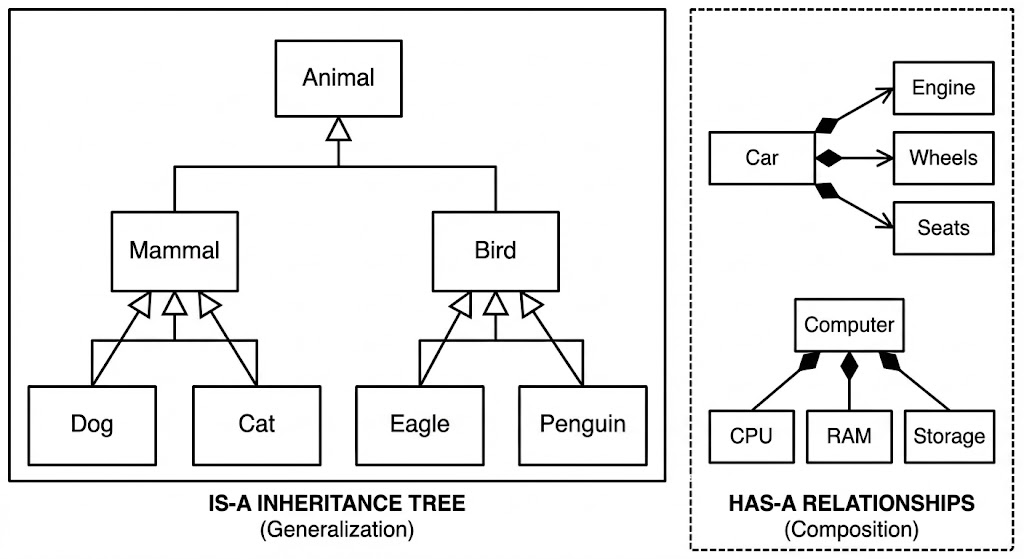
7. When to Use Which?
Use IS-A (Inheritance) when:
- The subclass is a special version of the parent class
- You need polymorphism
- You want to override behavior
Use HAS-A (Composition) when:
- You want to build functionality by combining objects
- Relationship is part-whole
- You want flexibility (composition is more flexible than inheritance)
8. Best Practices
-
Prefer HAS-A (composition) over IS-A when possible (Composition is more flexible and avoids tight coupling)
-
Use inheritance cautiously to avoid deep hierarchies
-
Check logical correctness: If you can say X is a Y, use inheritance. If you say X has a Y, use composition.
9. Summary
- IS-A represents inheritance; implemented using
extends. - HAS-A represents composition/aggregation; implemented using fields.
- IS-A is used for specialization; HAS-A for combining objects.
- Composition is generally preferred over inheritance due to flexibility.
- Understanding both relationships is essential for good object-oriented design.
This completes HAS-A vs IS-A Relationship in Java.
Written By: Shiva Srivastava
How is this guide?
Last updated on