
What Is Inheritance
1. Introduction
Inheritance is one of the core features of Object-Oriented Programming (OOP).
It allows a new class (called child, subclass, or derived class) to acquire the properties and behaviors of an existing class (called parent, base, or superclass).
This promotes:
- Code reusability
- Polymorphism
- Cleaner design
- Better maintainability
In Java, inheritance is implemented using the extends keyword.
2. Definition of Inheritance
Inheritance is the mechanism in Java where one class inherits fields and methods of another class.
Syntax:
class Child extends Parent {
    // new properties and methods
}
Here:
Parent→ superclassChild→ subclass
The child class automatically gets:
- All non-private fields
- All non-private methods
3. Simple Example of Inheritance
class Animal {
    void eat() {
        System.out.println("Animal eats");
    }
}

class Dog extends Animal {
    void bark() {
        System.out.println("Dog barks");
    }
}

public class Main {
    public static void main(String[] args) {
        Dog d = new Dog();
        d.eat();  // inherited from Animal
        d.bark(); // own method
    }
}
Output:
Animal eats
Dog barks
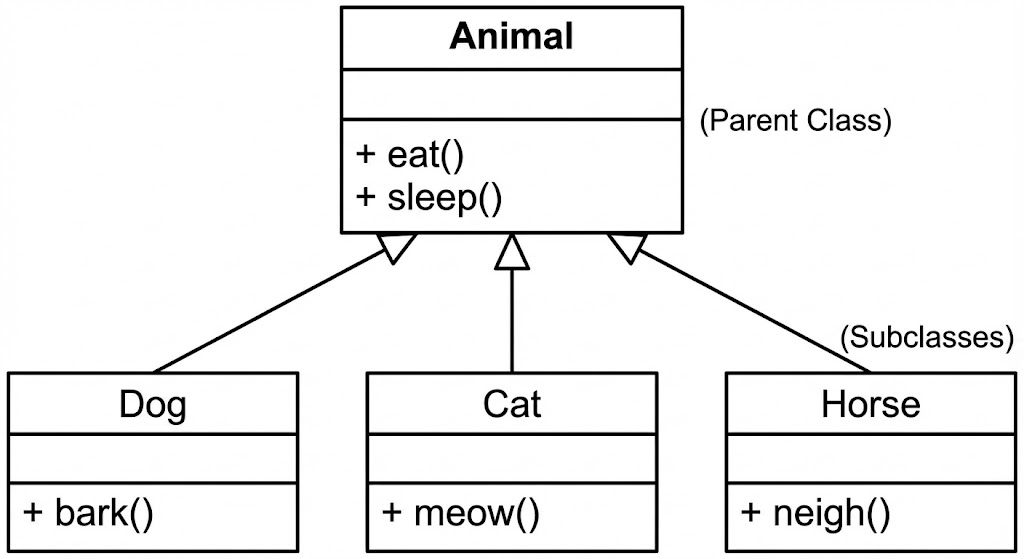
The Dog class inherited the eat() method from Animal.
4. Key Terminology
4.1 Superclass (Parent Class)
The class whose properties are inherited.
4.2 Subclass (Child Class)
The class that inherits properties from the parent.
4.3 Inheritance Hierarchy
Structure showing parent-child relationships.
Example:
Fruit
 ├── Mango
 ├── Apple
 └── Orange
4.4 IS-A Relationship
Inheritance must satisfy an IS-A relationship:
- A Dog is an Animal
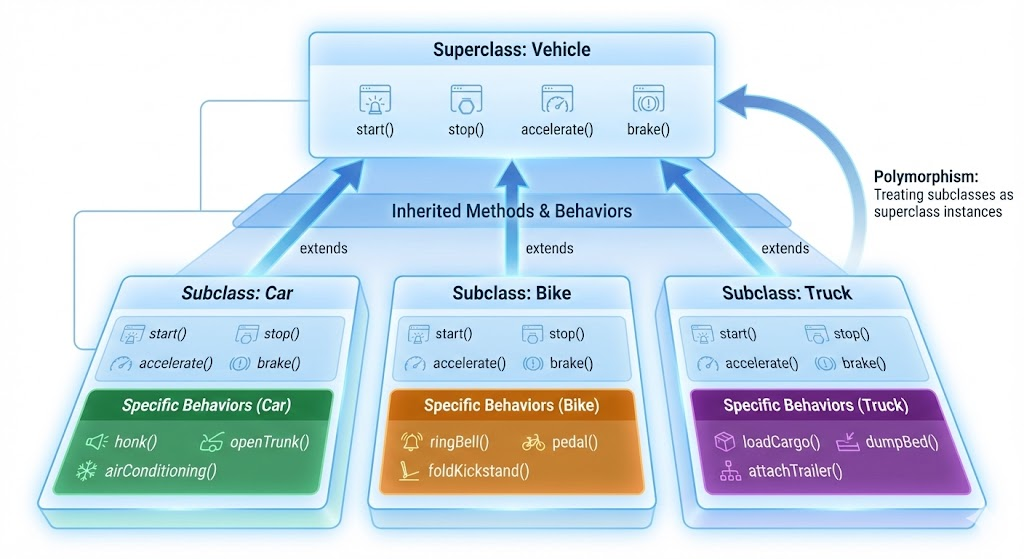
- A Car is a Vehicle
If the relationship doesn't make logical sense, inheritance should not be used.
5. What Gets Inherited?
A subclass inherits:
- All non-private fields
- All non-private methods
- All protected members
- Default members (if in same package)
It does not inherit:
- Constructors
- Private fields/methods
- Static methods (they are accessible but not inherited)
- Final methods cannot be overridden
6. Accessing Superclass Members
The subclass can access superclass members (except private ones):
class A {
    protected int value = 10;
}

class B extends A {
    void display() {
        System.out.println(value); // allowed
    }
}
Private members are accessible only via:
- Getters/setters
- Public methods
7. Constructor Behavior in Inheritance
Constructors are not inherited, but when a subclass is created, the superclass constructor is called automatically.
Example:
class A {
    A() {
        System.out.println("Parent Constructor");
    }
}

class B extends A {
    B() {
        System.out.println("Child Constructor");
    }
}
Output:
Parent Constructor
Child Constructor
8. Real-World Examples of Inheritance
8.1 Vehicles
Vehicle
 ├── Car
 ├── Bike
 └── Truck
All vehicles have:
- start()
- stop()
Each subclass extends behavior.
8.2 Application Users
User
 ├── Admin
 ├── Guest
 └── RegisteredUser
Shared properties: id, name, login()
9. Why Inheritance Matters
| Benefit | Description |
|---|---|
| Reusability | Use superclass code in subclasses |
| Maintainability | Fixing a bug in superclass fixes all subclasses |
| Extensibility | Add new subclasses without modifying existing code |
| Polymorphism | Enables method overriding and dynamic dispatch |
10. Summary
- Inheritance allows one class to derive properties and methods from another.
- Implemented using the
extendskeyword. - Supports IS-A relationship.
- Subclasses inherit all non-private members of the parent.
- Provides foundation for polymorphism and overriding.
- Helps in designing structured, reusable, and maintainable code.
This completes What Is Inheritance.
Written By: Shiva Srivastava
How is this guide?
Last updated on