
Upcasting and Downcasting
1. Introduction
When working with inheritance, Java allows you to treat an object of a subclass as if it were an object of its parent class.
This is known as type casting in inheritance, and it is divided into:
- Upcasting → Casting child to parent (safe)
- Downcasting → Casting parent to child (requires explicit cast, not always safe)
Casting plays a major role in polymorphism, method overriding, and runtime object handling.
2. Upcasting (Child → Parent)
Definition
Upcasting means assigning a child object to a parent reference.
Parent p = new Child(); // upcastingWhy Upcasting Is Safe?
- A child is-a parent (IS-A relationship)
- Child object contains everything the parent has
- No explicit cast required
Example
class Animal {
    void sound() { System.out.println("Animal sound"); }
}

class Dog extends Animal {
    void bark() { System.out.println("Bark"); }
    @Override
    void sound() { System.out.println("Dog sound"); }
}

public class Main {
    public static void main(String[] args) {
        Animal a = new Dog(); // upcasting
        a.sound();            // Dog sound (polymorphism)
    }
}
Upcasting allows runtime polymorphism - the child method overrides the parent method.
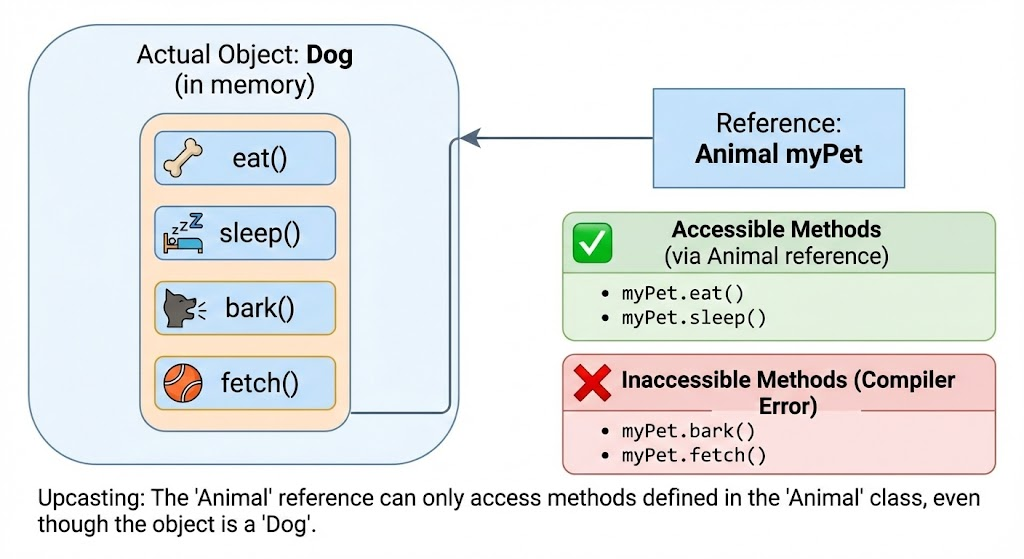
Limitations of Upcasting
Animal a = new Dog();
a.bark();   // ERROR: bark() not accessible
Because the reference type controls what you can access.
3. Downcasting (Parent → Child)
Definition
Downcasting means assigning a parent reference to a child reference.
Child c = (Child) p; // downcastingImportant:
- Requires explicit cast
- Not always safe
- Can throw ClassCastException at runtime
- Should only be done when the object is truly of the child type
Example
Animal a = new Dog(); // upcast
Dog d = (Dog) a;      // downcast (safe)
d.bark();             // works
Unsafe Downcasting Example
Animal a = new Animal();
Dog d = (Dog) a; // ERROR at runtime: ClassCastException
Because the actual object is not a Dog.
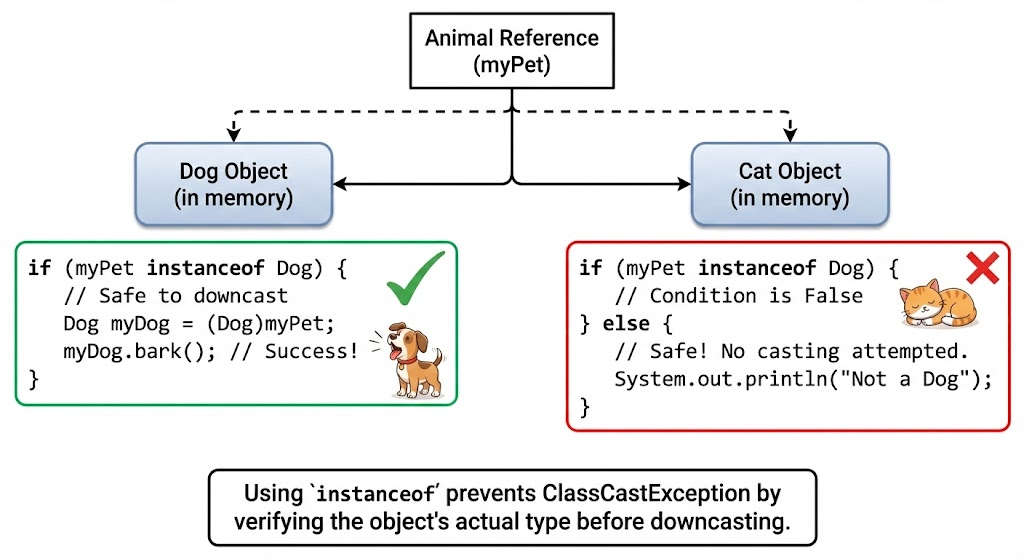
4. Checking Safe Downcasting Using instanceof
Before downcasting, always check:
if (a instanceof Dog) {
    Dog d = (Dog) a;
    d.bark();
}
Output:
BarkThis avoids runtime exceptions.
5. Upcasting + Downcasting in Polymorphism
Example
Animal a = new Dog(); // upcasting
Dog d = (Dog) a;      // downcasting
d.bark();
Upcasting gives the object a parent reference; Downcasting restores the child-specific features.
6. Real-World Example
Example: Payment System
class Payment {
    void pay() {
        System.out.println("General payment");
    }
}

class CreditCard extends Payment {
    void creditOffer() {
        System.out.println("Special credit card offer");
    }
}
Usage:
Payment p = new CreditCard(); // upcasting
p.pay();

CreditCard c = (CreditCard) p; // downcasting
c.creditOffer();
7. Differences Between Upcasting and Downcasting
| Feature | Upcasting | Downcasting |
|---|---|---|
| Direction | Child → Parent | Parent → Child |
| Explicit cast required? | No | Yes |
| Safety | Always safe | Not always safe |
| Access | Parent methods only | Child methods too |
| Purpose | Polymorphism | Regain child features |
8. Summary
- Upcasting is safe and automatic; enables polymorphism.
- Downcasting is explicit and risky; must ensure type compatibility.
instanceofshould be used to prevent ClassCastException.- Upcasting restricts access to parent-level features; downcasting restores child-specific methods.
This completes Upcasting and Downcasting in Java.
Written By: Shiva Srivastava
How is this guide?
Last updated on