
Multiple Inheritance
1. Introduction
Multiple Inheritance refers to a feature where a class can inherit properties and behaviors from more than one parent class.
Example (hypothetical):
class C extends A, B; // Not allowed in JavaUnlike C++, Java does not support multiple inheritance using classes. This restriction was introduced deliberately to avoid ambiguity and maintain simplicity in the language.
However, Java does support multiple inheritance using interfaces, which is the preferred and safe way to achieve it.
2. Why Java Does Not Support Multiple Inheritance?
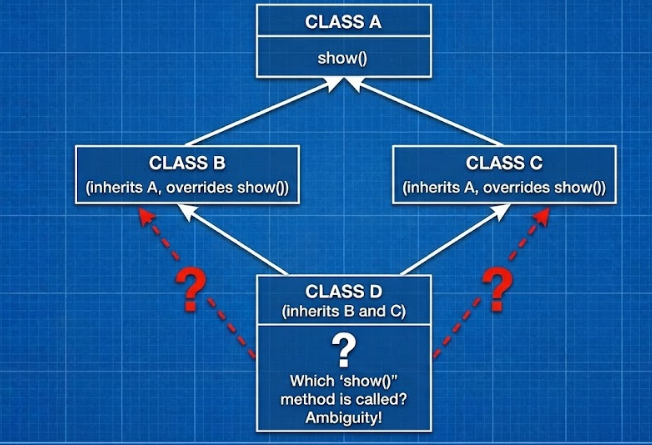
The main reason is to avoid ambiguity, commonly called the Diamond Problem.
Diamond Problem Example (Conceptual)
     A
    / \
   B   C
    \ /
     D
If B and C both have a method:
void show() { }And class D inherits from both B and C:
class D extends B, C; // If this were allowedThen calling:
d.show();Which show() should be inherited?
- B’s?
- C’s?
This ambiguity creates complexity and confusion.
To prevent such complications, Java designers disabled multiple inheritance using classes.
3. Multiple Inheritance Through Interfaces (Supported in Java)
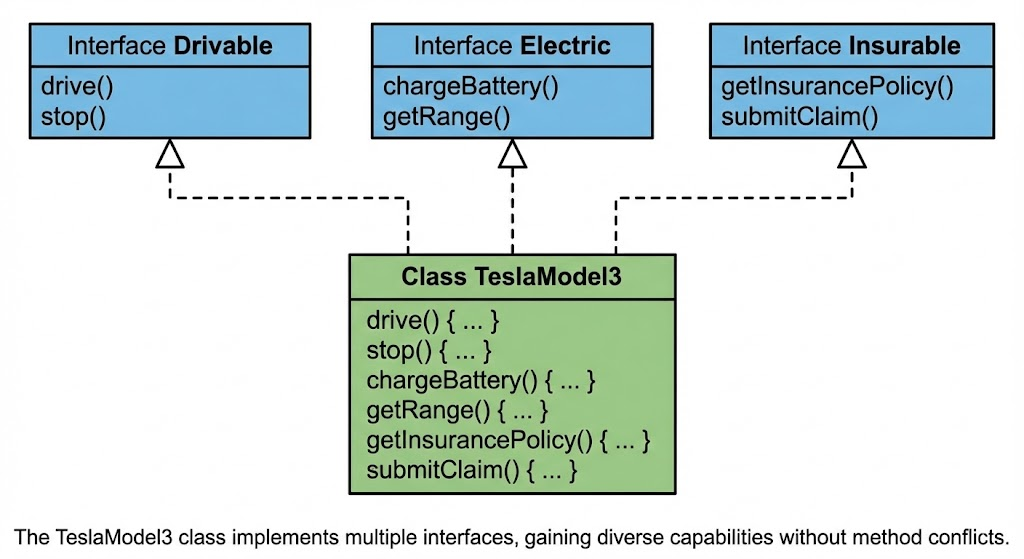
While Java restricts multiple inheritance for classes, it allows a class to implement multiple interfaces.
Example:
interface A {
    void m1();
}

interface B {
    void m2();
}

class C implements A, B {
    public void m1() { }
    public void m2() { }
}
Output behavior is predictable and unambiguous because interfaces contain abstract methods only (until Java 8+ added default and static methods).
This allows Java to enjoy the benefits of multiple inheritance without the complications.
4. How Interfaces Solve the Ambiguity Issue
Interfaces provide method declarations, not method implementations (except default/static methods). Therefore, the class implementing multiple interfaces must override the conflicting methods.
Example With Conflicting Default Methods
interface A {
    default void show() { System.out.println("A show"); }
}

interface B {
    default void show() { System.out.println("B show"); }
}

class C implements A, B {
    @Override
    public void show() {
        A.super.show(); // explicitly choose one
    }
}
Java forces the programmer to specify which version to use - removing ambiguity.
5. Multiple Inheritance Through Interfaces: Practical Example
interface Printer {
    void print();
}

interface Scanner {
    void scan();
}

class MultiFunctionMachine implements Printer, Scanner {
    public void print() {
        System.out.println("Printing...");
    }

    public void scan() {
        System.out.println("Scanning...");
    }
}
Now the class inherits capabilities of both interfaces without conflict.
6. Key Differences Between Class and Interface Multiple Inheritance
| Feature | Classes | Interfaces |
|---|---|---|
| Multiple inheritance allowed? | No | Yes |
| Method implementation | Yes (creates ambiguity) | Only abstract method definitions (no conflict) |
| Ambiguity risk | High | Low |
| Supported keywords | extends (only 1 parent) | implements (multiple parents allowed) |
7. Advantages of Multiple Inheritance via Interfaces
- No ambiguity
- Cleaner design
- Flexible architecture
- Better decoupling of behaviors
- Supports mix-in styles (adding capabilities)
8. Summary
- Java does not allow multiple inheritance through classes to avoid ambiguity (diamond problem).
- Java supports multiple inheritance through interfaces, providing flexibility with safety.
- Interfaces allow combining multiple behaviors without method conflicts.
- If conflicts arise (default methods), Java forces explicit resolution.
This completes Multiple Inheritance in Java.
Written By: Shiva Srivastava
How is this guide?
Last updated on