
Immutable Class
1. Introduction
An immutable object is an object whose state cannot be changed after it is created.
Strings in Java are the best-known example of immutability.
Creating immutable classes is a key practice in:
- Safe multithreading
- Security
- Functional programming
- Cache implementations
- Preventing accidental modification of shared objects
Java provides the ability to design custom immutable classes using certain rules.
2. What Is an Immutable Class?
An immutable class is a class where:
- All fields are fixed after object creation
- No method can modify object state
- Any modification creates a new object instead of changing the old one
Example of immutable objects:
String, Integer, LocalDate, BigDecimal
Benefits of Immutability
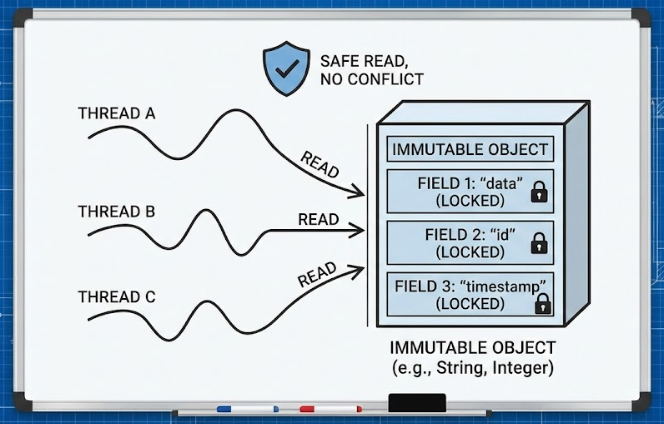
- Thread-safe without synchronization
- Easy to use, reason about, and test
- Reduces bugs caused by unexpected changes
- Ideal for use as keys in HashMap
- More secure for sensitive data
3. Rules for Creating an Immutable Class
To make a class immutable, follow these rules:
1. Declare the class as final
Prevents subclassing, which might add mutable behavior.
2. Make all fields private
Prevents direct modification.
3. Make all fields final
Ensures fields are assigned once.
4. No setters
Do not provide any setter methods.
5. Initialize fields in the constructor only
6. Perform deep copy of mutable fields
7. Return copies instead of actual objects for getters
4. Example: Immutable Class (Basic)
final class Student {
    private final int id;
    private final String name;

    public Student(int id, String name) {
        this.id = id;
        this.name = name;
    }

    public int getId() { return id; }

    public String getName() { return name; }
}
This class is fully immutable.
5. Example: Immutable Class with Mutable Fields
If a class contains mutable types (arrays, lists, custom objects), we must return copies.
Example:
final class Employee {
    private final String name;
    private final Address address; // mutable object

    public Employee(String name, Address address) {
        this.name = name;
        this.address = new Address(address.getCity()); // deep copy
    }

    public String getName() {
        return name;
    }

    public Address getAddress() {
        return new Address(address.getCity()); // return copy
    }
}
The original Address object remains protected.
Importance of Deep Copy
Without deep copy:
Address a = emp.getAddress();
a.setCity("New York"); // modifies Employee’s internal state → breaks immutability
So getters must always return a new object, not the original.
Image prompt
"Visual showing a mutable Address object outside the immutable Employee, but Employee safely returns cloned copies to prevent modifications."
6. Advantages of Immutable Classes
6.1 Thread Safety
Immutable objects can be shared across threads without fear of race conditions.
6.2 Caching and Optimization
JVM can safely reuse immutable objects (as seen with String pool).
6.3 Predictability
No unexpected changes → fewer bugs.
6.4 Security
State remains protected from malicious or accidental modification.
7. Disadvantages of Immutable Classes
- More object creation → higher memory use
- Can be less efficient for frequently updated data
- Deep copying can be expensive for large objects
These disadvantages are often outweighed by safety and clarity.
8. Real-World Examples of Immutable Classes
StringInteger,Double,BooleanLocalDate,LocalTime,LocalDateTimeBigInteger,BigDecimal- Enum types
All widely used for thread-safe, predictable behavior.
9. Complete Example Demonstrating Immutability
final class Person {
    private final String name;
    private final int age;
    private final Address address;

    public Person(String name, int age, Address address) {
        this.name = name;
        this.age = age;
        this.address = new Address(address.getCity());
    }

    public String getName() { return name; }

    public int getAge() { return age; }

    public Address getAddress() {
        return new Address(address.getCity());
    }
}
Attempt to modify:
Person p = new Person("John", 25, new Address("Delhi"));
Address a = p.getAddress();
a.setCity("Mumbai");
Person still holds "Delhi", proving immutability.
10. Summary
- Immutable classes cannot be modified after creation.
- Must use private final fields, no setters, and deep copies.
- Immutable objects are thread-safe, secure, and predictable.
- Widely used in Java core libraries.
- Perfect for safe shared data and functional programming patterns.
This completes Immutable Class in Java.
Written By: Shiva Srivastava
How is this guide?
Last updated on