
Getters and Setters
Why Do We Need Getters and Setters?
Once we declare variables as private, they cannot be accessed directly from outside the class.
To read or modify these private variables safely, we use public methods.
These methods are known as getters (to retrieve data) and setters (to modify data).
Encapsulation relies heavily on these methods to ensure controlled access to internal data.
What Are Getters and Setters?
| Method Type | Purpose |
|---|---|
| Getter | Provides read-only access to private variables |
| Setter | Allows controlled modification of private variables |
Getters and setters maintain data security and allow validation before updating any field.
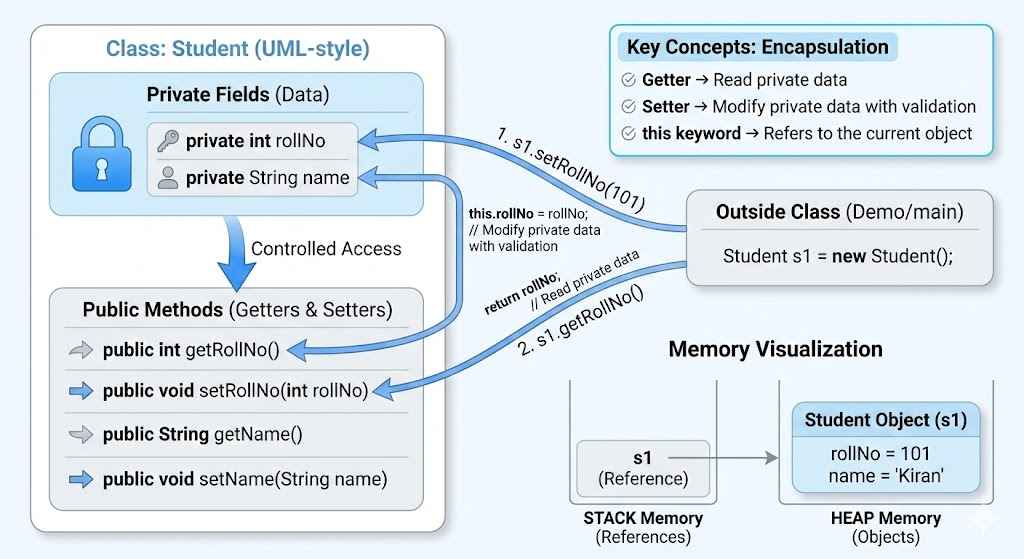
Example
class Student {
    private int rollNo;
    private String name;

    // Setter for roll number
    public void setRollNo(int rollNo) {
        this.rollNo = rollNo;   // 'this' refers to the current object
    }

    // Getter for roll number
    public int getRollNo() {
        return rollNo;
    }

    // Setter for name
    public void setName(String name) {
        this.name = name;
    }

    // Getter for name
    public String getName() {
        return name;
    }
}

public class Demo {
    public static void main(String[] args) {
        Student s1 = new Student();

        s1.setRollNo(101);
        s1.setName("Kiran");

        System.out.println("Student RollNo: " + s1.getRollNo());
        System.out.println("Student Name: " + s1.getName());
    }
}
Output
Student RollNo: 101
Student Name: Kiran
Understanding the this Keyword
When method parameters have the same name as instance variables,
this is used to differentiate between them.
Example:
public void setAge(int age) {
    this.age = age;
}
Here:
this.age→ instance variableage→ method parameter
This avoids naming conflicts and makes the code clearer.
Why Not Access Variables Directly?
Allowing direct access leads to several issues:
- No validation (someone may set
age = -5) - Breaks encapsulation
- Reduces control over how data is modified
- Makes debugging and maintenance harder
Using setters allows controlled updates:
obj.setAge(-5); // You can validate inside the methodNaming Conventions
Java follows standard naming rules:
| Variable | Getter | Setter |
|---|---|---|
age | getAge() | setAge(int age) |
name | getName() | setName(String name) |
rollNo | getRollNo() | setRollNo(int rollNo) |
These conventions help frameworks and tools automatically recognize getter and setter methods.
Summary
| Concept | Description |
|---|---|
| Encapsulation | Hiding internal data and controlling access |
| Private variables | Cannot be accessed directly |
| Getter | Returns the value of a private variable |
| Setter | Updates a private variable with validation |
| this keyword | Refers to the current object |
| Benefit | Data hiding, validation, flexibility, maintainability |
Real-World Analogy
A vending machine stores items inside, but you cannot access them directly. You use buttons to request an item. These buttons act like getters and setters - providing controlled access to what’s inside.
Written By: Shiva Srivastava
How is this guide?
Last updated on