
Access Modifiers
1. Introduction
Access modifiers in Java define the visibility and accessibility of classes, methods, variables, and constructors.
They help implement security, encapsulation, and proper structuring of code.
Java provides four primary access modifiers:
- public
- protected
- default (no modifier)
- private
Each modifier controls how members of a class can be accessed within the program.
2. Types of Access Modifiers
2.1 public
- Accessible from anywhere
- No restrictions
- Commonly used for APIs, utility classes, and entry points
Example:
public class Student {
    public String name;
}
2.2 private
- Accessible only within the same class
- Most restrictive
- Used to implement encapsulation
Example:
class Student {
    private int age; // cannot access from outside class
}
Using private forces use of getters & setters, enabling controlled access.
2.3 default (package-private)
If no modifier is written, Java uses default access.
- Accessible within the same package
- Not accessible from outside its package
Example:
class Student { // default class
    String course; // default variable
}
2.4 protected
-
Accessible in:
- Same class
- Same package
- Subclasses in other packages through inheritance
Example:
class A {
    protected int value;
}
Subclass in another package can access it using inheritance.
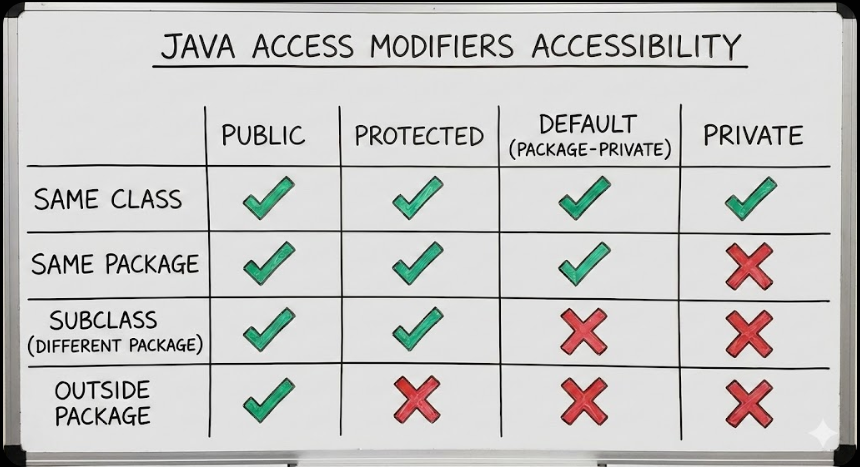
3. Accessibility Comparison Table
| Modifier | Same Class | Same Package | Subclass (Different Package) | Outside Package |
|---|---|---|---|---|
| public | Yes | Yes | Yes | Yes |
| protected | Yes | Yes | Yes | No |
| default | Yes | Yes | No | No |
| private | Yes | No | No | No |
4. Why Access Modifiers Are Important
-
Encapsulation Prevents direct access to internal data.
-
Security Restricts unauthorized usage.
-
API Design Exposes only what is necessary.
-
Code Maintainability Reduces accidental misuse of internal code.
5. Practical Examples
Example 1 - private and getters/setters
class Student {
    private int age;

    public void setAge(int age) {
        if(age > 0)
            this.age = age;
    }

    public int getAge() {
        return age;
    }
}
Example 2 - protected across packages
package pkg1;

public class A {
    protected int marks = 90;
}
Subclass in another package:
package pkg2;
import pkg1.A;

public class B extends A {
    public void display() {
        System.out.println(marks); // allowed
    }
}
Example 3 - default access
package pack1;

class A {
    int x = 10; // default
}
Cannot access default members from another package:
package pack2;

import pack1.A; // ERROR - cannot import default class
6. Choosing the Right Modifier
| Use Case | Recommended Modifier |
|---|---|
| Helper methods not meant for users | private |
| Class-level constants | public static final |
| API methods | public |
| Fields related to inheritance | protected |
| Internal package utilities | default |
7. Common Mistakes
- Making fields public → breaks encapsulation
- Assuming protected is available everywhere
- Using default unintentionally
- Overusing public for everything
8. Summary
- Access modifiers control visibility and accessibility.
- private → strongest restriction
- public → no restriction
- default → package-level access
- protected → package + subclass access
- Essential for encapsulation, API design, and secure coding.
This completes Access Modifiers in Java.
Written By: Shiva Srivastava
How is this guide?
Last updated on