
Encapsulation
What Is Encapsulation?
Encapsulation is one of the core principles of Object-Oriented Programming (OOP).
To understand it clearly, think of any real-world object. A human, for example, has data such as name and age. In real life, you cannot directly set someone’s age to a negative number. There must be rules and restrictions.
In Java, encapsulation helps us protect data so that it cannot be modified directly from outside the class.
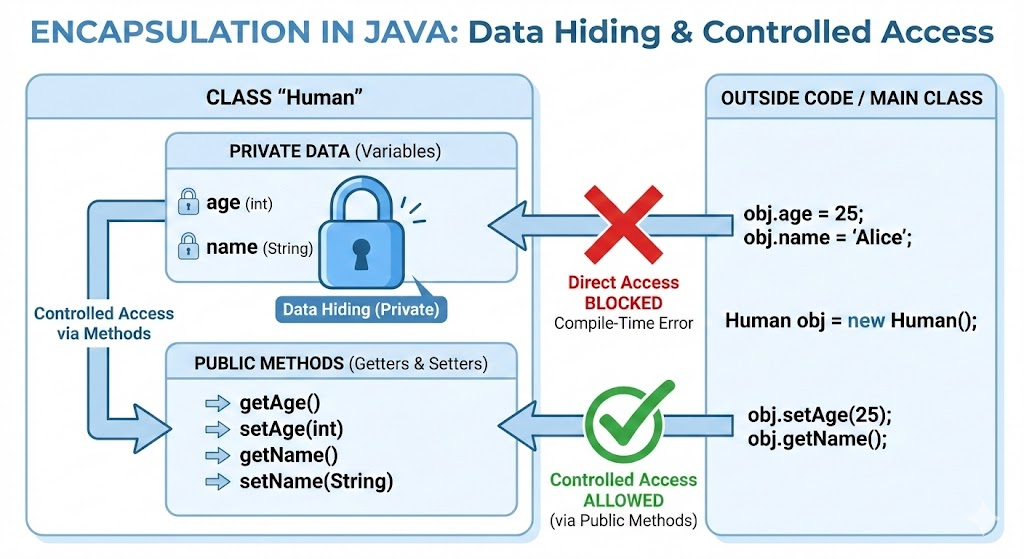
Definition
Encapsulation means:
- Binding data and methods together into a single unit (class)
- Restricting direct access to internal data using access modifiers
- Providing controlled access through methods
Encapsulation ensures data security, consistency, and better maintainability.
Example Without Encapsulation
class Human {
    int age;
    String name;
}

public class Demo {
    public static void main(String[] args) {
        Human obj = new Human();
        obj.age = 11;
        obj.name = "Navin";

        System.out.println(obj.age + " " + obj.name);
    }
}
In this example:
- Variables are public by default
- Any code can change them freely
- No validation or protection exists
This leads to weak data integrity.
Applying Encapsulation
We can protect data by:
- Marking variables as private
- Creating public getter and setter methods to access them
class Human {
    private int age;
    private String name;

    public int getAge() {
        return age;
    }

    public void setAge(int a) {
        if (a > 0)
            age = a;
        else
            System.out.println("Invalid age");
    }

    public String getName() {
        return name;
    }

    public void setName(String n) {
        name = n;
    }
}

public class Demo {
    public static void main(String[] args) {
        Human obj = new Human();
        obj.setAge(22);
        obj.setName("Navin");

        System.out.println(obj.getName() + " is " + obj.getAge() + " years old");
    }
}
Output
Navin is 22 years oldNow:
- Data is hidden inside the class
- Access is controlled through setter and getter methods
- Validation can be performed before assigning values
Why Encapsulation?
Encapsulation offers several advantages:
1. Data Hiding
Prevent accidental or unauthorized modification of internal data.
2. Validation
Setter methods allow you to check values before assigning them.
3. Maintainability
Internal implementation can change without affecting external code.
4. Flexibility
You can control how other parts of the program interact with the object.
Summary
- Encapsulation binds data and methods into a single class.
- Data is kept private and accessed via public methods.
- This ensures safety, validation, and structured programming.
- In Java, encapsulation = private variables + getters/setters.
Written By: Shiva Srivastava
How is this guide?
Last updated on