
Static Block
1. Introduction
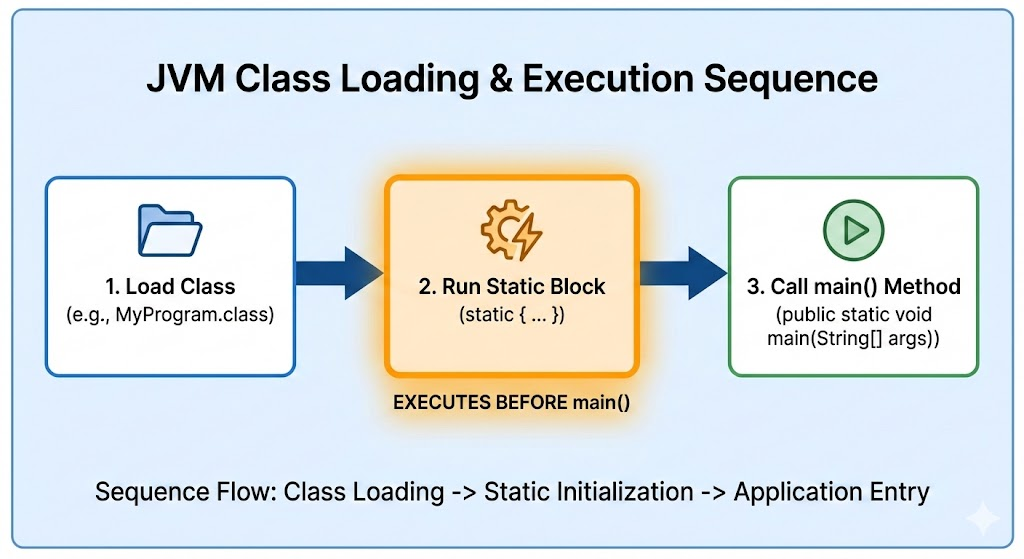
In Java, a static block (also called a static initialization block) is a special block of code that runs automatically when the class is loaded into the JVM, before any object is created and even before the main() method runs.
Static blocks are used to:
- Initialize static variables
- Perform class-level setup
- Load configurations
- Execute code only once for the entire program
Understanding static blocks is essential for mastering class loading, static initialization, and JVM behavior.
2. What Is a Static Block?
A static block is declared using the static keyword:
static {
    // code here
}
Key Characteristics
- Executes only once when the class is loaded
- Runs before main()
- Used for static initialization
- Executes in the order they appear if multiple static blocks exist
Example
class Demo {
    static {
        System.out.println("Static Block Executed");
    }

    public static void main(String[] args) {
        System.out.println("Main Method Executed");
    }
}
Output:
Static Block Executed
Main Method Executed
Static block runs first because class loading happens before main().
3. Why Use Static Blocks?
Static blocks are useful when you need:
3.1 Complex Initialization of Static Variables
Example:
static int data;

static {
    data = 10 * 5;  // complex calculation
}
3.2 Loading Configuration Files
Example:
static Properties config = new Properties();

static {
    config.load(new FileInputStream("config.properties"));
}
3.3 Initializing static final variables
static final int MAX;

static {
    MAX = 100;  // allowed for final variables
}
3.4 Calling static helper methods during class load
4. Multiple Static Blocks
Java allows multiple static blocks. Execution happens top to bottom, in the order they appear.
class Test {
    static {
        System.out.println("Block 1");
    }

    static {
        System.out.println("Block 2");
    }
}
Output:
Block 1
Block 2
5. Static Block vs Static Method
| Feature | Static Block | Static Method |
|---|---|---|
| Runs when | Class is loaded | Method is called |
| How many times? | Once | Multiple times |
| Accept arguments? | No | Yes |
| Return something? | No | Yes |
| Purpose | Initialization | Reusable logic |
Static blocks are intended for one-time setup only.
6. Static Block with Object Creation
Even if no objects are created, static blocks still run.
class A {
    static {
        System.out.println("Static Block of A");
    }
}

public class Main {
    public static void main(String[] args) {
        // No object created
    }
}
Output:
(no output)Because class A is never referenced or loaded in this program, its static block does not execute. Static blocks run only when the class is actually loaded (for example, when an object is created, a static member is accessed, or Class.forName("A") is used).
7. Static Block and Class.forName()
Static blocks also run when the class is loaded dynamically using Class.forName().
Class.forName("Test");This causes the static block inside Test to execute immediately.
8. Using Static Blocks to Load Native Libraries
static {
    System.loadLibrary("mylib");
}
This ensures the library is loaded only once.
9. Common Mistakes
Mistake 1: Trying to access instance variables
Static block cannot access non-static variables:
int x = 10;

static {
    System.out.println(x); // ERROR
}
Mistake 2: Using static blocks unnecessarily
If simple assignment works, no need for a static block.
Mistake 3: Expecting static block to run multiple times
It runs only once per class loading.
10. Complete Example Demonstrating Static Block Behavior
class DatabaseConnection {

    static String url;
    static String username;
    static String password;

    static {
        System.out.println("Loading configuration...");
        url = "jdbc:mysql://localhost/test";
        username = "root";
        password = "1234";
    }

    static void connect() {
        System.out.println("Connecting to " + url);
    }
}

public class Main {
    public static void main(String[] args) {
        DatabaseConnection.connect();
    }
}
Output:
Loading configuration...
Connecting to jdbc:mysql://localhost/test
11. Summary
- Static blocks execute once when the class loads.
- They run before main() and before any object creation.
- Used for initializing static variables and configurations.
- Multiple static blocks execute in order.
- Cannot access instance members.
- Useful for complex initialization and setup tasks.
This completes Static Block in Java.
Written By: Shiva Srivastava
How is this guide?
Last updated on