
Garbage Collection and finalize()
1. Introduction
Java manages memory automatically using a system called Garbage Collection (GC).
The goal of garbage collection is to identify and remove unused objects from the heap, freeing memory and preventing memory leaks.
Unlike languages such as C or C++, Java developers do not explicitly free memory.
The JVM automatically tracks which objects are no longer needed and cleans them up.
This makes Java safer and reduces chances of memory-related bugs.
2. What Is Garbage Collection?
Garbage Collection is the process of:
- Detecting objects in heap memory that are no longer referenced
- Reclaiming memory occupied by those objects
- Preventing memory overflow
- Optimizing memory usage
An object becomes eligible for GC when no reference variable is pointing to it.
Example:
Student s = new Student();
s = null;  // object eligible for GC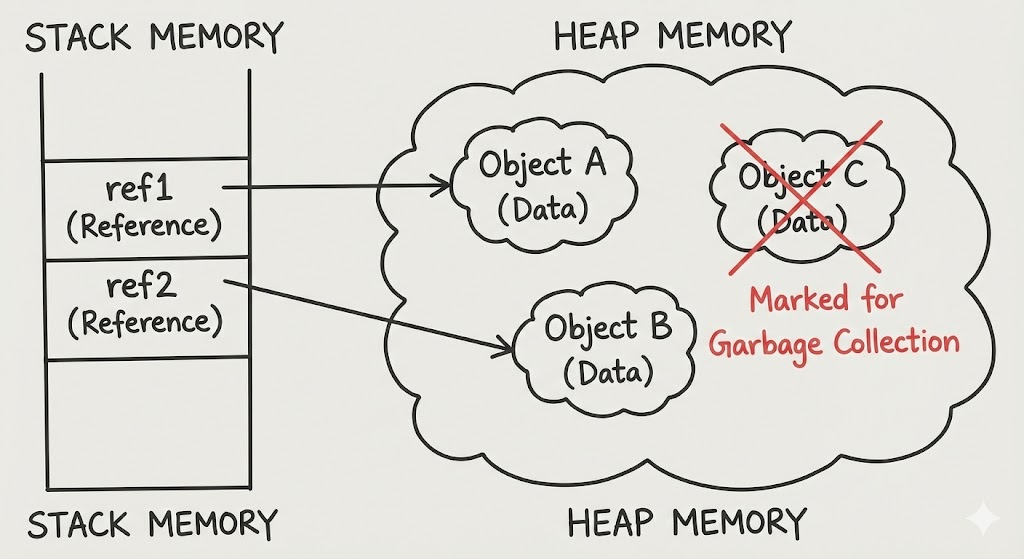
3. When Does an Object Become Eligible for GC?
3.1 Reference Set to null
Employee e = new Employee();
e = null;  // GC can clean the Employee object
3.2 Reference Reassigned
Employee e1 = new Employee();
Employee e2 = new Employee();

e1 = e2; // first object loses reference → eligible for GC
3.3 Object Created Without Reference
new Student(); // anonymous object → GC candidate3.4 Out of Scope Variables
void test() {
    Employee e = new Employee();
} // after test() ends → e disappears → object eligible for GC
4. How Garbage Collection Works Internally
JVM uses mark and sweep (and other algorithms depending on GC type):
-
Mark Phase
-
JVM marks objects that are reachable from root references such as:
- Local variables
- Static variables
- Active threads
-
-
Sweep Phase
- Unmarked (unreachable) objects are deleted.
-
Compaction Phase
- Heap memory is rearranged to avoid fragmentation.
5. Types of Garbage Collectors in JVM (High-level)
- Serial Garbage Collector
- Parallel Garbage Collector
- CMS (Concurrent Mark Sweep) – obsolete
- G1 (Garbage First GC) – modern default
- ZGC (Z Garbage Collector) – ultra-low latency
- Shenandoah GC
Even though GC types differ, the core idea remains the same: remove unreachable objects.
6. Calling Garbage Collector Manually (Not Guaranteed)
You can request GC using:
System.gc();Or:
Runtime.getRuntime().gc();But JVM may ignore the request. JVM decides the best time to run GC.
7. finalize() Method (Deprecated)
What is finalize()?
finalize() was a method in the Object class that was meant to run before the object was garbage collected.
Syntax:
protected void finalize() {
    // cleanup code
}
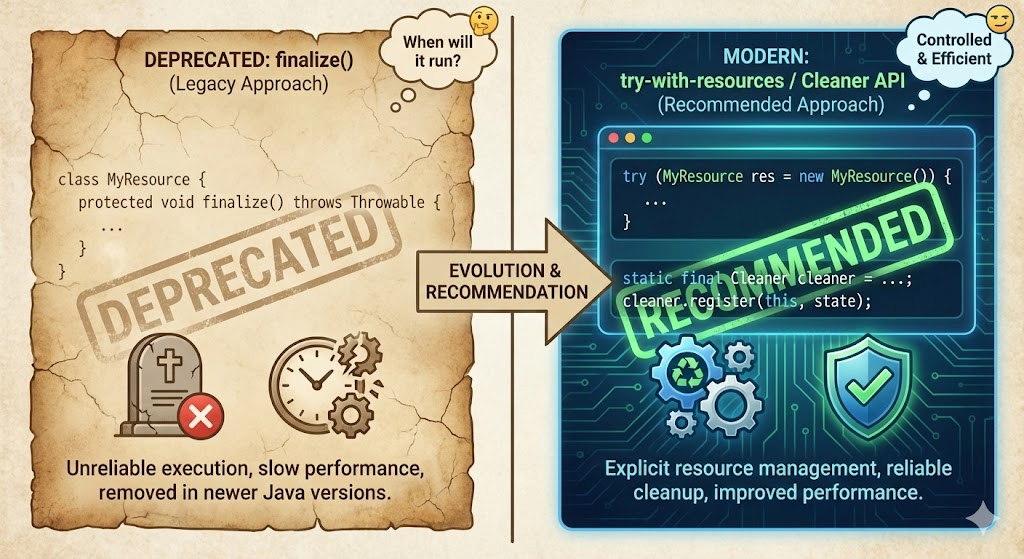
But finalize() is unreliable and has been deprecated in Java 9 and removed in Java 18** because:
- No guarantee it will run
- Can cause performance issues
- Can cause deadlocks
- Can revive dead objects (bad design)
Example (Old Approach):
class Demo {
    @Override
    protected void finalize() {
        System.out.println("Object destroyed");
    }
}
Why finalize() Should Not Be Used?
-
GC may never run
finalize() -
Multiple objects waiting for finalize() cause heap buildup
-
Difficult to predict
-
Replaced by:
- try-with-resources
- Cleaner API
- PhantomReference
8. Object Resurrection (Bad Practice)
If an object assigns its reference inside finalize():
protected void finalize() {
    Main.obj = this; // resurrecting object
}
This is one reason why finalize() was removed-it breaks GC logic.
9. Best Practices for Resource Cleanup
Instead of finalize(), use:
9.1 try-with-resources (Recommended)
try (FileInputStream fis = new FileInputStream("file.txt")) {
    // use file
}
Automatically closes resources.
9.2 Explicit close()
Connection con = DriverManager.getConnection(...);
con.close();
9.3 Cleaner API (Java 9+)
Provides controlled cleanup without finalize() problems.
10. Complete Example Demonstrating GC Behavior
class Test {

    int id;

    Test(int id) {
        this.id = id;
    }

    @Override
    protected void finalize() {
        System.out.println("Finalize called for id: " + id);
    }
}

public class Main {
    public static void main(String[] args) {
        Test t1 = new Test(1);
        Test t2 = new Test(2);

        t1 = null;
        t2 = null;

        System.gc(); // Request GC
    }
}
Output (not guaranteed):
Finalize called for id: 1
Finalize called for id: 2
11. Summary
- Garbage Collection removes unused objects automatically.
- An object becomes eligible for GC when no references point to it.
- GC algorithms: marking, sweeping, compacting.
- Calling
System.gc()is only a request. - finalize() is deprecated and must not be used.
- Use try-with-resources or Cleaner API instead.
Understanding GC helps prevent memory leaks and improve JVM performance.
This completes Garbage Collection and finalize() in Java.
Written By: Shiva Srivastava
How is this guide?
Last updated on