
Object Class Methods
1. Introduction
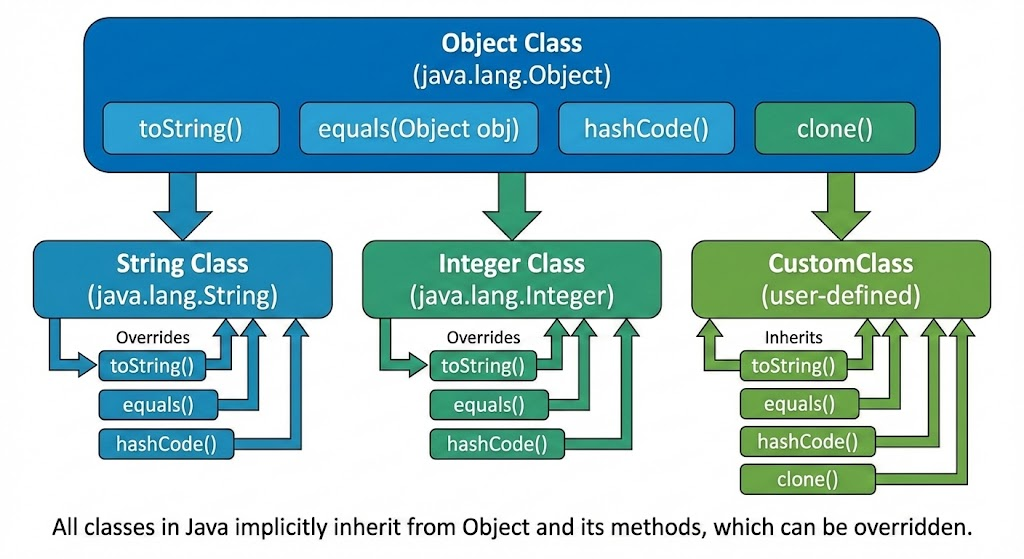
In Java, every class implicitly inherits from the Object class, which is the root (top-most) class in the Java class hierarchy.
This means:
- All Java objects have the methods defined in
Object - These methods provide core functionality like comparison, hashing, cloning, threading support, etc.
- Many of these methods are overridden by classes to provide meaningful behavior
Understanding the Object class is essential for OOP, collections, multithreading, and interview preparation.
2. List of Key Methods of the Object Class
The most commonly used and important methods are:
toString()equals(Object obj)hashCode()getClass()clone()finalize()(deprecated)wait()notify()notifyAll()
Each serves a different purpose and is used in various scenarios.
3. toString() Method
Purpose
toString() returns a string representation of the object.
Default implementation:
public String toString() {
    return getClass().getName() + "@" + Integer.toHexString(hashCode());
}
Example:
class Student {
    String name;
}

public class Main {
    public static void main(String[] args) {
        Student s = new Student();
        System.out.println(s);   // calls toString() automatically
    }
}
Output (default):
Student@5acf9800Overriding toString()
class Student {
    String name;
    int age;

    @Override
    public String toString() {
        return name + " (" + age + ")";
    }
}
4. equals() Method
Purpose
Checks if two objects are meaningfully equal.
Default implementation compares memory addresses (reference equality).
public boolean equals(Object obj) {
    return (this == obj);
}
Overriding equals()
To compare object content, override it:
class Student {
    String name;
    int age;

    @Override
    public boolean equals(Object obj) {
        Student s = (Student) obj;
        return this.name.equals(s.name) && this.age == s.age;
    }
}
5. hashCode() Method
Purpose
Provides integer hash value for the object. Used heavily in HashMap, HashSet, HashTable.
Relationship with equals():
- If two objects are equal via equals(), their hashCode() must be equal.
- If not equal, hashCodes may differ.
Example Override
@Override
public int hashCode() {
    return name.hashCode() + age;
}
6. Relationship Between equals() and hashCode()
Very important rule:
- If
equals()is overridden,hashCode()must also be overridden.
Because HashMap requires:
if a.equals(b) → a.hashCode() == b.hashCode()Not following this rule leads to bugs in hashing collections.
7. getClass() Method
Returns the runtime class of the object.
Student s = new Student();
System.out.println(s.getClass().getName());
Output:
StudentUsed in reflection, debugging, and frameworks.
8. clone() Method
clone() creates and returns a copy of the object.
To use clone:
- Implement
Cloneableinterface - Override
clone()method
Example:
class Student implements Cloneable {
    int age;

    @Override
    protected Object clone() throws CloneNotSupportedException {
        return super.clone();
    }
}
Deep cloning requires manually copying nested objects.
(This is fully explained in cloneable-interface.mdx.)
9. finalize() Method (Deprecated)
Called by GC before object deletion. Not reliable → deprecated.
Do not use finalize().
10. wait(), notify(), notifyAll()
Used for inter-thread communication.
These methods:
- Must be called inside synchronized blocks
- Belong to Object class because every object can be used as a monitor lock
Full details are covered in concurrency topics (advanced).
11. Complete Example Demonstrating Multiple Object Methods
class Employee implements Cloneable {
    String name;
    int id;

    Employee(String name, int id) {
        this.name = name;
        this.id = id;
    }

    @Override
    public String toString() {
        return name + " : " + id;
    }

    @Override
    public boolean equals(Object obj) {
        Employee e = (Employee) obj;
        return this.id == e.id && this.name.equals(e.name);
    }

    @Override
    public int hashCode() {
        return id + name.hashCode();
    }

    @Override
    protected Object clone() throws CloneNotSupportedException {
        return super.clone();
    }
}

public class Main {
    public static void main(String[] args) throws Exception {

        Employee e1 = new Employee("John", 101);
        Employee e2 = new Employee("John", 101);

        System.out.println(e1.toString());
        System.out.println(e1.equals(e2));
        System.out.println(e1.hashCode());

        Employee e3 = (Employee) e1.clone();
        System.out.println(e3);
    }
}
12. Summary
- All classes in Java inherit the
Objectclass. toString()→ string representation of objectequals()→ content comparisonhashCode()→ used in hashing collectionsgetClass()→ runtime class informationclone()→ copies object (requires Cloneable)wait(),notify(),notifyAll()→ used in multithreadingfinalize()→ deprecated
Object class methods are fundamental and widely used across Java applications.
This completes Object Class Methods.
Written By: Shiva Srivastava
How is this guide?
Last updated on