
Cloneable Interface
1. Introduction
Cloning in Java allows you to create an exact copy of an existing object.
To enable cloning, Java provides the Cloneable interface and the clone() method.
Key rule:
A class must implement Cloneable to allow its objects to be cloned.
If not, invoking clone() throws:
java.lang.CloneNotSupportedExceptionCloneable is a marker interface-it contains no methods.
Its purpose is to tell the JVM and the Object class that the class has given permission for cloning.
2. What Is the Cloneable Interface?
Defined in java.lang:
public interface Cloneable { }Characteristics:
- Marker interface (no abstract methods)
- Represents permission to perform object cloning
- Used along with
Object.clone()method
Without this interface, cloning is not allowed.
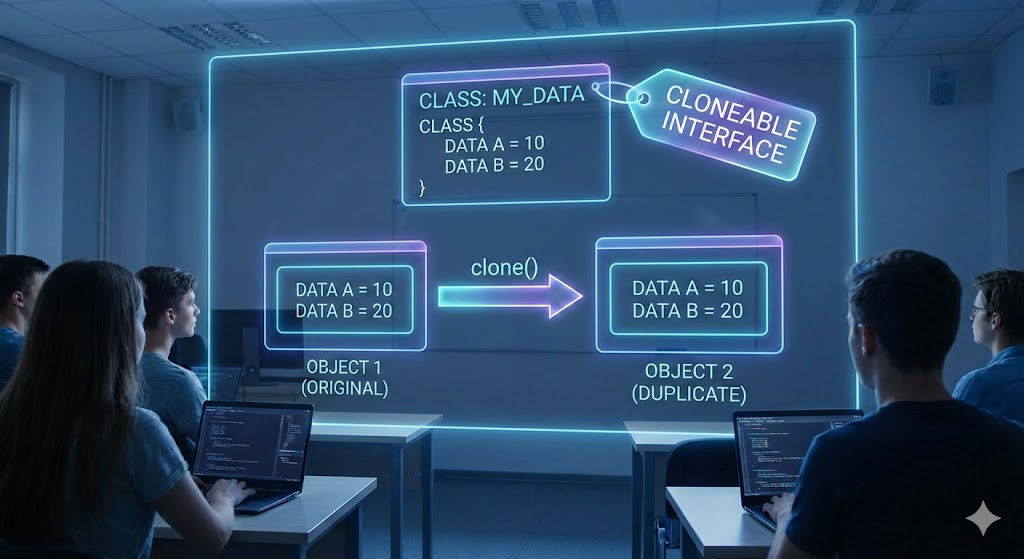
3. clone() Method in Object Class
The clone() method is defined in the Object class:
protected native Object clone() throws CloneNotSupportedException;Important notes:
- It is protected, so you must override it to use publicly.
- Throws
CloneNotSupportedExceptionunless the class implements Cloneable. - Performs shallow copying by default.
4. Enabling Cloning: Steps
Step 1 - Implement Cloneable interface
class Student implements Cloneable {
}
Step 2 - Override clone() method
@Override
public Object clone() throws CloneNotSupportedException {
    return super.clone();
}
Step 3 - Clone the object
Student s2 = (Student) s1.clone();5. Shallow Copy vs Deep Copy
5.1 Shallow Copy (Default)
Shallow copy duplicates:
- Primitive values
- Reference addresses (not the actual objects they point to)
Example:
class A implements Cloneable {
    int x;
    B obj;

    @Override
    public Object clone() throws CloneNotSupportedException {
        return super.clone();  // shallow
    }
}
Both original and cloned objects share the same nested object.
5.2 Deep Copy
Deep copy duplicates:
- Primitive values
- New copies of reference objects
Example:
class A implements Cloneable {
    int x;
    B obj;

    @Override
    public Object clone() throws CloneNotSupportedException {
        A temp = (A) super.clone();
        temp.obj = new B(obj.value); // manually copying nested object
        return temp;
    }
}
Deep copies are safer because modifications in one object do not affect the other.
6. Example: Shallow Copy
class Student implements Cloneable {
    int id;
    String name;

    Student(int id, String name) {
        this.id = id;
        this.name = name;
    }

    @Override
    public Object clone() throws CloneNotSupportedException {
        return super.clone(); // default shallow copy
    }
}
Usage:
Student s1 = new Student(1, "Amit");
Student s2 = (Student) s1.clone();
Both are independent objects with identical data.
7. Example: Deep Copy
class Address {
    String city;

    Address(String city) {
        this.city = city;
    }
}

class Student implements Cloneable {
    String name;
    Address addr;

    Student(String name, Address addr) {
        this.name = name;
        this.addr = addr;
    }

    @Override
    public Object clone() throws CloneNotSupportedException {
        Student s = (Student) super.clone();
        s.addr = new Address(this.addr.city); // deep copy
        return s;
    }
}
Now changes to nested objects won’t propagate.
8. clone() vs Copy Constructor
| Feature | clone() | Copy Constructor |
|---|---|---|
| Requires Cloneable? | Yes | No |
| Type safety | Low | High |
| Implementation complexity | Higher | Simple |
| Shallow/Deep | Default shallow | Depends on constructor |
| Popularity | Lower | Higher |
Copy constructors are often preferred in industry.
9. Rules for Using clone()
- Class must implement
Cloneable. - Override
clone()and make itpublic. - Handle
CloneNotSupportedException. - Default cloning is shallow.
- Deep cloning must be manually implemented.
10. Complete Example Demonstrating Cloneable
class Employee implements Cloneable {
    int id;
    String name;

    Employee(int id, String name) {
        this.id = id;
        this.name = name;
    }

    @Override
    public Object clone() throws CloneNotSupportedException {
        return super.clone();
    }
}

public class Main {
    public static void main(String[] args) throws Exception {
        Employee e1 = new Employee(1001, "John");
        Employee e2 = (Employee) e1.clone();

        System.out.println(e1.id + " - " + e1.name);
        System.out.println(e2.id + " - " + e2.name);
    }
}
Output:
1001 - John
1001 - John
Two separate objects created successfully.
11. Summary
- Cloneable is a marker interface that enables object cloning.
- clone() must be overridden from the Object class.
- Default implementation performs shallow copy.
- Deep copy must be coded manually.
- Copy constructors are often cleaner alternatives.
- clone() is powerful but should be used carefully.
This completes Cloneable Interface in Java.
Written By: Shiva Srivastava
How is this guide?
Last updated on