
Stack and Heap Memory
1. Introduction
Java uses a structured memory model to store data during program execution.
Two of the most important memory areas in the JVM are:
- Stack Memory → stores method calls, local variables, references
- Heap Memory → stores objects and instance variables
Understanding stack and heap memory is essential for mastering:
- Object creation
- Performance optimization
- Garbage collection
- Reference handling
- Debugging memory-related issues
This is one of the most asked interview topics, and also a foundation for JVM internals.
2. What Is Stack Memory?
Stack memory is the part of JVM memory used for:
- Method calls
- Local variables
- Reference variables
- Return values
- Primitive values inside methods
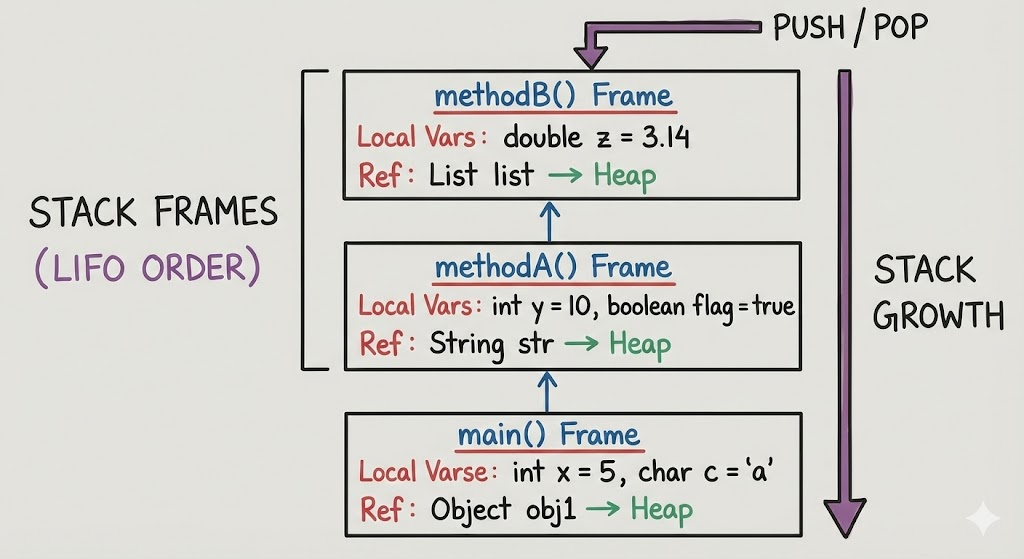
The stack follows LIFO (Last In, First Out) execution.
Each time a method is called, a stack frame is created.
When the method ends, the frame is removed automatically.
2.1 Characteristics of Stack Memory
- Very fast access
- Stores primitives and references
- Thread-specific (each thread has its own stack)
- Memory is freed automatically when methods finish
- Cannot store objects, only references to objects
Example
int a = 10;         // stored on stack
Student s = new Student(); // reference stored on stack, object on heap
Here:
a→ stacks→ stack (reference)new Student()→ heap
2.2 Stack Frame Example
void test() {
    int x = 5;
    int y = 10;
}
When test() is called, a stack frame is created storing x and y.
When test() ends, the frame is deleted.
3. What Is Heap Memory?
The heap is the memory area used for storing:
- Objects
- Instance variables
- Arrays
- Inner class objects
Heap memory is shared across all threads.
Every time you use new, memory is allocated in the heap.
3.1 Characteristics of Heap Memory
- Slower than stack memory
- Stores actual object data
- Managed by Garbage Collector
- Shared across threads
- Flexible storage size
Example
Student s1 = new Student();
Student s2 = new Student();
s1 and s2 point to two different objects in the heap.
4. How Stack and Heap Work Together
Consider:
class Demo {
    int num;
}

public class Main {
    public static void main(String[] args) {
        Demo d = new Demo();
        d.num = 10;
    }
}
Memory allocation:
d→ stored on stacknew Demo()→ stored on heapnum = 10→ stored inside the object on heap
5. What Goes on Stack vs Heap?
| Stored in Stack | Stored in Heap |
|---|---|
| Local variables | Objects |
| Primitive variables | Instance variables |
| Method arguments | Arrays |
| Reference variables | Inner classes |
| Return values | String objects (mutable ones) |
6. Example to Understand Deeply
Example Code
class Car {
    int speed;
}

public class Test {
    public static void main(String[] args) {
        int a = 5;
        Car c1 = new Car();
        Car c2 = c1;

        c1.speed = 100;
    }
}
Memory Explanation
a→ stackc1,c2→ stacknew Car()→ heapspeed = 100→ inside Car object in heap
Both c1 and c2 point to the same object.
7. Stack Overflow vs Heap Overflow
7.1 Stack Overflow
Occurs when:
- Too many nested method calls (infinite recursion)
Example:
void call() {
    call(); // infinite recursion → StackOverflowError
}
7.2 Heap Overflow
Occurs when:
- Creating too many objects without releasing memory
- Not enough heap space
Example:
while (true) {
    new int[1000000];
}
Throws:
java.lang.OutOfMemoryError: Java heap space8. Garbage Collection and Heap
Heap memory is managed by the Garbage Collector, which removes objects that are no longer referenced by any variable.
Example:
new Student(); // no reference → eligible for GC immediatelyMore about this in garbage-collection-and-finalize.mdx.
9. Stack and Heap with Multi-threading
- Each thread gets its own stack
- All threads share one common heap
This design helps:
- Thread isolation (stack)
- Object sharing (heap)
10. Complete Visualization Example
class Person {
    String name;
}

public class Main {
    public static void main(String[] args) {
        Person p = new Person();
        p.name = "John";
    }
}
Stack Memory:
- Reference variable
p
Heap Memory:
Object:
Person {
   name: "John"
}
11. Summary
- Stack → stores method frames, primitives, and object references.
- Heap → stores objects and instance data.
- Stack works on LIFO, heap is dynamically allocated.
- Stack is faster; heap is slower but more flexible.
- Garbage Collector manages only heap memory, not stack.
- Each thread has its own stack; heap is shared globally.
Understanding stack and heap is essential for:
- Debugging
- Writing efficient code
- Avoiding memory leaks
- Mastering JVM internals
This completes Stack and Heap Memory in Java.
Written By: Shiva Srivastava
How is this guide?
Last updated on