
Load Balancer Introduction
A Load Balancer is a component that distributes incoming client requests across multiple servers to ensure that no single server becomes overloaded. It acts as an intermediary between clients and a pool of backend servers, routing each request to the most appropriate server based on a load-balancing algorithm.
By evenly distributing traffic, a load balancer improves performance, scalability, availability, and fault tolerance in distributed systems.
Why is a Load Balancer Needed?
As the number of users increases, sending all requests to a single server can lead to:
- High response times
- Server overload
- Reduced application performance
- Increased chances of downtime
A load balancer solves these problems by distributing traffic across multiple servers, allowing the system to handle more concurrent users efficiently.
Core Functions of a Load Balancer
| Function | Description |
|---|---|
| Choosing the Server | Determines which backend server should handle an incoming request using a load-balancing algorithm. |
| Health Checks | Continuously monitors backend servers to ensure they are healthy and available before routing traffic to them. |
Load Balancing Algorithms
Round Robin
Round Robin distributes incoming requests sequentially among all available servers in a circular order.
How It Works
Request 1 → Server 1
Request 2 → Server 2
Request 3 → Server 3
Request 4 → Server 1
Request 5 → Server 2
...
Each server receives approximately the same number of requests.
Key Points:
- Each server handles an approximately equal number of requests.
- Only a single counter is needed to track which server receives the next request.
- No server state management required.
Disadvantage: Does not account for differences in server configurations (RAM, CPU, storage). A low-capacity server receives the same load as a high-capacity server, leading to unfair distribution.
Weighted Round Robin
Weighted Round Robin improves upon Round Robin by assigning a weight to each server based on its hardware capacity.
Servers with higher weights receive proportionally more requests.
How It Works
Example:
| Server | Weight |
|---|---|
| Server 1 | 5 |
| Server 2 | 3 |
| Server 3 | 2 |
Request distribution:
Server 1 → 50%
Server 2 → 30%
Server 3 → 20%
Key Points:
- Higher configuration → Higher weight → More requests routed to that server.
- Addresses the limitation of standard Round Robin by considering server capacity.
Geo-Based Algorithm
The Geo-Based Algorithm routes client requests to the server that is geographically closest to the user.
The objective is to reduce network latency by minimizing the physical distance between the client and the server.
How It Works
User (India)
      ↓
Nearest Server (Mumbai)

User (Europe)
      ↓
Nearest Server (Frankfurt)

User (USA)
      ↓
Nearest Server (Virginia)
Key Points:
- Load balancer maintains information about request origin and server locations.
- Reduces latency by minimizing physical distance between client and server.
- Database replication and partitioning must be maintained across geographic regions.
- Data should be replicated to nearby servers as failover in case of server crashes.
Disadvantage: VPNs and proxies can mislead the traffic by masking the user's actual location.
Least Connection Algorithm
The Least Connection Algorithm routes incoming requests to the server with the fewest active client connections.
How It Works
Example:
| Server | Active Connections |
|---|---|
| Server 1 | 120 |
| Server 2 | 45 |
| Server 3 | 70 |
The next request is routed to Server 2 because it has the fewest active connections.
Key Points:
- Only the number of active connections is considered.
- Connection counts need to be continuously updated.
Disadvantage: Does not check server metrics like response time or server configuration. A server may have few connections but still be under heavy processing load.
Least Time Algorithm
The Least Time Algorithm routes requests to the server with the lowest average response time.
Unlike Least Connection, it considers actual server performance.
How It Works
The load balancer continuously measures:
- Average response time
- Number of requests
- Current workload
Requests are sent to the fastest responding server.
Key Points:
- Accounts for server configuration - higher-capacity servers naturally have lower response times.
- Load balancer continuously calculates the average response time for each server.
- Additional information maintained: number of requests per server and average response time.
- Ideal for latency-sensitive applications (e.g., stock trading platforms).
IP Hash Algorithm
The IP Hash Algorithm uses the client's IP address to calculate a hash value that determines which backend server will handle the request.
This ensures that the same client is consistently routed to the same server.
How It Works
Client IP
      ↓
Hash Function
      ↓
Assigned Server
Example:
| IP Range | Server |
|---|---|
| 1–10 | Server 1 |
| 11–20 | Server 2 |
| 21–30 | Server 3 |
Key Points:
- IP ranges are mapped to specific servers (e.g., IPs hashing to 1–10 → Server 1, 11–20 → Server 2).
- Ensures the same client always reaches the same server (session persistence).
- The server must be healthy to maintain proper sessions; if it crashes, data must be replicated to another server.
Disadvantage:
- Scaling is challenging - adding a new server requires rehashing and reassignment of all values.
- Not ideal for microservice architectures where session continuity is critical.
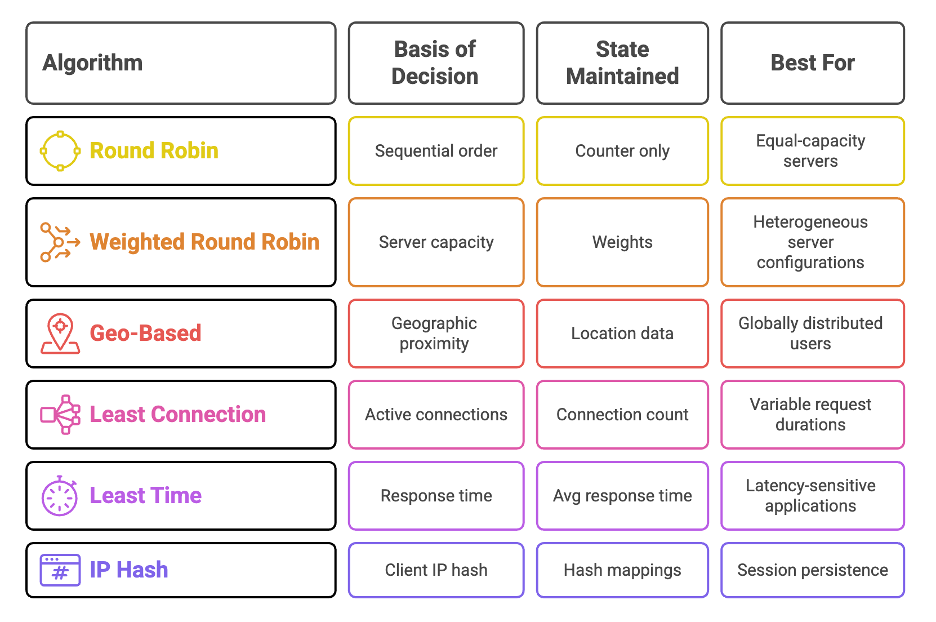
Algorithm Comparison
Hybrid Load Balancing
Modern distributed systems rarely rely on a single load-balancing algorithm. Instead, they combine multiple algorithms to achieve better performance and reliability.
For example:
- IP Hash + Round Robin provides session persistence while distributing requests evenly.
- Geo-Based + Least Time routes users to the nearest region and then selects the fastest server within that region.
- Weighted Round Robin + Least Connection balances traffic based on both server capacity and current workload.
This hybrid approach enables systems to optimize for multiple factors simultaneously.
Summary
- A Load Balancer distributes incoming requests across multiple servers, improving system scalability, availability, fault tolerance, and performance.
- Its two primary responsibilities are server selection using routing algorithms and health monitoring to ensure requests are sent only to healthy servers.
- Round Robin distributes requests sequentially and is best suited for identical servers.
- Weighted Round Robin considers server capacity, allowing more powerful servers to handle a larger share of traffic.
- Geo-Based Routing directs users to the nearest server, reducing latency for globally distributed applications.
- Least Connection routes traffic to the server with the fewest active connections, making it suitable for long-lived client sessions.
- Least Time selects the server with the lowest average response time, making it ideal for latency-sensitive applications.
- IP Hash ensures session persistence by consistently routing the same client to the same server.
- Modern distributed systems commonly adopt a hybrid load-balancing approach, combining multiple algorithms to achieve optimal performance, reliability, and user experience.
Written By: Muskan Garg
How is this guide?
Last updated on