
Replication
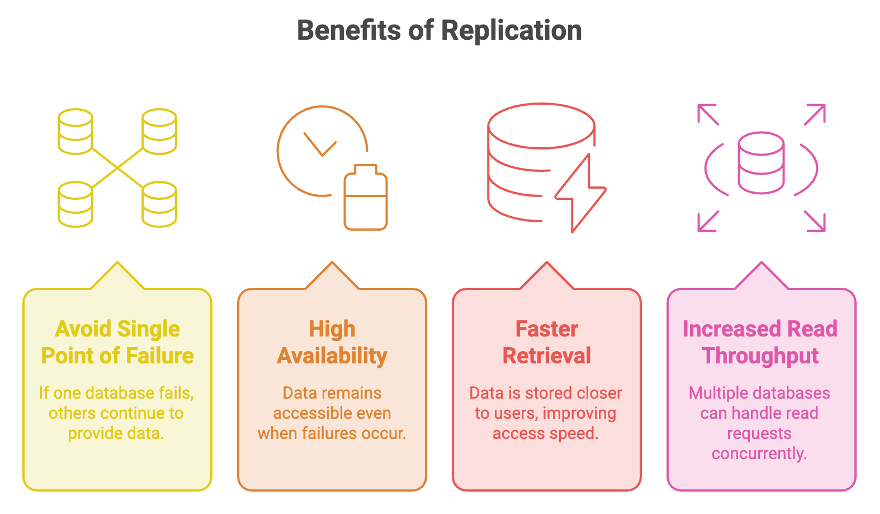
Replication is the process of copying and maintaining data across multiple databases or nodes. Instead of storing data in a single location, identical copies are maintained on multiple servers.
Replication improves:
- High availability
- Fault tolerance
- Read performance
- Disaster recovery
- Data durability
By maintaining multiple copies of data, applications can continue operating even if one or more database servers become unavailable.
Types of Replication
There are three major replication strategies:
- Single Leader Replication
- Multi-Leader Replication
- Leaderless Replication
Single Leader Replication
In Single Leader Replication, one database acts as the Leader (Primary), while the remaining databases act as Followers (Replicas).
Only the leader accepts write requests.
Followers receive replicated data from the leader.
Architecture
             User
               │
               ▼
            Application
               │
               ▼
         Leader Database
          /     |      \
         ▼      ▼       ▼
   Follower1 Follower2 Follower3
Flow:
User → Server → Leader → FollowersAsynchronous Replication
In Asynchronous Replication, the leader immediately responds to the client after updating its own data.
Followers are updated later in the background.
How It Works
- The leader completes the write and responds to the user.
- Followers update in the background.
- If followers fail, they sync again once recovered.
Advantage: Faster response, no resource blocking.
Disadvantage: Consistency is not guaranteed; data can be temporarily inconsistent or corrupted if followers lag behind.
Synchronous Replication
In Synchronous Replication, the leader waits until all follower nodes acknowledge the write before responding to the client.
How It Works
- The leader sends a write request to all followers.
- The leader waits until all followers return an OK response.
- Only then does it confirm success to the user.
| Aspect | Advantage | Disadvantage |
|---|---|---|
| Data Consistency | Followers are always up-to-date. | Longer response time. |
| Failover | Any follower can become the leader (all followers have the latest data). | Blocks resources while waiting for confirmations. |
In practice: Asynchronous replication is preferred for most use cases due to faster responses and no resource blocking.
Adding a New Follower Node
- Create a snapshot of the data from the leader (or an existing follower).
- Load the snapshot into the new node.
- Establish a connection between the leader and the new node for ongoing replication.
Leader Failure - Electing a New Leader
When the leader fails, a new leader must be elected:
- Identify the most up-to-date follower - check timestamps to determine which follower has the latest data.
- Inform all other nodes about the newly elected leader.
Tools like FSImage (full metadata snapshot) and EditLogs (incremental change logs) are used for data replication and recovery.
Multi-Leader Replication
Multiple data centers each have their own leader and follower nodes. Leaders communicate with each other across data centers in addition to their own followers.
Key Points:
- Each leader communicates with its followers and with leaders of other data centers.
- Improves performance and fault tolerance, if one leader fails, others continue to serve.
- Enables parallel writes from multiple leaders.
Architecture
 Data Center A                 Data Center B

     Leader A  ◄────────────►  Leader B
      /   \                     /   \
     ▼     ▼                   ▼     ▼
Follower Follower          Follower Follower
Conflict Problem
When two leaders write to the same data simultaneously, conflicts arise.
Example
Leader A

File Name = A

──────────────

Leader B

File Name = B
Both users receive successful responses.
During synchronization:
A ≠ BConflict detected.
Conflict Resolution Strategies
| Strategy | Description |
|---|---|
| Last Write Wins | The value with the most recent timestamp becomes the final value. |
| Leader Priority | Leaders are assigned priorities, and the higher-priority leader's update is retained. |
| User Resolution | The application presents the conflict to the user, allowing them to choose the correct version. |
Leaderless Replication
Leaderless Replication removes the concept of a primary database.
Every node can receive both read and write requests.
A write succeeds only when enough nodes acknowledge the update.
Architecture
          User
            │
            ▼
      Distributed Cluster

      Node A
      Node B
      Node C
      Node D
      Node E
No single node acts as the leader.
Quorum
A Quorum defines the minimum number of nodes that must successfully participate before an operation is considered successful.
For a cluster containing n nodes:
Quorum > n / 2| Operation | Quorum Requirement |
|---|---|
| Read | More than n/2 nodes must respond |
| Write | More than n/2 nodes must confirm |
Where:
n = Total Number of NodesThis ensures that at least one node in both read and write operations has the latest data, maintaining consistency across the system.
Summary
- Replication is the process of maintaining multiple copies of data across different nodes or databases to improve availability, fault tolerance, read performance, and disaster recovery.
- Single Leader Replication uses one primary node to handle all write operations, while follower nodes replicate the data using either Asynchronous or Synchronous Replication.
- Asynchronous Replication prioritizes performance by acknowledging writes immediately, whereas Synchronous Replication prioritizes strong consistency by waiting for follower confirmations.
- Multi-Leader Replication enables multiple leaders to accept write requests across different locations, improving availability and scalability while introducing the possibility of write conflicts.
- Conflict Resolution in multi-leader systems can be achieved using Last Write Wins, Leader Priority, or User Resolution strategies.
- Leaderless Replication eliminates the primary node and uses Quorum-Based Reads and Writes to maintain consistency across distributed nodes.
- The choice of replication strategy depends on the application's requirements for consistency, availability, latency, fault tolerance, and scalability.
Written By: Muskan Garg
How is this guide?
Last updated on