
Introduction
A comprehensive introduction to System Designs
System Design is the process of defining the architecture, components, and interactions of a system to satisfy specified requirements. At its core:
System = Components + Common Goal
All components within a system work together to achieve a unified objective, whether it's handling user requests, processing data, or delivering services reliably at scale.
Understanding System Design Through a Real-World Analogy
Consider a bank called AlienBank with a simple cash counter.
Basic Banking Flow
Components in the System
- Customer
- Cash Counter
- Cashier
- Receipt System
- Database
Customer Flow Cycle
- Customer comes to the counter
- Customer requests withdrawal/deposit
- Cashier processes the request
- Receipt is generated
- Transaction completed
Initially, the system works fine when the number of customers is small.
But as usage increases, different problems start appearing.
Problems and Solutions - Mapping to System Design Concepts
Issue 1: Process is Slow
Problem: Each customer takes ~10 minutes due to:
- Understanding requirements
- Counting cash manually
- Preparing the receipt
Solution: Optimize the process to reduce time to ~5 minutes per customer.
- Train the cashier to count faster
- Train the cashier to type faster
System Design Mapping:
| Analogy | System Concept |
|---|---|
| Faster cashier | Improved code quality |
| Optimization | Low-Level Design (LLD) |
Issue 2: Customer Count is Increasing
Problem: A single counter cannot handle growing demand.
Solution: Upgrade the counter's capacity.
- Increase desk size
- Introduce a cash counting machine
- Pre-fill forms before reaching the counter
- Reduced time to ~3 minutes per customer
System Design Mapping:
| Analogy | System Concept |
|---|---|
| Bigger desk / better tools | Vertical Scaling |
| Upgrading existing resources | Adding more CPU, RAM, or storage to a single server |
Issue 3: Customer Waiting Time is High
Problem: Even with optimizations, a single counter creates a bottleneck during peak hours.
Solution: Add more cashiers and more counters.
System Design Mapping:
| Analogy | System Concept |
|---|---|
| Multiple counters | Horizontal Scaling |
| Adding more cashiers | Adding more server instances |
Issue 4: Data Discrepancy
Problem: Counter 1 and Counter 2 each maintain their own data. If they are not in sync, inconsistencies arise (e.g., incorrect account balances).
Solution: Introduce a centralized database that all counters read from and write to, ensuring a single source of truth.
System Design Mapping:
| Analogy | System Concept |
|---|---|
| Shared records | Centralized Database |
| Data consistency across counters | Database synchronization |
Issue 5: Underutilized Counters
Problem: Some counters are overloaded while others sit idle, leading to uneven resource usage.
Solution: Introduce a middleman who checks the load on each counter and directs customers accordingly.
System Design Mapping:
| Analogy | System Concept |
|---|---|
| Middleman | Load Balancer |
| Directing customers | Distributing incoming requests |
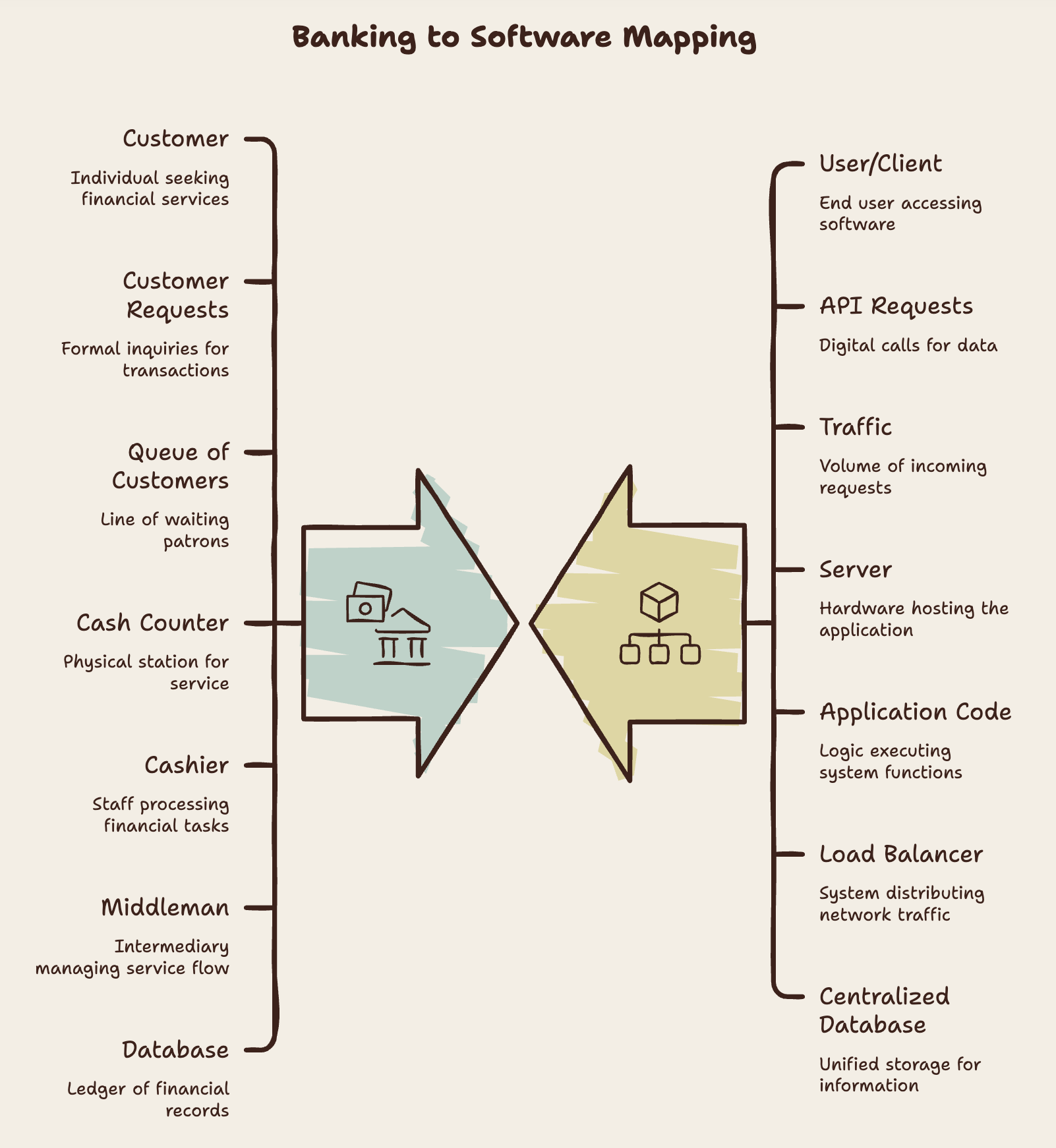
Key Takeaways of System Design Concepts
| Issue | Solution | System Design Concept |
|---|---|---|
| Slow processing | Optimize process | Low-Level Design (LLD) |
| Increasing customers | Upgrade machine | Vertical Scaling |
| High waiting time | Add more counters | Horizontal Scaling |
| Data inconsistency | Shared database | Centralized Database |
| Uneven traffic | Traffic distribution | Load Balancing |
Summary
-
System Design focuses on building scalable and efficient systems capable of handling increasing traffic, complexity, and performance demands as the user base grows.
-
Scalability is achieved through two primary approaches: Vertical Scaling (increasing server capacity) and Horizontal Scaling (adding more servers to distribute workload).
-
In distributed systems, maintaining data consistency and synchronization across multiple servers is critical to avoid data discrepancies and ensure reliable operations.
-
Load Balancers play a vital role in distributing requests efficiently, preventing server overload, improving performance, and optimizing resource utilization.
-
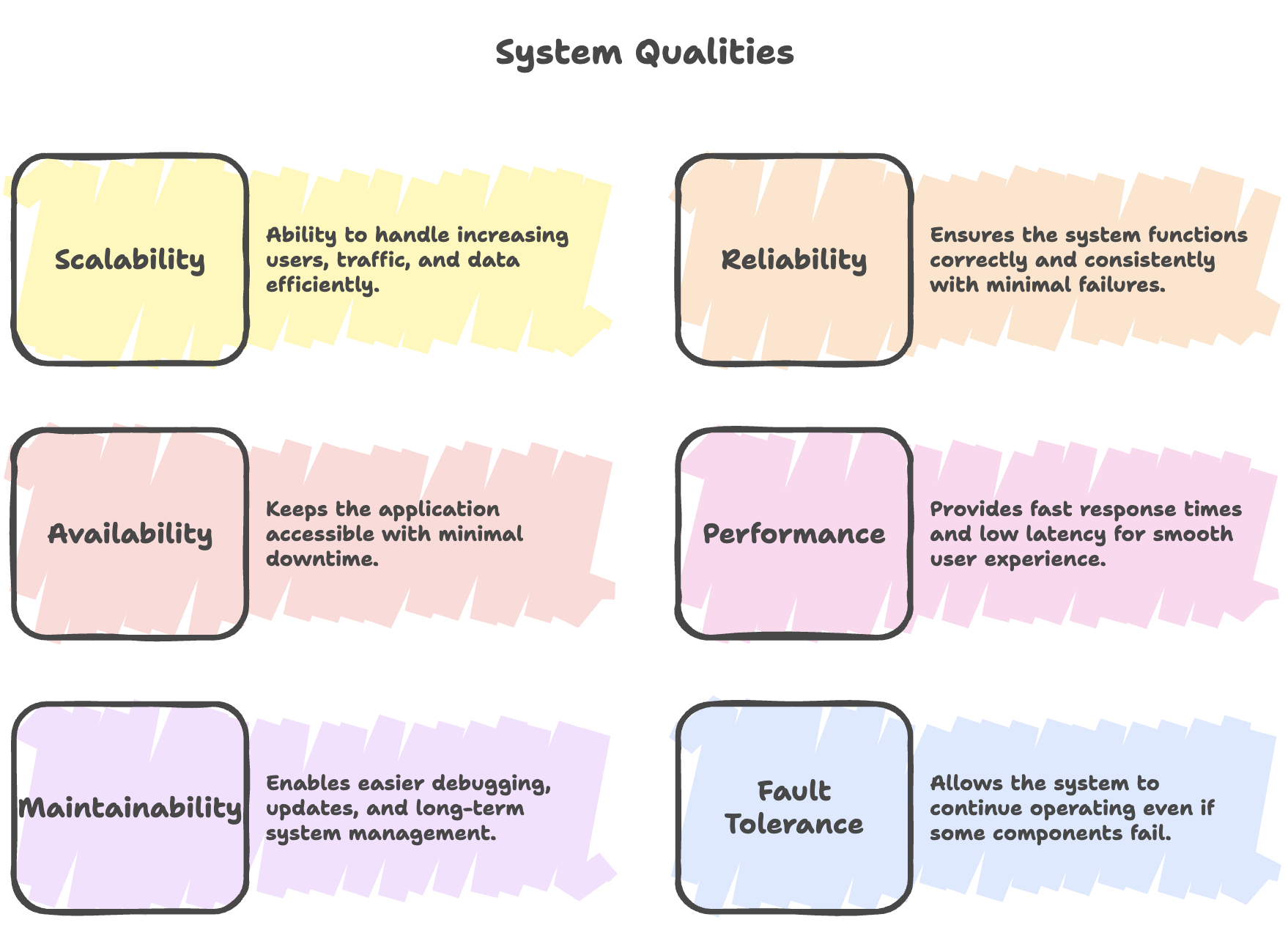
A well-designed system should be scalable, reliable, efficient, maintainable, and fault-tolerant to support long-term growth and operational stability.
Written By: Muskan Garg
How is this guide?
Last updated on