
Partitioning
Partitioning is the process of dividing a large dataset into smaller, manageable chunks called partitions, which are distributed across multiple nodes.
Each partition stores only a subset of the data, and when all partitions are combined, they represent the complete dataset.
Partitioning enables distributed systems to efficiently store and process massive amounts of data while improving scalability and performance.
Why is Partitioning Needed?
As datasets continue to grow, storing all data on a single database server becomes inefficient.
Without partitioning:
- Replicating the entire dataset across multiple nodes is expensive.
- Database queries become slower.
- Search performance degrades.
- Storage and processing become bottlenecks.
- Scaling the system becomes difficult.
Partitioning addresses these issues by distributing data across multiple nodes, allowing queries and processing to occur in parallel.
Benefits of Partitioning
- Improves scalability.
- Enables parallel query execution.
- Reduces query response time.
- Distributes storage across multiple nodes.
- Improves overall system performance.
Key Rule of Partitioning
Data should always be distributed as evenly as possible across all partitions.
Even distribution ensures:
- Balanced workload
- Better resource utilization
- Higher throughput
- Improved fault tolerance
Uneven distribution can lead to hotspots, reducing system performance.
Hotspot
A Hotspot occurs when one partition receives significantly more requests than the others.
Instead of distributing traffic evenly, one partition becomes overloaded while the remaining partitions remain underutilized.
Problems Caused by Hotspots
- Excessive CPU utilization.
- Increased memory consumption.
- Higher response times.
- Uneven resource utilization.
- Increased risk of node failure.
Example
Suppose there are three partitions:
Partition 1 → 20 Requests
Partition 2 → 30 Requests
Partition 3 → 500 Requests
Partition 3 becomes a hotspot because it handles the majority of the workload.
Partitioning Strategies
Partition by Key (Range-Based Partitioning)
In Range-Based Partitioning, data is divided based on a range of key values.
Each partition stores a specific range of keys.
Example
Keys A–M → Partition 1

Keys N–Z → Partition 2
Problem: If traffic is unevenly distributed across key ranges, one partition becomes a hotspot. Example: Partition 1 stores India's data, Partition 2 stores US data. If the application is more popular in the US, Partition 2 becomes a hotspot while Partition 1 remains underutilized.
Partition by Hash of Key (Hash-Based Partitioning)
In Hash-Based Partitioning, a hash function converts the partition key into a numeric value.
The hash value determines which partition stores the data.
Example:
Hash(Customer1)
↓
Partition 2

Hash(Customer2)
↓
Partition 5
Handling Hotspots
Even hash-based systems can occasionally experience hotspots.
Common techniques include:
- Attach timestamps to requests.
- Continuously monitor partition traffic.
- Redistribute data when a partition becomes overloaded.
Partition by Local Secondary Index
Each partition maintains its own secondary index for non-primary key attributes.
The index exists only within that partition.
Example
Partition 1
| Color | Car IDs |
|---|---|
| Blue | 209, 305 |
| Red | 350, 359 |
Partition 2
| Color | Car IDs |
|---|---|
| Blue | 509, 609 |
| Red | 610, 690 |
Query Example
Searching for:
Red CarsThe application must query:
- Partition 1
- Partition 2
Each partition searches its own local index independently.
Similarly:
Silver CarsEach partition checks its local index.
If no records exist, the partition immediately reports no matches without scanning the actual data.
Used By
- Apache Cassandra
- Elasticsearch
Disadvantage: Every partition must be queried (scatter-gather), even if a partition has no relevant data , since each partition maintains its own local index independently.
Partition by Global Secondary Index
Instead of maintaining separate indexes for each partition, a Global Secondary Index (GSI) maintains one centralized index for all partitions.
The global index stores information about which partition contains a particular value.
Example
Global Index

Blue Cars
↓
Partition 1
Partition 2

--------------------

Silver Cars
↓
Partition 3
Query Example
Searching for:
Blue CarsThe global index immediately identifies:
Partition 1

Partition 2
Only those partitions are queried.
Other partitions are skipped entirely.
Advantages
- Faster read performance.
- Queries only relevant partitions.
- Eliminates unnecessary partition scans.
- Better search efficiency.
Disadvantages
- Every write must update the global index.
- Higher write latency.
- More complex implementation.
- Additional storage required for maintaining the index.
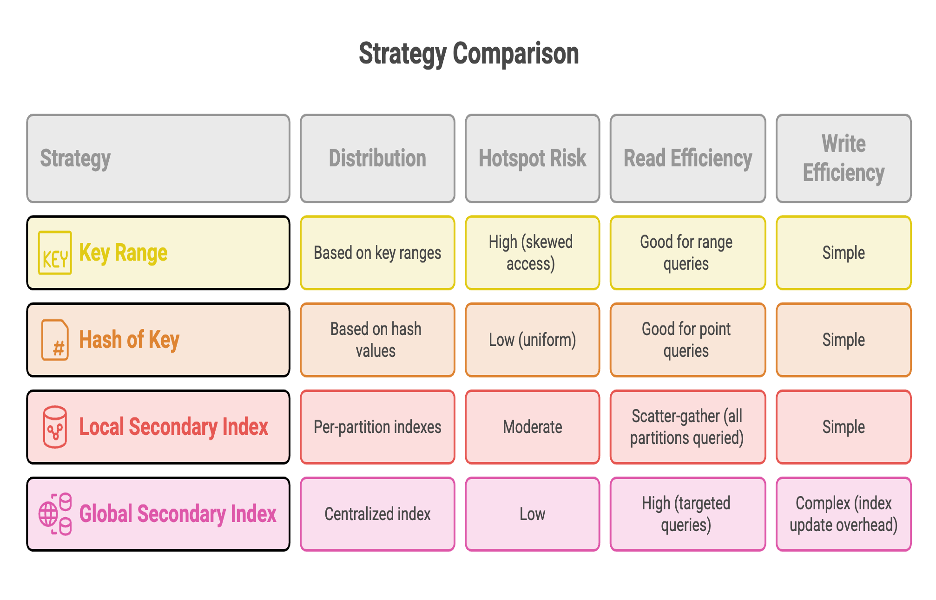
Summary
- Partitioning is the process of dividing a large dataset into smaller partitions and distributing them across multiple nodes to improve scalability, performance, and parallel processing.
- The primary objective of partitioning is to distribute both data and traffic evenly, preventing hotspots, where one partition becomes overloaded while others remain underutilized.
- Range-Based Partitioning organizes data using key ranges and is efficient for range queries but can suffer from uneven traffic distribution.
- Hash-Based Partitioning uses hash functions to achieve a more uniform distribution of data, significantly reducing the likelihood of hotspots.
- Local Secondary Indexes maintain indexes within each partition, simplifying writes but requiring scatter-gather queries across multiple partitions during reads.
- Global Secondary Indexes maintain a centralized index that directs queries only to relevant partitions, improving read performance while introducing additional write overhead.
- Selecting the appropriate partitioning strategy requires balancing read performance, write performance, scalability, query patterns, and maintenance complexity based on the application's requirements.
Written By: Muskan Garg
How is this guide?
Last updated on