
Cache Eviction Policies
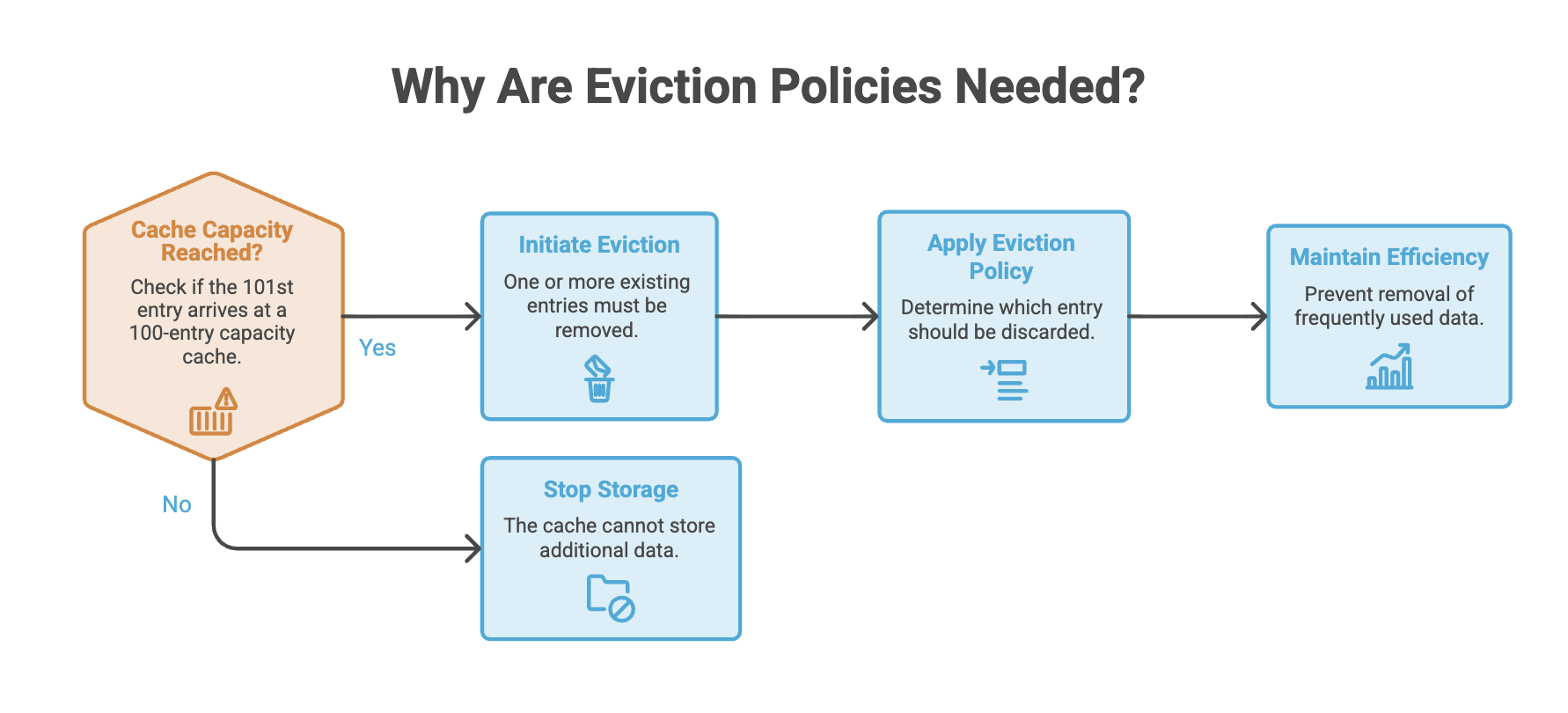
Cache memory is limited and cannot store data indefinitely. When the cache reaches its maximum capacity, some existing entries must be removed to make room for new data.
The process of deciding which cache entries should be removed is governed by Cache Eviction Policies.
An effective eviction policy helps:
- Maximize cache hit rates
- Improve application performance
- Optimize memory utilization
- Retain the most valuable data in the cache
LRU (Least Recently Used)
Least Recently Used (LRU) removes the data that has not been accessed for the longest period of time.
The assumption behind LRU is: If data has not been used recently, it is less likely to be needed again in the near future.
How Does It Work?
Consider the following access sequence:
A → B → C → DLater, the user accesses:
B → CCurrent order of recent usage:
D (Least Recent) → A → B → C (Most Recent)If the cache becomes full, D is removed first because it has not been accessed for the longest time.
Example
After a new mobile phone version is launched:
- Users frequently search for the latest model.
- Older models receive fewer recent accesses.
As a result, product data for older models is evicted first.
Common Use Cases
- Web applications
- Browser caching
- Database query caching
- Content delivery systems
MRU (Most Recently Used)
Most Recently Used (MRU) removes the data that was accessed most recently.
The assumption behind MRU is: If data was just used, there is a lower probability it will be needed again immediately.
How Does It Work?
Access sequence:
A → B → C → DMost recently accessed item:
DIf eviction is required:
D is removed first.Example
A user applies a discount coupon during checkout.
Once applied:
- The coupon is unlikely to be used again immediately.
- The cached coupon data can be evicted first.
Common Use Cases
- Batch-processing systems
- Sequential data access workloads
- Certain analytical applications
LFU (Least Frequently Used)
Least Frequently Used (LFU) removes the data that has been accessed the fewest number of times.
The assumption behind LFU is: Data with a low access count is less valuable and should be removed first.
How Does It Work?
Suppose the cache contains:
| Item | Access Count |
|---|---|
| Gadgets | 500 |
| Clothes | 300 |
| Books | 120 |
| Plants | 25 |
If space is required:
Plantsis evicted first because it has the lowest access frequency.
Example
In an e-commerce platform:
- Gadgets are searched thousands of times daily.
- Plants receive very few searches.
When the cache becomes full, the Plants category is removed first.
Common Use Cases
- Product recommendation systems
- Search engines
- Streaming platforms
- Frequently accessed content services
FIFO (First In First Out)
First In First Out (FIFO) removes the data that entered the cache first, regardless of how frequently or recently it was accessed.
The oldest cached entries are removed first. FIFO follows a Queue structure.
How Does It Work?
Insertion order:
A → B → C → DIf the cache becomes full:
A is removed first.Example
Cache entries are inserted as:
User1 → User2 → User3 → User4When a new entry arrives:
User1 is evicted first.even if User1 is still frequently accessed.
Common Use Cases
- Basic caching systems
- Queue-based processing
- Systems where simplicity is more important than optimization
LIFO (Last In First Out)
Last In First Out (LIFO) removes the most recently inserted entry first.
The newest entry is considered the first candidate for eviction. LIFO follows a Stack structure.
How Does It Work?
Insertion order:
A → B → C → DMost recently inserted:
DIf eviction is needed:
D is removed first.Example
Suppose cache entries are:
Course1 → Course2 → Course3 → Course4If the cache reaches capacity:
Course4is removed first because it was inserted most recently.
Common Use Cases
- Stack-based systems
- Specialized processing workloads
- Temporary data structures
Summary
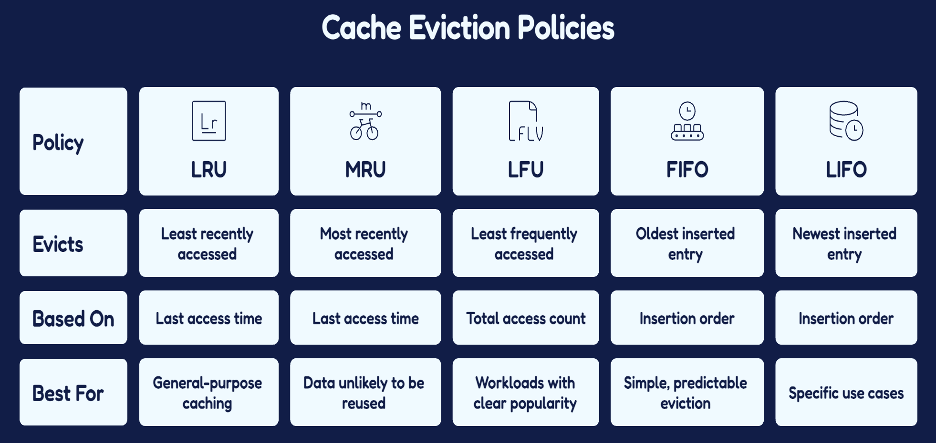
- Cache Eviction Policies determine which data should be removed when cache memory becomes full.
- LRU (Least Recently Used) removes the least recently accessed data and is one of the most widely used cache eviction strategies.
- MRU (Most Recently Used) removes the most recently accessed data and is useful in specialized access patterns.
- LFU (Least Frequently Used) removes data with the lowest access frequency and is ideal for workloads with consistently popular items.
- FIFO (First In First Out) evicts entries based on insertion order, removing the oldest data first.
- LIFO (Last In First Out) removes the newest entries first and is commonly associated with stack-like processing.
- The best eviction policy depends on application access patterns, performance requirements, memory constraints, and the nature of the cached data.
Written By: Muskan Garg
How is this guide?
Last updated on